We Are Hiring! View Open Positions

24/7 Service & Repair

Commercial Glass Doors, OK Commercial Door Repair, Norman OK

Types of Automatic Doors: A Complete Guide for Business Owners

Automatic doors handle more daily use than almost any other system. They manage the flow of people in and out of a facility from the moment it opens to the moment it closes, and come in a wide range of configurations and applications, from sliding doors at a retail entrance to high-speed roll-ups in a distribution center. Each is built to do the work so people and operations do not have to stop for it.

We put this guide together to share what these systems are, how they work, and what each type of automatic door is suited for. We’ll also cover what separates a well-run system from one that is going to cause problems. If you are evaluating automatic doors for your facility or trying to get a better handle on what you already have, this is a good place to start.

How Do Commercial Automatic Doors Work?

Commercial automatic doors are power-operated door systems used in commercial buildings, designed to open and close without requiring manual operation. 

When a person approaches, the door opens automatically in response to either a sensor signal, such as a motion detector picking up movement, or an access control command, such as a key fob, swipe card, or keypad entry. Many facilities use both: sensors on public-facing entrances and access control on restricted areas. The door then closes automatically after each use, without requiring anyone to physically open or close it. 

Here is the sequence from the moment a person approaches to the moment the door closes behind them.

1. The Sensor Detects Movement

Above every automatic door we install, there is an activation sensor doing a job most people never think about. It sits above the entrance and continuously scans the approach zone, waiting to trigger the opening sequence the moment someone enters its range. 

Most commercial systems use either microwave beam motion detectors or passive infrared sensors for this. Microwave detectors work by emitting pulses and reading the disruption when someone moves through them. Passive infrared sensors detect body heat. Each has a weakness: microwave detectors are vulnerable to electrical interference from nearby equipment, and passive infrared sensors can struggle when ambient temperatures are close to body temperature or when someone is moving slowly. 

Choosing between them, or deciding to use both, comes down to the specific conditions of the entry. That is a call we make based on traffic patterns, the environment, and how much tolerance the location has for a false trigger or a missed detection.

2. The Operator Drives the Door Open

When the sensor fires, it signals the electric motor in the door operator to move the door. On sliding systems, the panels run along overhead tracks. On swinging systems, the operator rotates the door through its arc at a controlled speed. 

3. A Presence Sensor Holds the Door Open

The activation sensor and the presence sensor are doing two different jobs, and both need to be calibrated correctly. The activation sensor triggers the door to open. The presence sensor covers the opening itself and keeps the door from closing while anyone is still passing through or standing in it. One opens the door, the other keeps it open. When a door closes on someone, one of those two sensors has failed or drifted. That is where we start every time.

4. The Door Closes With Safety Systems Active

Once the presence sensor confirms the opening is clear, the operator closes the door. Safety sensors monitor the door path throughout the closing sequence and reverse the door if something enters it. We set these parameters at installation, and they need to be verified periodically against applicable safety regulations. They drift over time from vibration and wear, and when they do, the door can look completely functional from the outside while its safety margin has quietly eroded.

Why Commercial Facilities Choose Automatic Doors

For facility managers and business owners responsible for operations, compliance, and occupant safety, automatic doors address several ongoing concerns at once. Here are the reasons we see driving the decision most often across commercial properties.

  • ADA compliance and accessibility. Automatic doors are one of the most direct ways to create accessible entrances under the Americans with Disabilities Act (ADA). They remove the need to grip door handles or apply manual force to open a door, which is the primary physical barrier for people with mobility limitations. An automatic door system following ADA entrance requirements is often the most straightforward path to a compliant, fully accessible entry point. We have helped many facilities address compliance gaps through automatic door installations, and it tends to be a simpler solution than clients expect.
  • Hygiene and contamination control. Because automatic doors require no hand contact to operate, they remove a high-contact touchpoint from your facility entrance. In healthcare environments, food processing facilities, and cleanrooms, that matters considerably. Airtight and hermetically sealed models go further, maintaining pressure differentials and contamination barriers in clinical and controlled areas.
  • Energy efficiency. Automatic doors open only when triggered and close promptly after each passage. That consistent behavior directly reduces energy loss at entry points, which translates to real energy savings in facilities where heating and cooling costs are high. For facilities in climates with extended heating or cooling seasons, the difference between a properly functioning automatic door and a manual door that gets propped open adds up fast.
  • Security and access control. Our teams integrate automatic doors with access control systems to manage who enters, through which entry points, and at what times. A facility can configure entry via pin codes, card readers, key fobs, video intercom systems, or biometric devices, with the automatic door as the controlled point of passage. Security systems can lock doors remotely, hold them open for emergency exit, or restrict entry to authorized individuals during off-hours.
  • Throughput and traffic flow. Entry points create bottlenecks when doors are slow, narrow, or require manual operation. In high traffic areas, that friction compounds fast. Automatic doors sized and configured for actual traffic volume keep people and equipment moving without requiring anyone to stop and manage the door. We see the most immediate operational improvement in facilities upgrading primary public entrances that were undersized or underspecified for the volume they handle every day.
  • Improved safety. Properly installed and maintained automatic doors with functioning obstruction detection and compliant force settings reduce the risk that someone is struck by a door. More importantly, they indicate that you are taking reasonable care for everyone entering the building, which matters in both regulatory and legal contexts.

Types of Commercial Automatic Doors

The common types of automatic doors used in commercial settings each have distinct operational uses, and the right choice depends on factors specific to your facility. Here is how we think about each of the types of automatic doors we install and service, including where they perform well and where we would steer a client toward a different option.

Automatic Sliding Doors
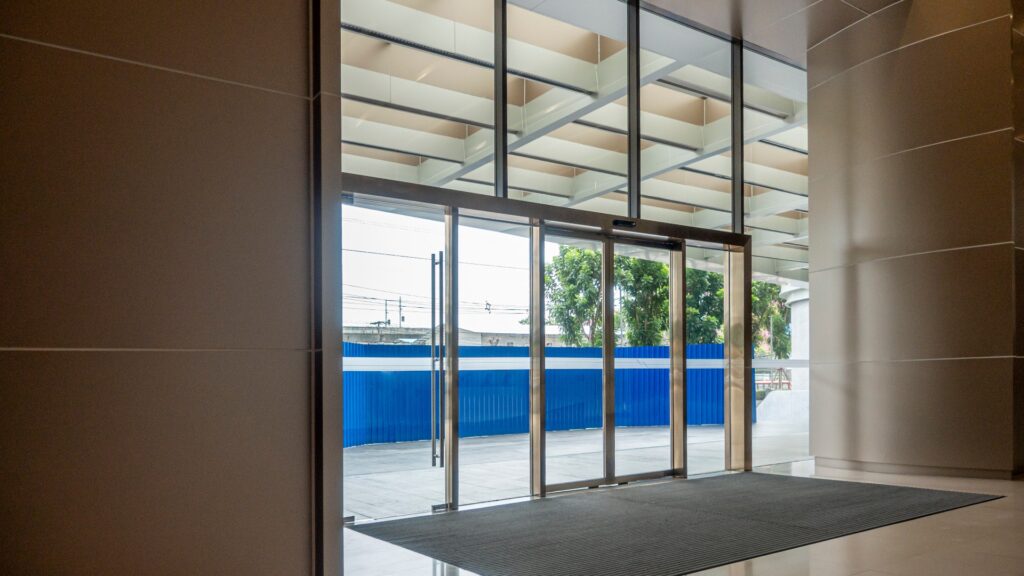
automatic sliding door guide

Sliding doors are the most common system we install. A single-panel configuration slides to one side, while a bi-parting configuration separates at the center and opens to both sides, supporting two-way traffic and giving you a wider, clearer opening without increasing the wall space the track requires. Because the panels slide rather than swing, no swing clearance is required, which makes them practical in tight entrance areas where a swinging door would not fit.

Automatic sliding doors run on overhead tracks and work well across a wide range of public entrances: office lobbies, retail storefronts, healthcare facilities, and most high-traffic areas where you need clean, continuous pedestrian flow.

Swinging Automatic Doors
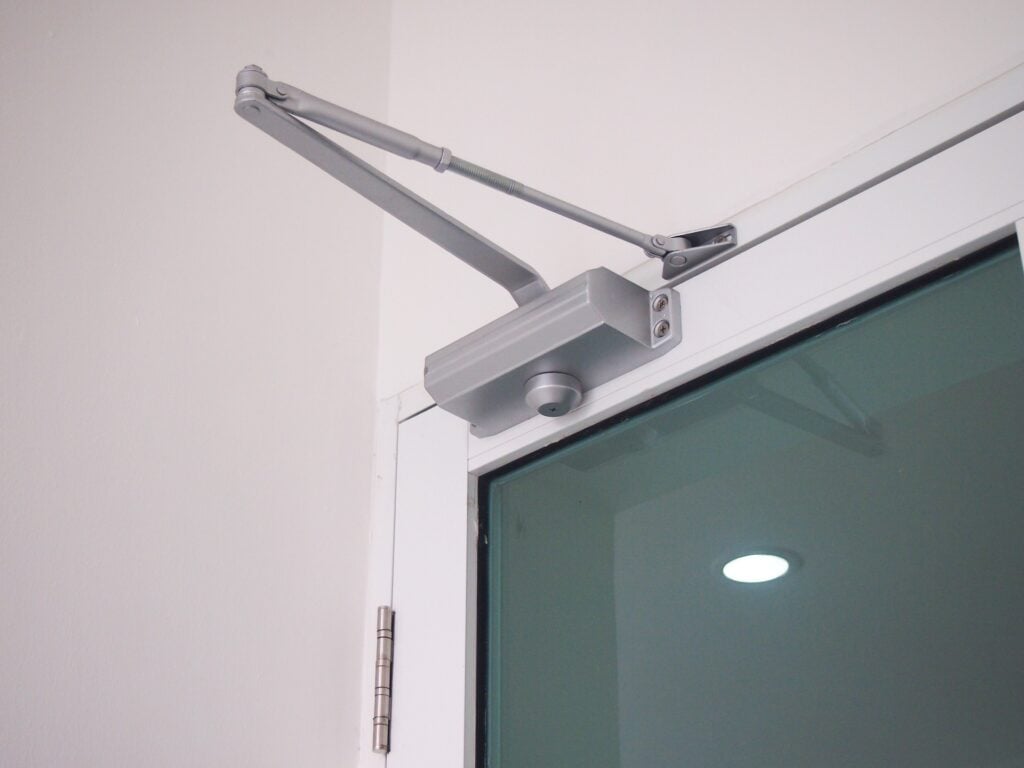
swinging automatic door guide

An automatic swinging door uses a low-energy or full-power operator to move a standard hinged door through its arc. Low-energy operators move the door at a controlled, code-compliant speed and are triggered by a push plate or motion sensor. Full-power operators handle heavier doors and higher traffic.

We spec these most often in interior passages, secondary entrances, and situations where a facility already has a swing door and needs to automate it for accessible entrances without replacing the full door assembly.

The installation is typically less involved than a sliding system, and for lower-traffic applications, it is usually the most cost-effective path to hands-free entry without door handles or manual operation.

Automatic Revolving Doors
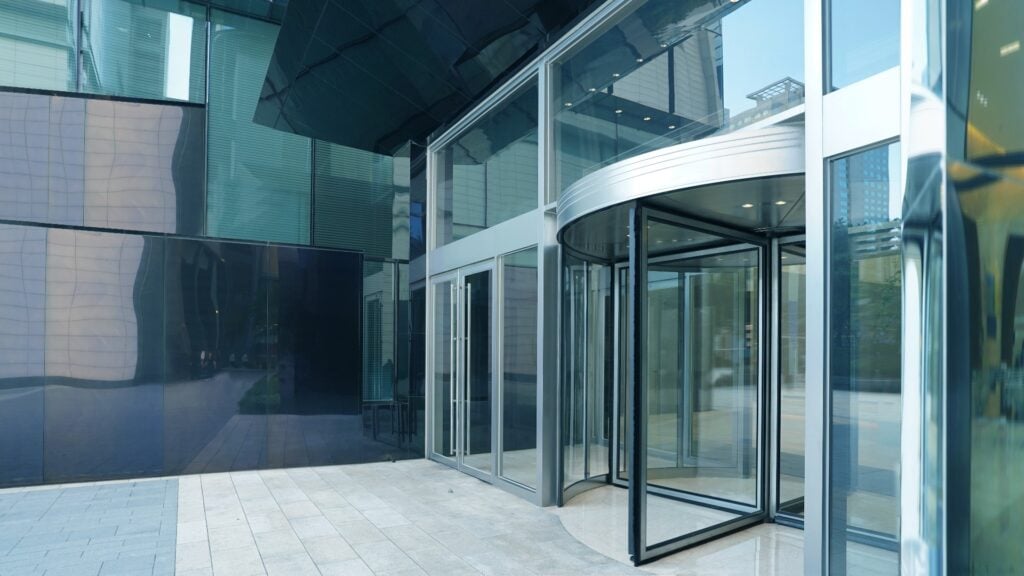
automatic revolving door guide

Automatic revolving doors rotate continuously or in response to sensor input, moving multiple users through the entrance simultaneously while keeping interior and exterior environments separated.

Hotels, office towers, airports, and large shopping centers get the most value from revolving doors because they have both the foot traffic volume and the energy costs to make the performance meaningful. They integrate with emergency egress requirements through breakaway panels that collapse flat to create a clear passage during a fire or evacuation event.

Folding and Telescoping Doors
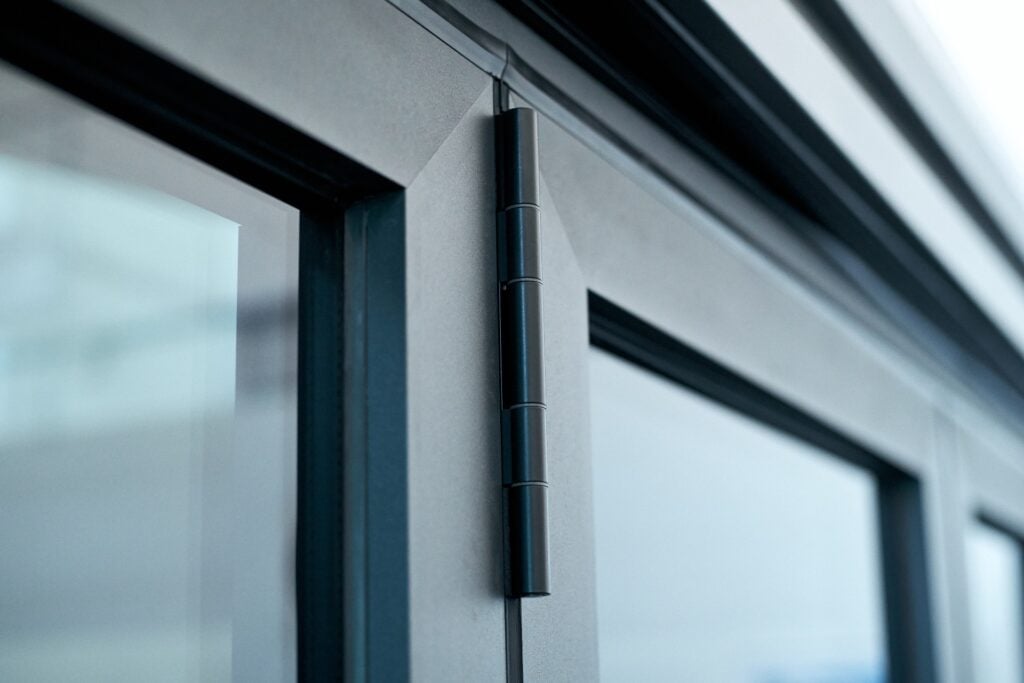
folding telescoping door guide

Folding doors use multiple narrow panels that stack accordion-style at the edge of the opening. Telescoping configurations use overlapping panels that slide in sequence, achieving a similar clear opening from a shorter track. Both are typically installed in hospital corridors, loading areas, and facilities that regularly move large equipment through entry points.

If a client comes to us with a wide opening and limited wall clearance on either side, folding or telescoping are the solutions we suggest. For most commercial facilities, it is an excellent solution that tends to get overlooked because it is less familiar than sliding or swinging options.

High-Speed Automatic Doors
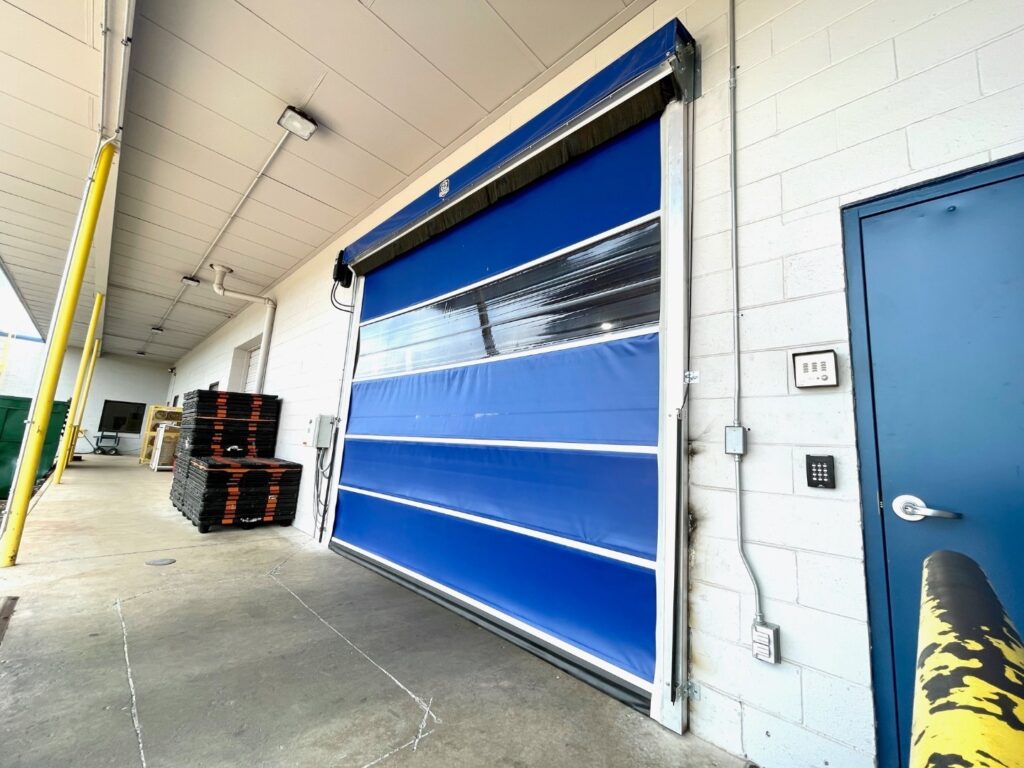
High-Speed Door, OK Commercial Doors, Commercial Door Services

If you are running a distribution center, a manufacturing facility, a cold storage operation, or a food processing plant, and you are not running high-speed doors on your high-cycle entries, you are either overspending on repairs or about to start.

Standard automatic doors are not built for the thousands of daily cycles that industrial and logistics environments demand. They wear ahead of schedule, require constant adjustment, and spend a disproportionate amount of time in a transitional state that defeats the purpose of having a door in the first place.

High-speed automatic doors open and close in seconds, are engineered for the cycle frequency these commercial properties require, and produce measurable energy savings by minimizing transition time at each entry point. For loading dock applications, the right solution is almost always a high-speed system.

What Commercial Automatic Door Installation Involves

what commercial automatic door installation involves

Installation is where the long-term performance of an automatic door system is either established or undermined. More often than we would like, the chronic problems we get called in to fix trace back to the original installation. The door may have worked fine for the first several months. That is not a reliable indicator of whether it was installed correctly. Here is how a proper installation should work.

  1. Structural mounting comes first. Before anything gets mounted, the wall or frame needs to be verified as capable of supporting the operator and door assembly under sustained load and vibration. Fasteners work loose over time in high-cycle applications, and the structural backing has to hold the load long-term. We have pulled wall mounts anchored into drywall by other contractors. That is not a story that ends well.
  2. The electrical connection has to be correctly specified. The wiring needs to match the requirements of the operator, the sensors, and any access control system the door communicates with. Sizing it for what the system actually requires, not just what gets it working on day one, is something that gets cut on rushed jobs and shows up as performance problems later.
  3. The operator gets programmed to the specific door and entry. Every automatic door has a motor that controls how fast the door opens, how much force it applies while closing, and how it responds to the load of the door itself. Those settings are not universal. They are programmed to the actual weight of the door, the expected traffic volume, and the force limits required by the American National Standards Institute and the Builders Hardware Manufacturers Association. Getting them right means the door performs correctly and safely from day one.
  4. Sensor calibration is specific to the geometry of the entrance. A detection zone that works correctly on a wide retail entry will behave completely differently on a narrow interior passage. Every sensor gets positioned and calibrated to the specific entry it is covering, then tested under real conditions before the job is done.

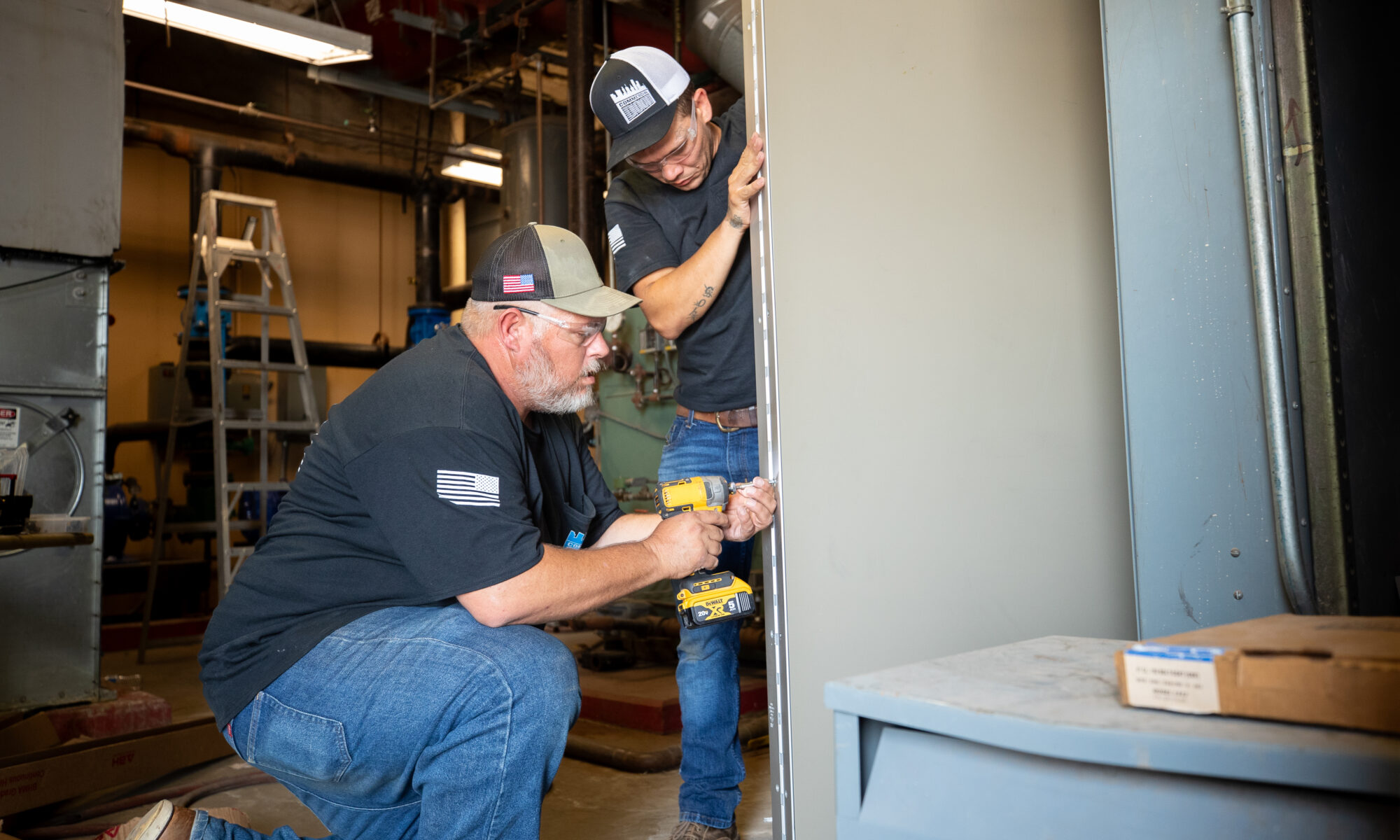
All of our technicians are AAADM-certified, the industry standard administered by the American Association of Automatic Door Manufacturers. When you are evaluating contractors, it is the clearest signal that the person doing the work knows what the requirements are and has been held accountable to them. For a full walk-through of what to expect from start to finish, our installation guide covers the process in detail.

Why Maintenance Matters

Automatic door systems run quietly in the background, and maintenance tends to get pushed when nothing is visibly wrong. That is completely understandable. The problem is that most of what degrades in these systems is invisible until it is not, and by the time something fails or triggers a safety concern, it has usually been developing for a while. Here is what is happening inside a system that has not been serviced recently.

  • Motion sensors and optical sensors lose detection accuracy. Dust and debris accumulate on sensor lenses over time, shortening detection range and narrowing the activation zone without triggering any obvious failure. A sensor that is not reliably detecting someone approaching is not a minor nuisance. It is a safety failure.
  • Operator force and speed settings drift out of spec. Vibration and wear shift these settings gradually, often with no visible sign of a problem. We have tested doors applying significantly more closing force than ANSI/BHMA standards allow, with nothing to indicate it from the outside.
  • The safety reverse function loses calibration. This is what stops and reverses the door when something enters the door path during closing. When force limits or detection drift, the safety margin shrinks without the door behaving any differently in normal operation. Periodic testing is the only way to know it is still working.
  • Track and hardware accumulate friction from inadequate lubrication. Increased drag puts additional load on the electric motor and accelerates wear on the drive components. We see premature operator failures regularly that trace back directly to lubrication being skipped.
  • Mounting fasteners work loose over time. Every cycle puts load and vibration through the mounting points. A door that is slightly misaligned because its hardware has shifted looks normal from the outside and shows up as uneven operation and accelerated track wear.

Scheduling regular automatic door maintenance keeps these issues from compounding silently. An annual inspection, or semi-annual for high-traffic applications, covers all of it. Finding a problem during a scheduled visit costs a fraction of what it costs after an incident.

Get Expert Automatic Door Service for Your Commercial Facility

If you manage a commercial facility and you are evaluating a new automatic door installation, assessing a system that has not been serviced recently, or dealing with a door that is not performing correctly, those are exactly the situations we handle every day. Our AAADM-certified technicians work exclusively on commercial automatic door systems and are available 24/7 for both scheduled service and emergency repair across Oklahoma, Texas, Arkansas, and Tennessee.

Business owners and facility managers in Norman, Oklahoma City, Tulsa, Dallas-Fort Worth, Western Arkansas, Little Rock, and Nashville can request a free estimate today—no long-term contract required. Tell us what you have or what you are trying to accomplish, and we will give you a straight answer on the right solution for your facility.
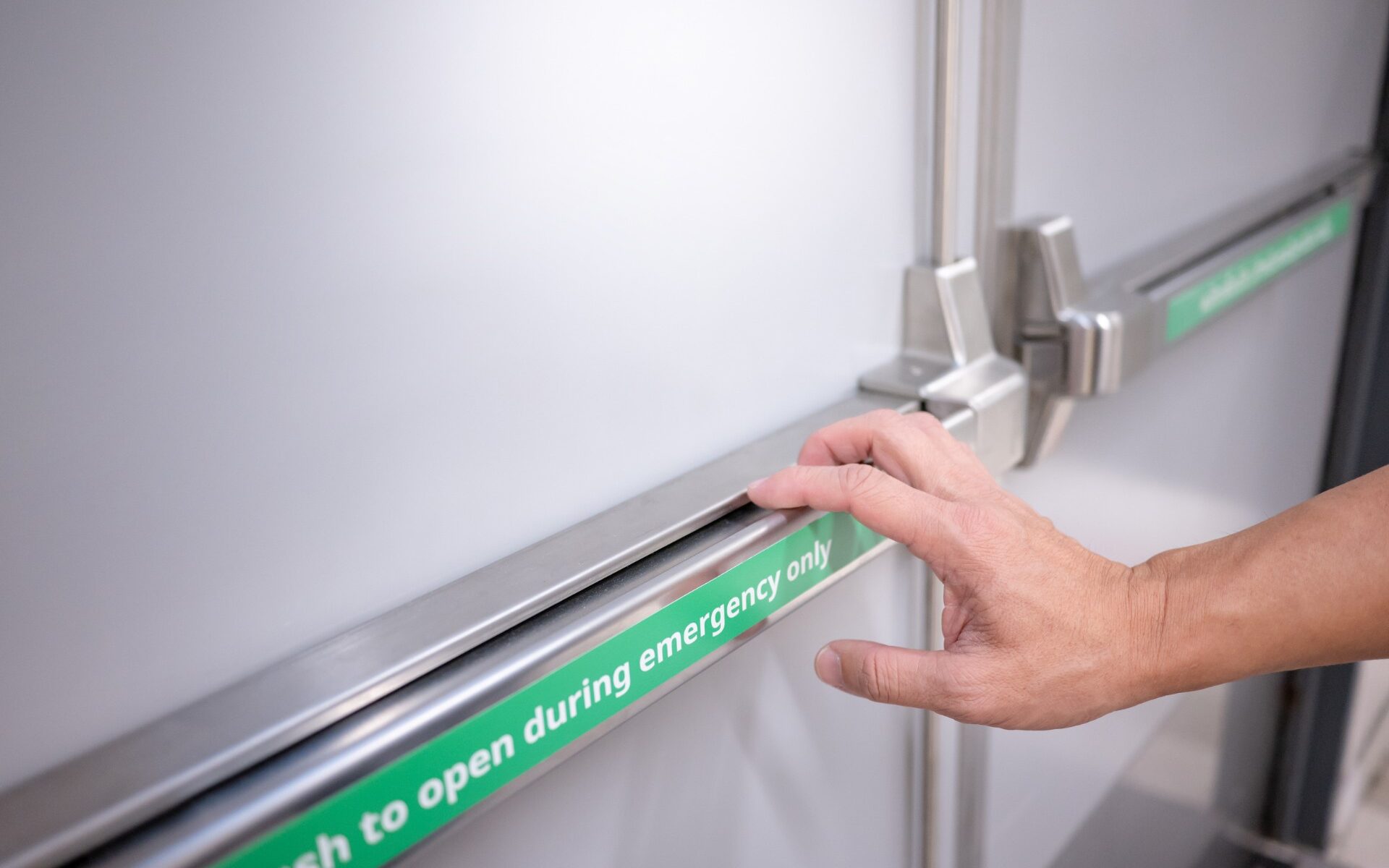
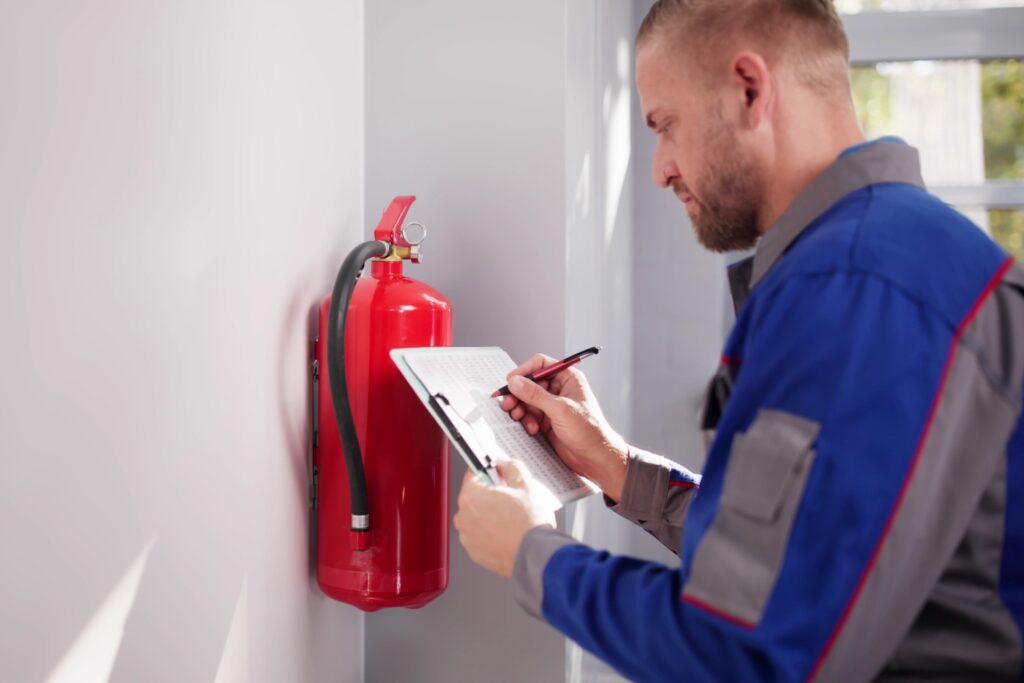
fire door regulations western arkansas

Fire Door Regulations in Western Arkansas

Fire door compliance is a legal obligation backed by state law and enforced by fire marshals across Western Arkansas. Fire doors protect building occupants, slow the spread of fire and smoke, and keep exit routes functional during an emergency.

This guide walks Western Arkansas business owners through the regulations that apply to their property, what compliance looks like in practice, and how to avoid the violations that most commonly trigger failed inspections.

What Governs Fire Door Regulations in Western Arkansas?

Fire door regulations in Western Arkansas are built on a consistent framework of nationally recognized standards and a statewide fire code, enforced locally by the fire marshal’s office in each jurisdiction.

There are governing bodies and requirements that apply uniformly throughout the region. The 2021 Arkansas Fire Prevention Code, administered by the Arkansas Department of Public Safety, is the foundational state document. The 2021 International Fire Code, with Arkansas-specific amendments, applies to every city and county in Western Arkansas. Three national standards are incorporated by reference:

  • National Fire Protection Association (NFPA) 80 governs how fire doors must be installed, tested, and maintained, covering clearance tolerances, hardware specifications, and annual inspection requirements.
  • NFPA 101 focuses on protecting occupants by regulating egress routes, fire barriers, and the door assemblies within them.
  • The International Building Code (IBC) determines where fire-rated construction, including fire door assemblies, is required based on a building’s occupancy classification, construction type, and design.

Fire Door Assembly Requirements Under Arkansas Code

Under the 2021 Arkansas Fire Prevention Code and NFPA 80, every fire door assembly in your building must meet specific performance and installation requirements that are consistent across all Western Arkansas jurisdictions:

  • Fire rating: Fire doors carry ratings from 20 minutes to three hours, meaning the assembly can contain fire and smoke for at least that duration. 
  • Labeling: Every component of a compliant assembly, including the door slab, frame, and often the hardware, must carry a permanently affixed, legible label from an accredited testing laboratory. A missing, painted-over, or illegible label renders the door non-compliant.
  • Self-closing mechanism: Fire doors must be equipped with an approved closer that returns the door to the fully closed and latched position without manual assistance.
  • Positive latching: The door must latch fully into the strike when it closes. A door that swings shut but does not positively engage the latch does not meet code.
  • Clearance gaps: NFPA 80 specifies maximum allowable gaps at the head, jamb, and bottom of the door. Exceeding these tolerances allows fire and smoke to pass through.
  • No unauthorized modifications: Drilling additional holes, installing non-rated hardware, or altering the door in any way not tested as part of the original assembly can void the fire rating.

Navigating Multiple Jurisdictions Across Western Arkansas

Western Arkansas spans multiple jurisdictions, each with its own fire marshal enforcing the same underlying state code but with distinct inspection processes, permit timelines, and enforcement priorities. Here is what to expect from each major authority having jurisdiction (AHJ) in the region.

Fort Smith Fire Prevention Division

The Fort Smith Fire Prevention Division handles fire inspections and plan reviews for commercial properties throughout Fort Smith and the River Valley. Fort Smith’s significant industrial and manufacturing base means the Fire Prevention Division regularly focuses on fire door compliance in warehouse, production facility, and heavy commercial settings, with particular attention to exit corridors and transitions between office and production spaces.

Fayetteville Fire Marshal’s Office

The Fayetteville Fire Marshal’s Office enforces fire safety citywide through plan reviews, inspections, and compliance follow-ups. Fayetteville’s sustained growth in mixed-use development, healthcare, and higher education keeps the office consistently active on new construction and change-of-occupancy reviews. Businesses planning renovations or tenant improvements should engage the Fire Marshal’s Office before construction begins.

Rogers Fire Department, Community Risk Reduction Division

The Community Risk Reduction Division of the Rogers Fire Department handles commercial plan reviews and life safety inspections throughout Rogers. The city’s rapid retail and hospitality growth, particularly around the Pinnacle Hills corridor, has made fire door compliance in new commercial construction a consistent enforcement focus. Rogers publishes its current adopted codes on the city website.

Springdale Fire Department

The Springdale Fire Department enforces fire safety across one of the region’s most commercially diverse cities, including food processing facilities, distribution centers, retail properties, and medical offices. Businesses in food processing and warehouse operations should pay particular attention to fire door assemblies in high-piled storage areas and at production-to-office transitions.

Other Municipalities and Multi-Location Businesses

For businesses in Bentonville, Van Buren, Alma, Siloam Springs, or other municipalities, the Arkansas State Fire Marshal’s Office provides statewide oversight and can direct you to the appropriate local AHJ. If you operate multiple locations across Western Arkansas, maintaining organized inspection records and building relationships with each local fire marshal’s office is the most reliable way to stay ahead of compliance requirements.

Annual Inspection and Maintenance Requirements

annual inspection maintenance western arkansas fire doors

One of the most important and most frequently overlooked provisions of NFPA 80 is the requirement for annual fire door inspections. This is not a one-time obligation tied to building permit approval. It is an ongoing requirement for the life of the building.

All fire door assemblies must be inspected and tested at least once per year by a qualified person, who must confirm:

  • The label is intact 
  • Clearance gaps are within tolerances
  • The door closes and latches fully without manual assistance
  • All hardware is operational
  • No unauthorized modifications have been made.

Inspection results must be recorded and made available to the local fire marshal upon request. A building that cannot produce records is out of compliance regardless of the physical condition of its doors. Deficiencies must be corrected promptly, as NFPA 80 does not allow deferred repairs on fire door assemblies.

Industry-Specific Fire Door Considerations in Western Arkansas

industry specific fire door considerations western arkansas

While the code requirements are consistent, different industries tend to encounter fire door compliance challenges in predictable patterns.

  • Retail and office: Mixed-use buildings require fire doors between tenant suites, at stairwells, and in exit corridors. High-traffic use accelerates hardware wear, making annual closer and latch inspections especially important.
  • Healthcare and medical: Medical facilities must meet both the Arkansas Fire Prevention Code and federal Centers for Medicare and Medicaid Services (CMS) standards, making compliance more layered than in most other occupancy types.
  • Hospitality and hotels: Hotels require fire doors at guest room entries along exit corridors, at stairwells, and in utility spaces. The high volume of doors in a typical hotel makes systematic inspection and record-keeping essential.
  • Warehouse and distribution: Warehouse and distribution facilities are widespread throughout Western Arkansas, given the region’s logistics industry. These properties often require fire doors separating storage classifications and connecting warehouse and office spaces, with especially stringent requirements in high-piled storage facilities.
  • Restaurants and food service: Restaurant kitchens often require fire-rated protection between the kitchen and other building areas. Hardware in these environments is exposed to grease, heat, and heavy daily use, requiring more frequent inspection than in standard commercial settings.
  • Food processing and manufacturing: Industrial facilities in Fort Smith and the River Valley face fire door requirements at mechanical equipment areas and between manufacturing and office spaces, with the added complexity of heavy vehicle traffic near some openings.

Common Fire Door Violations

Some violations appear regularly in fire door inspections across commercial properties in Western Arkansas and throughout Arkansas more broadly. Here’s a list of common violations to be aware of:

  • Propped-open fire doors: Any device holding a fire door open that is not tied to the building’s fire alarm system is a code violation.
  • Missing or illegible labels: A label that has been painted over or removed renders the assembly non-compliant regardless of the door’s physical condition.
  • Failed or improperly adjusted door closers: A closer that does not bring the door to a fully latched position must be repaired or replaced immediately.
  • Clearance gaps exceeding NFPA 80 tolerances: Oversized gaps allow fire and smoke to bypass the assembly and typically result from settling, warping, or improper installation.
  • Unauthorized hardware or modifications: Only hardware tested as part of the fire door assembly may be installed. Non-rated additions can void the door’s fire rating.
  • No inspection records: Missing documentation is a violation of NFPA 80, regardless of the physical condition of the doors.

How to Stay Compliant With Western Arkansas Fire Door Regulations

Staying compliant requires a consistent, proactive approach rather than a reactive scramble before your next inspection.

  • Schedule annual inspections with a qualified fire door professional. NFPA 80 places this responsibility on the building owner and requires that inspections be performed by someone with the knowledge to evaluate every component of the assembly. A visit from your local fire marshal is an enforcement inspection, not a substitute for the owner-required annual inspection.
  • Address deficiencies immediately. Deferred repairs are not permitted under NFPA 80, and a documented non-compliant door creates significant liability exposure.
  • Keep thorough records. Maintain inspection reports, repair invoices, and any documentation related to fire door installations or replacements.
  • Engage your AHJ proactively. If you are planning a renovation or change of occupancy, contact your local fire marshal’s office before construction begins.

Get a Professional Fire Door Assessment in Western Arkansas

Commercial Door serves Western Arkansas businesses with professional fire door installation, inspection, repair, and maintenance. Whether you are managing a single location in Fort Smith or operating multiple facilities across the Northwest Arkansas corridor, our team understands the regulatory landscape and the practical demands of keeping fire door assemblies compliant year after year.

If you are unsure whether your building’s fire doors meet current requirements, or if you have an upcoming inspection and want to be prepared, contact Commercial Door today to schedule a fire door assessment for your property in Western Arkansas.

AdobeStock 1895092967

ADA Door Width and Dimensional Requirements: What You Need to Know

Getting commercial door dimensions right is an important facility design and renovation decision. The Americans with Disabilities Act (ADA) establishes specific dimensional standards for doors on accessible routes, and those standards are precise enough that small specification errors can render an otherwise well-designed entrance non-compliant.

This guide covers the dimensional requirements the ADA establishes for commercial doors, how those requirements apply across the door types most commonly found in commercial facilities, where facilities most often get the specifications wrong, and what a professional assessment involves. 

What the ADA Requires and Who It Applies To

The Americans with Disabilities Act establishes accessibility obligations for two broad categories of facilities.

  • Title II applies to state and local government facilities, including public buildings, courthouses, libraries, and municipal offices.
  • Title III applies to private businesses open to the public, covering most commercial establishments, including retail stores, restaurants, medical facilities, and hotels.

Both titles impose entrance accessibility requirements, though the enforcement mechanisms and remediation timelines differ.

The 2010 ADA Standards for Accessible Design outline the standards for door compliance. These standards apply in full to facilities built or altered after March 15, 2012. For existing facilities that predate the current standards, the obligation is to remove architectural barriers when doing so is “readily achievable.” This is a case-by-case determination based on the cost and difficulty of the modification relative to the resources of the business. Any planned alteration to a facility triggers compliance requirements for the affected area to the maximum extent technically feasible, provided the cost of path-of-travel improvements does not exceed 20% of the total cost of the alteration.

The Numbers That Define ADA Door Compliance

ADA door compliance is defined by several dimensional requirements, including clear opening width, maneuvering clearance, threshold height, and hardware mounting height, each of which must be met independently. Meeting one does not satisfy the others, and a deficiency in any single measure constitutes a barrier under ADA standards.

Clear Width vs. Door Width

ada complaint door clear width

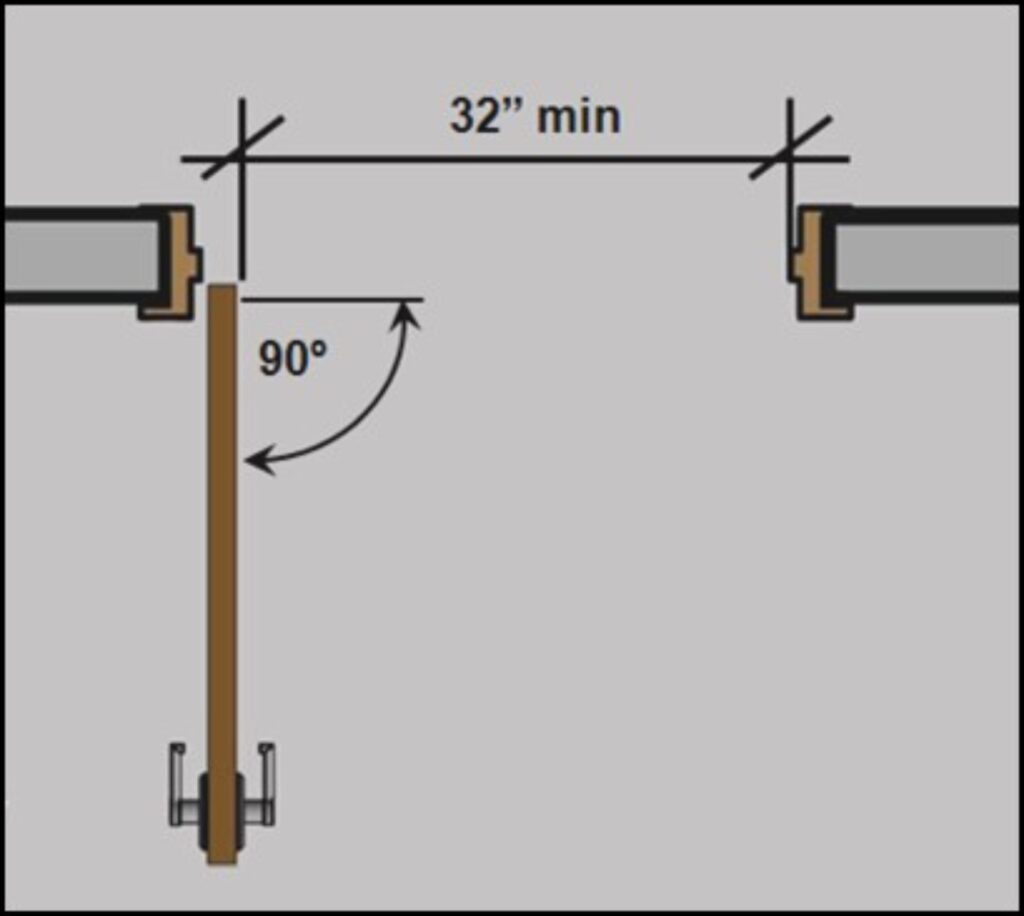
ADA standards require a minimum clear opening width of 32 inches when the door is open 90 degrees. This minimum width represents the actual space for a wheelchair, walker, or mobility device to pass through the door. 

Clear width is not the same as the nominal door width printed on a specification sheet or stamped on a door slab. The difference can be the source of many compliance miscalculations. The clear width is measured from the face of the door stop on the latch side to the face of the door at its 90-degree open position, not from frame to frame and not from the rough opening.

When a hinged door opens, the door stop on the latch side and the door slab itself both reduce the available clear opening. 

  • A 32-inch door slab produces a clear opening of approximately 29.5 inches, which falls short of the requirement.
  • A 34-inch slab produces roughly 31.5 inches of clear opening, still non-compliant.
  • A 36-inch slab consistently produces the required 32-inch clear opening under standard installation conditions, which is why 36 inches has become the practical specification standard for ADA-compliant hinged doors.

This measurement method must be used consistently when specifying new doors and evaluating existing ones.

Maneuvering Clearance

ada maneuvering clearance

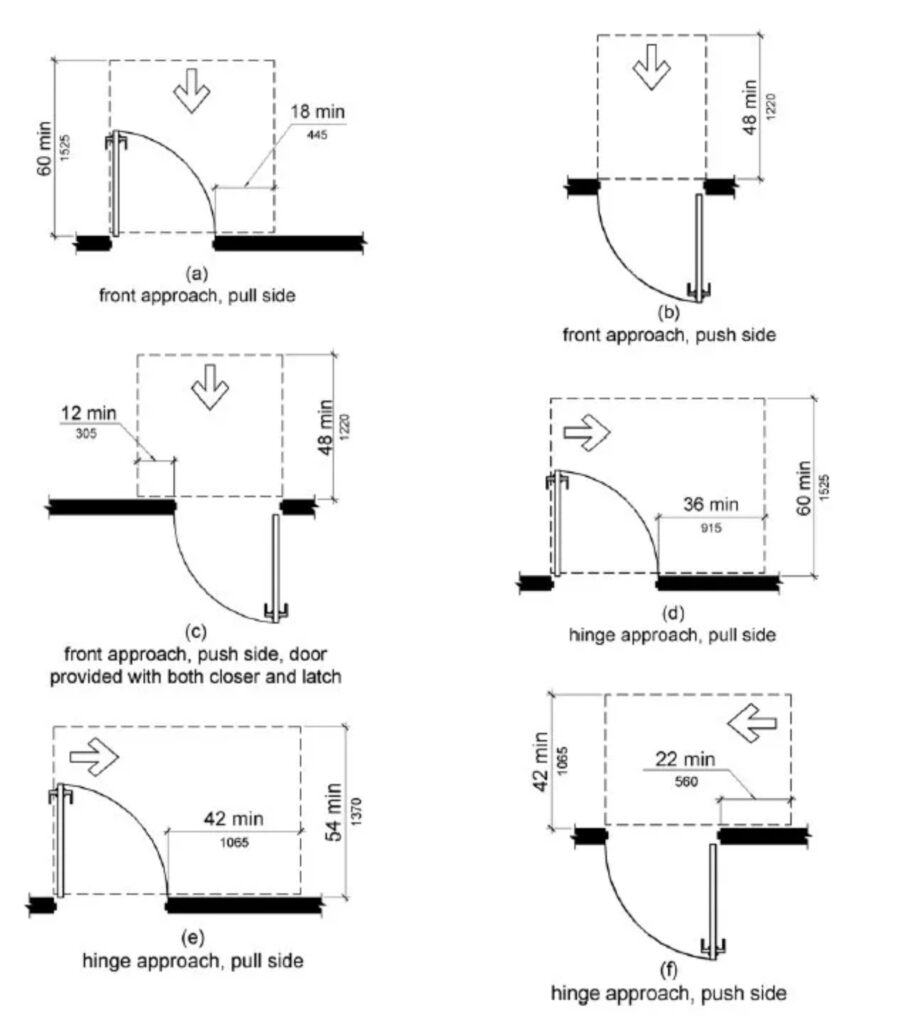
Maneuvering clearance refers to the floor space required on both sides of a door to allow a wheelchair user to approach, operate, and pass through the door independently. It is one of the most frequently deficient requirements in commercial door compliance. A door can meet every dimensional specification and still fail if the surrounding approach space is inadequate. The required clearances have four variables: 

  • Push or pull: Which side of the door the person is on
  • Front, hinge, or latch side: The direction of approach
  • Door configuration: Whether the door has a closer, a latch, or both
  • Door type: Whether the door is a swinging, sliding, folding, or the opening has no door at all
  • Level, unobstructed surface: Maneuvering clearances must be flat, obstacle-free, and no steeper than 1:48.

As an example, a forward approach to the pull side of a swinging door, the Standards require at least 18 inches of clearance on the latch side and 60 inches of depth perpendicular to the doorway, as seen in panel (a) above. On the push side of the same door with both a closer and latch, the perpendicular depth drops to 48 inches, and the latch-side clearance requirement becomes 12 inches, as seen in panel (c) above.

Each combination of approach direction and door configuration produces its own required dimensions. The full clearance requirements for swinging doors, sliding and folding doors, and recessed doors are published by the U.S. Access Board at sections 404.2.4 through 404.2.4.4 of the ADA Standards, which is the authoritative reference for specifying or evaluating any door on an accessible route.

Threshold Height

ada door threshold requirements

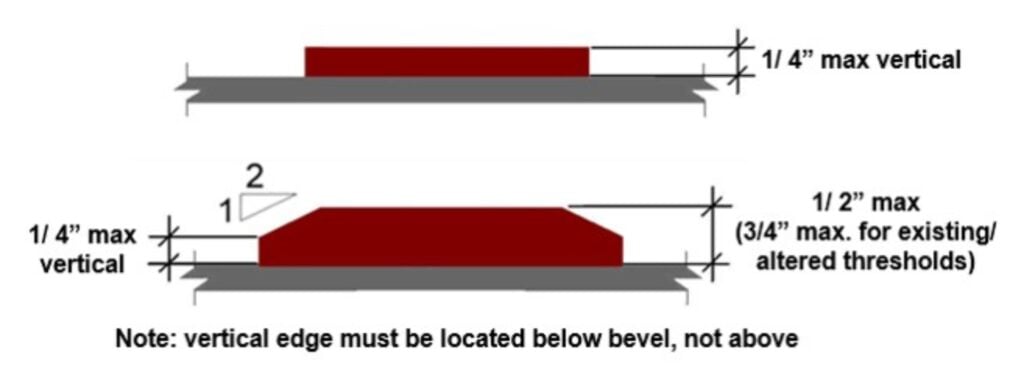
A threshold is the raised strip at the base of a door frame that seals the gap between the door and the floor. Thresholds must not exceed one-half inch in height. Any threshold between one-quarter inch and one-half inch must be beveled with a slope no steeper than 1:2 (as noted in the above diagram), meaning for every half inch of height, the bevel extends at least one inch horizontally (see triangle, upper-left of diagram above). 

Thresholds at or below one-quarter inch do not require beveling and may have a vertical edge. New construction and alterations must keep thresholds at or below the one-half inch maximum, and beveling is required for anything over one-quarter inch.

In practice, threshold height is most relevant to exterior door specifications, where weatherproofing often drives threshold design. Flush or near-flush thresholds with appropriate perimeter sealing are the most reliable way to satisfy both weatherproofing needs and ADA requirements simultaneously.

Hardware Mounting Height

ada hardware mounting height

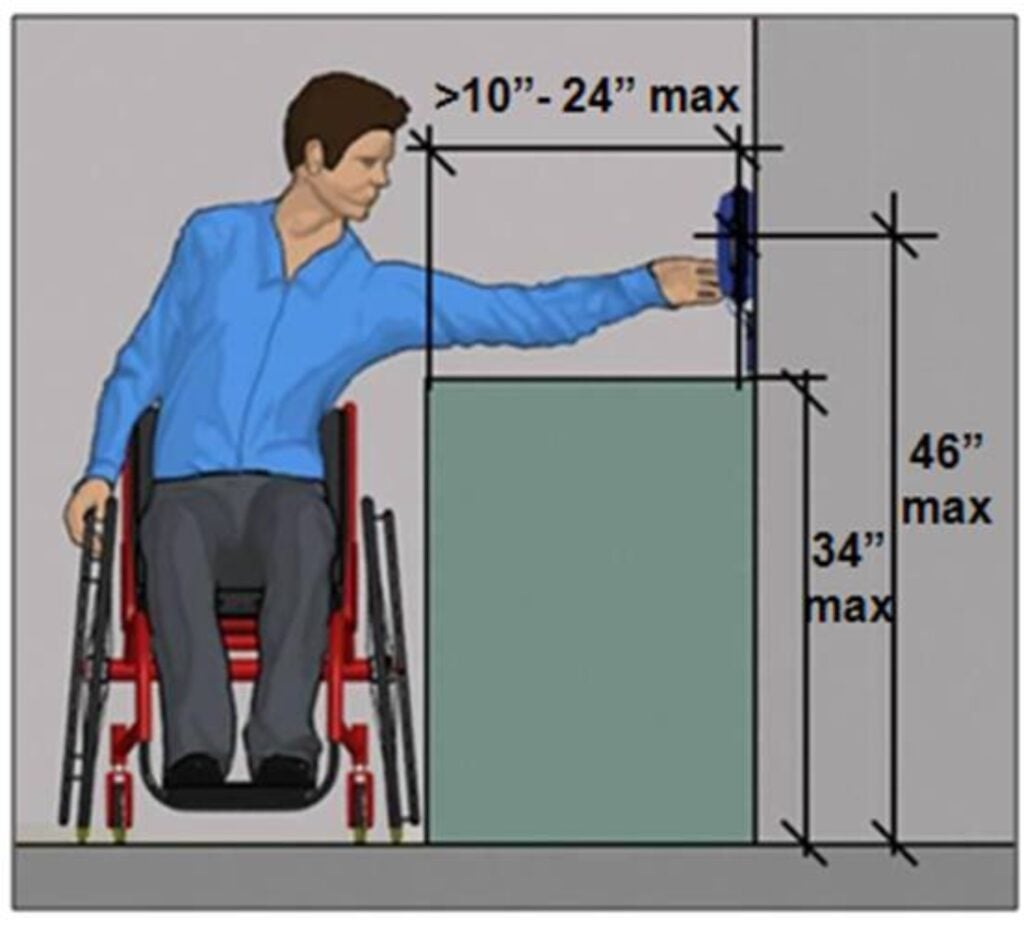
Door hardware must be mounted between 34 and 48 inches above the finished floor. This range ensures hardware is reachable from a seated position and does not require reaching above or below the accessible range. The requirement applies to all ADA-compliant hardware, including handles, pulls, locks, and access control devices.

Doors in Succession

ada doors in succession

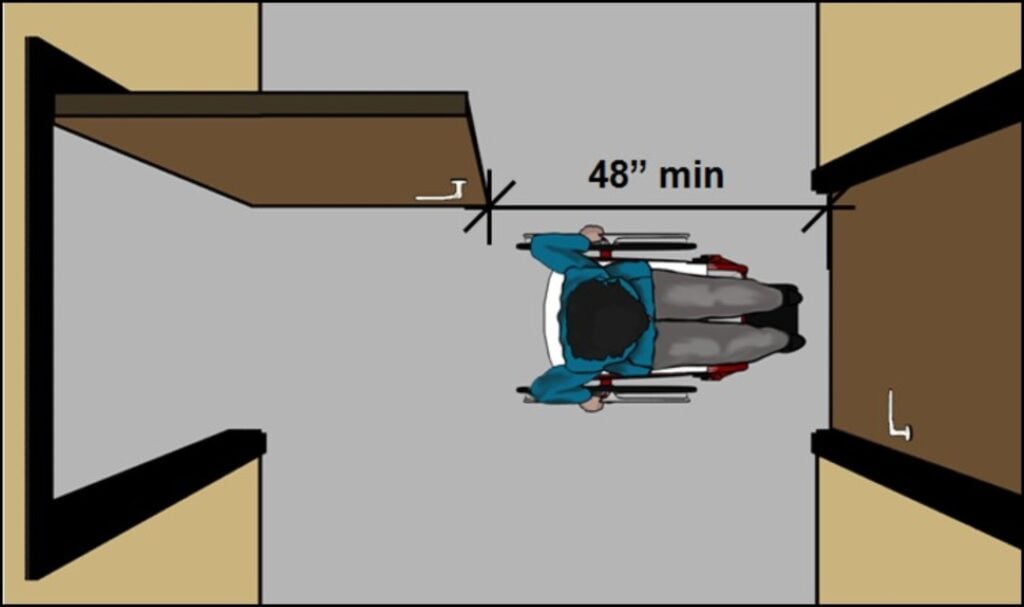
When two hinged or pivoted doors are positioned in series, ADA standards require a minimum of 48 inches between them, measured from the leading edge of the first door in its open position to the face of the second. Both doors must also independently meet all applicable clear width, threshold, hardware, and maneuvering clearance requirements.

The 48-inch minimum ensures a wheelchair user can fully enter the space between the doors, allow the first door to close behind them, and position themselves to open the second without being trapped or forced to hold one door open while operating the other. Where either door swings into the between-door space, the required 48 inches is measured in addition to the door’s swing.

When Full Compliance Isn’t Required

Not every door in a commercial facility is required to meet ADA dimensional standards. For existing facilities, determining what ADA accessibility improvements are required, the obligation is to remove barriers when doing so is readily achievable. What qualifies depends on the cost and difficulty of the modification relative to the resources of the business. Replacing a non-compliant door is generally considered readily achievable for most businesses. Reconfiguring a corridor to achieve maneuvering clearance may or may not be, depending on structural constraints and cost.

The 2010 Standards apply to doors that are part of an accessible route, which is defined as a continuous, unobstructed path connecting accessible elements and spaces within and between facilities. Doors that do not serve an accessible route, including certain service entrances, mechanical room access doors, and doors to spaces that are not required to be accessible, may not be subject to the same requirements.

The Standards also include a dimensional tolerance for existing conditions. In alterations where existing structural or site constraints make it technically infeasible to achieve a 32-inch clear opening, a clear width of no less than 31.75 inches is permitted. This tolerance is narrow and intended for genuine constraint situations, not as a routine alternative to full compliance. Where door replacement alone cannot achieve compliance, alternatives such as ADA lifts may provide an accessible route where one cannot otherwise be achieved within the existing structure.

Which Doors Are Subject to ADA Dimensional Requirements

Whether a door must comply has less to do with its type and more to do with where it sits in a building and who uses it. The following table outlines the most common commercial door locations and whether ADA dimensional requirements apply.

Doors required to complyDoors not required to comply
Primary public entry doorsDoors to spaces not required to be accessible (e.g., storage closets, private offices not open to the public)
Secondary public entrances on an accessible routeService entrances not used by the public, such as loading docks, provided another compliant entrance exists
Interior doors serving public spaces (restrooms, dining areas, meeting rooms)Doors to mechanical, electrical, and equipment rooms
Interior doors serving employee areas that are shared by more than one employee, such as break rooms, shared offices, or internal corridorsDoors to spaces accessed only by ladders, catwalks, or very narrow passageways
Doors serving accessible parking areas and loading zonesDoors used exclusively by security personnel to control access
Doors on an accessible means of egress, including fire doorsRaised areas exempt from accessible route requirements, such as elevated platforms and certain press boxes
Vestibule and mantrap doors when they connect accessible spacesEmployee work areas under 1,000 square feet defined by permanent partitions

A door that is not required to comply is not necessarily exempt from all ADA requirements. ADA standards address scoping (which doors must be on an accessible route) separately from the technical requirements that apply once a door is on that route. When in doubt about whether a specific door in your facility is subject to ADA dimensional requirements, a professional assessment is the most reliable way to determine compliance obligations accurately.

What Non-Compliance May Cost

ADA Title III complaints can be filed with the U.S. Department of Justice or through private civil action. A successful ADA lawsuit can result in a court order requiring remediation, attorney’s fees, and, in cases involving repeated or widespread violations, civil penalties. The cost of court-ordered remediation is typically higher than proactive correction because it is completed under a compliance deadline rather than as part of planned construction or maintenance work.

Beyond litigation, non-compliant entries affect the actual usability of a facility for customers, employees, and visitors with disabilities. Barriers at entry points have a direct impact on customer access and, in facilities that serve the public regularly, on the facility’s reputation and customer relationships.

The cost of bringing a non-compliant door into compliance varies by situation. A door replacement to achieve clear width compliance is a straightforward project. Reconfiguring an approach to achieve maneuvering clearance may require corridor modifications that are substantially more involved. Identifying and correcting deficiencies during planned renovation or construction is almost always less expensive than addressing them as standalone corrective projects after the fact.

Why a Professional Assessment Is the Right Starting Point

ADA door dimensional compliance involves multiple measurements that interact with each other and with the physical conditions surrounding each door. A deficiency in any one of them constitutes a non-compliant installation regardless of what else is correct. A qualified commercial door contractor can measure clear openings accurately, test closer force on interior doors, evaluate maneuvering clearance dimensions against current approach requirements, review hardware mounting heights, and assess threshold conditions. For facilities planning renovations, a pre-construction assessment identifies which doors in the project scope require correction and allows compliance work to be sequenced alongside planned improvements rather than addressed separately.

Commercial Door provides professional door assessments, installation, and replacement for commercial facilities across Oklahoma, Texas, Arkansas, and Tennessee. Our technicians work with all major commercial door types and are experienced with ADA dimensional requirements across new construction, alteration, and existing facility contexts. Request a free estimate to schedule an assessment or discuss a specific project.

commercial door 78

Installing Commercial Doors: What to Expect and How to Prepare

Installing new commercial doors is a significant investment, and understanding what to expect throughout the process helps you complete the job correctly and efficiently. Whether you’re replacing aging entry doors, upgrading to automated systems, or installing specialized applications, proper planning and coordination make all the difference.

This guide walks through the complete installation process, from selecting the right doors to post-installation support, so you know exactly what happens at each stage and how to prepare your business for a successful outcome.

Choosing the Right Commercial Doors for Your Facility

image 3

Commercial facilities have different needs than residential properties, and choosing the right doors ensures your business has the protection and reliable performance required by daily operations. It drives every other point in the installation process, from timeline and budget to operational requirements and code compliance. Consider these key factors:

  • Materials and construction standards. Material selection affects performance, maintenance requirements, and lifecycle costs. The best commercial-grade doors use heavier gauge steel, reinforced frames, and impact-resistant materials designed to withstand thousands of daily cycles in high-traffic environments.
  • Security features. It’s important to match security features to the level of protection each entrance requires without creating operational bottlenecks. Entry points with valuable inventory, sensitive information, or restricted areas need reinforced frames, multi-point locking systems, and access control integration. Customer entrances may prioritize visibility and ease of access while maintaining basic security through controlled access hardware and monitored entry systems.
  • ADA compliance. Planning for compliance from the beginning prevents costly modifications later. Accessible entrances require specific door widths, threshold heights, and clear floor space on both sides of the door. Automatic operators, push-button controls, and properly positioned hardware meet accessibility requirements for employees and customers.
  • Energy efficiency. Insulated doors with proper weatherstripping reduce heat transfer and air infiltration, lowering heating and cooling expenses throughout the year. High-performance doors with thermal breaks and low-emissivity glass maintain interior temperatures while allowing natural light. For loading docks or high-frequency operation, high-speed doors minimize air exchange and maintain climate control. The upfront investment in energy-efficient doors typically pays for itself through reduced utility costs.
  • Application-specific requirements. Understanding the specific demands of your industry and operations helps you select doors that perform reliably in their intended environment. Facilities handling food products need doors that meet sanitation standards and temperature control requirements. Manufacturing environments may require impact-resistant doors that withstand forklift traffic and frequent opening cycles. Retail locations need doors that support customer flow while preventing unauthorized access to back-of-house areas.

The Commercial Door Installation Process

commercial door 41

A successful installation follows a structured process from initial consultation through final testing and documentation. Understanding what happens at each stage helps you coordinate resources, communicate with staff, and maintain business operations.

Initial Consultation and Site Assessment

The installation process begins with a site assessment where the installer evaluates specific needs and constraints. Technicians take precise measurements of your door openings, examine structural conditions, verify power supply locations for automatic operators, and identify accessibility or code compliance requirements. They also assess daily traffic patterns, operating schedules, and special considerations like temperature control or security requirements.

To ensure the project runs smoothly, the site assessment also includes verifying local building codes, confirming permit requirements and inspection schedules, fire safety requirements, and any industry-specific regulations. The assessment also identifies any structural modifications needed to accommodate the new doors, such as header reinforcement, floor preparation, or electrical work for automatic operators.

Quote and Scheduling

Following the site assessment, you receive a detailed estimate that breaks down material costs, labor, any required structural modifications, permit fees, and the projected timeline. The estimate should specify door models, hardware packages, finish options, and warranty coverage so there are no surprises.

Lead times vary depending on door type, customization requirements, and current demand. Standard doors with common configurations may be available within a few weeks, while custom sizes, specialized finishes, or doors with integrated access control systems may require longer fabrication periods. Scheduling around business operations is critical, and experienced installers work with you to identify optimal installation windows. Some installations can proceed during normal business hours with limited impact, while others may require after-hours or weekend scheduling to avoid interfering with daily operations.

Pre-Installation Preparation

Proper preparation before installation day helps prevent delays and keep the installation on schedule. Take these steps to prepare:

  1. Coordinate deliveries. If you receive regular deliveries, coordinate with shipping companies to reschedule deliveries that would normally arrive through the door being replaced, or establish temporary receiving locations.
  2. Manage building access. Notify staff of any alternate entrances they need to use, and post temporary signage directing customers to available entry points. For customer-facing businesses, a brief announcement on social media or your website helps set expectations and reduces confusion. If the door being replaced is a primary access point, plan for additional foot traffic at other entrances.
  3. Plan for parking. Small parking lots may need reserved spaces for installation vehicles. Planning with your installer provides crew access without taking spaces away from customers or employees.
  4. Secure the building. If the door being replaced provides security for valuable inventory or sensitive areas, relocate those assets to more secure locations for the duration of the installation, or arrange for temporary security measures.
  5. Prepare access control systems. New doors often need new keys, updated access credentials, or modifications to electronic access systems. Be sure to coordinate with your access control company before the installation so that card readers, keypads, or biometric systems can be configured and tested as soon as the new doors are operational.

Installation Day

Installation day follows a structured process from crew arrival through final cleanup. Here’s what happens:

  1. Site setup and preparation. The crew arrives at the scheduled time and establishes a safe work zone around the door opening. They protect adjacent floors and walls from damage and stage tools and materials. For occupied facilities, installers contain dust and debris and maintain clear pathways for building occupants, communicating with you throughout the entire process.
  2. Existing door removal. If applicable, technicians carefully disconnect automatic operators, remove old hardware, and extract the existing door and frame. They inspect the rough opening for any structural issues, verify dimensions match the new door specifications, and make any necessary repairs or modifications before proceeding.
  3. New door installation. Technicians install the door frame, shim and level it to exact specifications, anchor it securely, and verify squareness before hanging the door. They install all hardware, connect automatic operators if applicable, adjust clearances and operating forces, and install weatherstripping and thresholds. 
  4. Safety testing and adjustments. Installers test opening and closing forces, verify that safety sensors activate properly, check emergency release functions, and confirm the door meets accessibility standards. They make fine adjustments to hardware, adjust automatic operator settings, and verify that locking mechanisms engage correctly.
  5. Cleanup and final inspection. Once all checks are complete, the crew cleans the work area, removes protective coverings, and disposes of old door components and installation debris. 

Post-Installation: Testing, Training, and Warranty Activation

Installation completion marks the beginning of the post-installation phase, where staff training, warranty activation, and ongoing maintenance help your doors perform reliably. This phase includes:

  • Staff training. Staff learn how to operate manual override systems, recognize warning signs that require professional attention, and perform simple maintenance tasks like cleaning tracks and checking weatherstripping. For doors with access control integration, training includes credential management and emergency procedures.
  • Documentation and warranty activation. Installers provide operation manuals, maintenance schedules, warranty documentation, and contact information for service and support. Proper warranty registration activates coverage immediately and protects your investment.
  • Ongoing support and maintenance. Installers advise on preventive maintenance schedules for lubrication, adjustment, and component inspection. Many commercial door service providers offer maintenance programs that include scheduled inspections, priority emergency response, and proactive component replacement to prevent unexpected failures.

Choosing an Installer Who Delivers

commercial door 24

The difference between a smooth, professional installation and one plagued by delays and substandard work comes down to the installer. Commercial door installation requires specialized knowledge beyond basic door hanging, and selecting an installer with proven commercial expertise helps your installation meet professional standards.

Evaluate installers based on their commercial specialization, track record, and service capabilities. Look for installers who work exclusively with commercial clients and can demonstrate experience with your specific door types through completed projects and client references. Check for consistent positive feedback regarding communication, schedule adherence, and problem-solving. Request detailed estimates that break down costs and timelines, and verify licensing, insurance coverage, and manufacturer certifications. An installer who handles the full range of commercial door needs becomes a valuable long-term partner rather than just a one-time vendor.

Get Started with Your Commercial Door Installation

A successful commercial door installation depends on careful planning, experienced installation, and ongoing support that keeps your doors functioning reliably for years. Understanding each phase of the installation process helps you prepare appropriately and maintain operations while protecting your investment. From selecting doors that match specific requirements through post-installation training and warranty activation, each step contributes to a successful outcome.

Commercial Door provides comprehensive commercial door installation services with the expertise to support your business needs. We specialize exclusively in commercial applications, bringing focused knowledge of commercial door systems, code compliance, and operational requirements to every installation. Our technicians handle the complete installation process from initial site assessment through final testing and staff training, and our 24/7 emergency service availability provides expert support whenever you need it. Request a free estimate to discuss your commercial door installation needs, or contact us directly to speak with one of our installation specialists.

types of commercial garage doors

Types of Commercial Garage Doors: A Complete Guide

Commercial garage doors are built to handle the demands of busy commercial and industrial environments. Unlike residential doors, they are designed for larger openings, heavier use, and specialized operational needs. Businesses rely on these doors for security, efficient movement of people and equipment, environmental control, and reliable day-to-day operations. Because different building types place very different demands on door systems, there are many types of commercial garage doors designed for specific functions, industries, and structural requirements.

This guide explains the main types of commercial garage doors used in modern buildings and how they differ from one another. It also covers the materials used to construct commercial doors, the factors businesses should consider when choosing one, typical door opening size and clearance requirements, and which door types are commonly used across different industries. Together, these sections provide a clear overview of the options available so business owners and facility managers can better understand which door systems may be best suited for their building.

What Are Commercial Garage Doors?

Commercial garage doors are large, heavy-duty door systems designed for commercial, industrial, and institutional buildings. They are typically installed in openings that allow vehicles, equipment, shipments, or large groups of people to move in and out of a facility. These doors are built to withstand frequent operation, larger structural loads, and harsher environments than residential garage doors.

One of the main differences between commercial and residential garage doors is scale and durability. Commercial doors are often wider and taller to accommodate trucks, forklifts, service vehicles, or large equipment. They are also built with stronger materials, reinforced hardware, and higher cycle ratings so they can open and close many times per day without premature wear.

Commercial garage doors are commonly found in a variety of commercial buildings, including:

  • Warehouses
  • Manufacturing facilities
  • Distribution centers
  • Auto service bays
  • Fire stations
  • Loading docks
  • Parking structures
  • Retail spaces 

Because these doors often play a critical role in operations, security, and building performance, choosing the right type of door for the environment is an important decision for property owners and facility managers.

Key Factors When Choosing a Commercial Garage Door

Choosing between different types of commercial garage doors involves more than selecting a door that fits the opening. The right door depends on how the building operates, how frequently the door is used, and what performance requirements the space demands. Considering these factors early can help ensure the door supports daily operations, safety, and long-term durability.

  • Building use and traffic flow: The way a facility operates often determines the most appropriate door type. Warehouses, service bays, manufacturing facilities, and retail environments all have different traffic patterns that influence door durability, speed, and size requirements.
  • Insulation and thermal performance: Buildings that are heated, cooled, or temperature-controlled often benefit from insulated commercial garage doors that help reduce energy loss and maintain more stable indoor conditions. Insulated doors can also provide low sound transmission between spaces, which can help reduce noise from equipment, traffic, or production areas.
  • Cycle ratings and door durability: Commercial doors are rated by how many times they can open and close before major components wear out. Facilities with frequent traffic may require high-cycle doors designed for constant operation.
  • Security considerations: Some environments require stronger door construction, reinforced locking systems, or steel components to help prevent unauthorized entry and protect equipment, vehicles, or inventory.
  • Speed of operation: In high-traffic areas, door speed can significantly affect workflow efficiency. Faster doors can help maintain productivity, reduce waiting time for vehicles and equipment, and minimize air exchange between indoor and outdoor environments.
  • Visibility and natural light: Certain door types, such as aluminum full-view doors, allow natural light into a building and provide exterior visibility. This can be beneficial in retail spaces, automotive facilities, and showrooms where visibility and appearance are important.
  • Environmental and weather conditions: Outdoor exposure, wind loads, moisture, dust, and temperature fluctuations can influence which commercial garage doors perform best in a given environment.
  • Space requirements and door operation: The amount of headroom, side room, and ceiling space available can affect which types of commercial garage doors can be installed, since different systems require different track styles or overhead clearances.

Types of Commercial Garage Doors

Commercial garage doors come in several designs, each built to serve different operational needs. Some doors prioritize durability and security, while others focus on speed, visibility, or space efficiency. The comparison table below highlights how the most common types of commercial garage doors perform across key decision factors.

Door TypeCommon ApplicationsSecurityDurabilitySpeedEnergy EfficiencyTypical Opening DimensionsCostMaintenance
Sectional overhead doorsWarehouses, service bays, loading docksModerateHighModerateHigh12-32 ft W × 12-24 ft HModerateModerate
Rolling steel doorsIndustrial buildings, storage facilitiesHighVery highModerateLow12-30 ft W × 12-20 ft HHighLow
Sheet doorsSelf-storage units, light commercial buildingsModerateModerateModerateLow8-12 ft W × 7-10 ft HLowLow
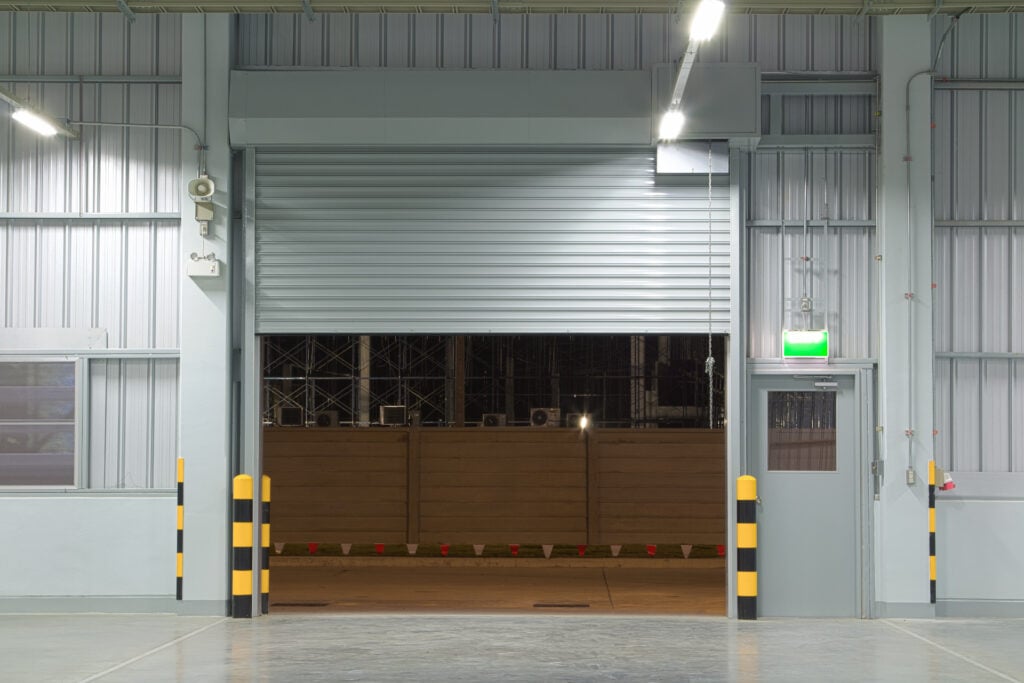
High-speed doorsManufacturing, logistics, high-traffic openingsLow to moderateHighVery fastModerate8-20 ft W × 8-16 ft HHighModerate
Fire-rated doorsFire separation openings, safety zonesHighHighSlowLow8-24 ft W × 8-20 ft HHighModerate
Aluminum full-view doorsShowrooms, dealerships, restaurantsLow to moderateModerateModerateLow8-20 ft W × 8-16 ft HHighModerate
Security grillesRetail storefronts, food courts, parking areasModerate to highHighModerateNone8-20 ft W × 8-12 ft HModerateLow
Specialty commercial doorsCold storage, clean rooms, food processing plantsHighVery highVariesHighVaries by applicationHighModerate

Sectional Overhead Doors

sectional overhead garage doors

Sectional overhead doors are one of the most common commercial garage door options because they offer a strong balance of durability, insulation, and versatility. These doors are built from horizontal panels connected by hinges that travel along overhead tracks and rest parallel to the ceiling when open. Many businesses choose sectional doors for large exterior openings where vehicles, equipment, or shipments regularly move in and out of a building. Because the panels seal tightly against the frame and can be insulated, they work especially well in loading bays, service entrances, and other openings where weather protection and energy efficiency matter.

Rolling Steel Doors

rolling steel garage doors

Rolling steel doors are designed for strength and space efficiency, making them a common choice where security and durability are priorities. Instead of using panels that travel along ceiling tracks, these doors are made of interlocking steel slats that roll into a compact coil above the opening when raised. These systems are often referred to as rolling service doors when they are installed in commercial service entrances, loading areas, or maintenance access points. Businesses often choose these doors for exterior openings that need strong protection against forced entry, impact, or harsh weather.

Sheet Doors

sheet garage doors

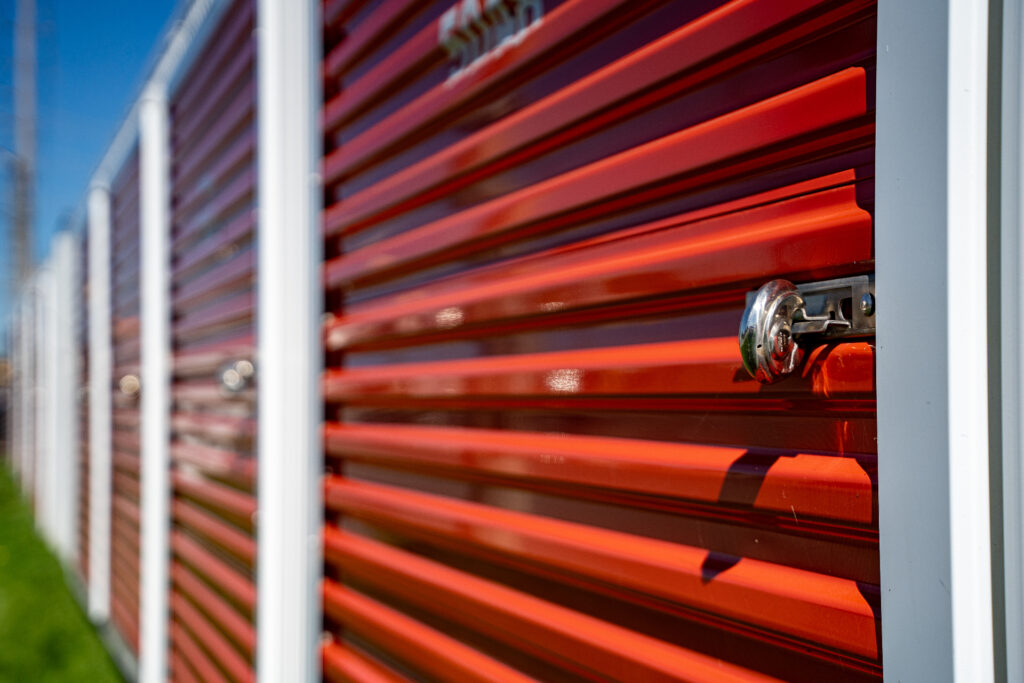
Sheet doors are a lightweight type of rolling door commonly used for basic security and access control in smaller commercial openings. Instead of interlocking slats, these doors are typically made from a single corrugated sheet of steel that rolls into a coil above the doorway. Businesses often choose sheet doors for areas where a simple, cost-effective barrier is needed rather than heavy-duty security or insulation. They work well for storage unit entrances, utility spaces, maintenance areas, and other secondary openings where durability and straightforward operation are more important than speed or energy efficiency.

High-Speed Doors

image

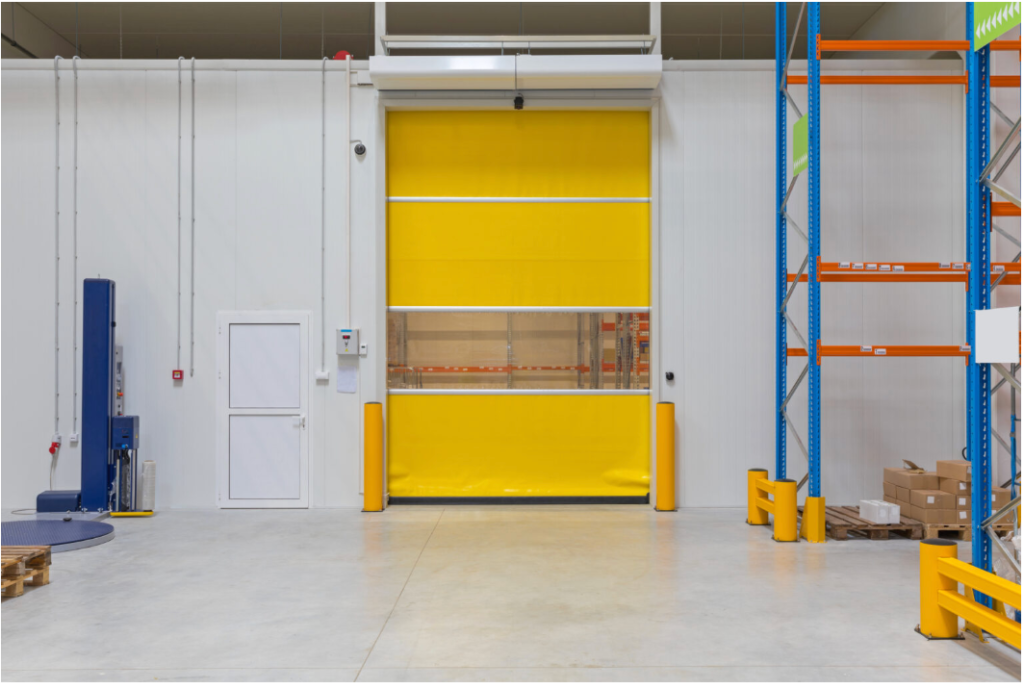
High-speed doors are designed for environments where openings are used frequently and operational efficiency matters. They use specialized motors and lightweight panels or curtains, such as rubber roll-up doors, that allow them to open and close much faster than traditional commercial doors. Businesses often install high-speed doors in areas where traffic moves constantly between spaces and delays can disrupt workflow. They work well in interior openings that separate production areas, climate-controlled zones, or logistics pathways where minimizing air exchange, maintaining temperature, or keeping dust and contaminants contained is important.

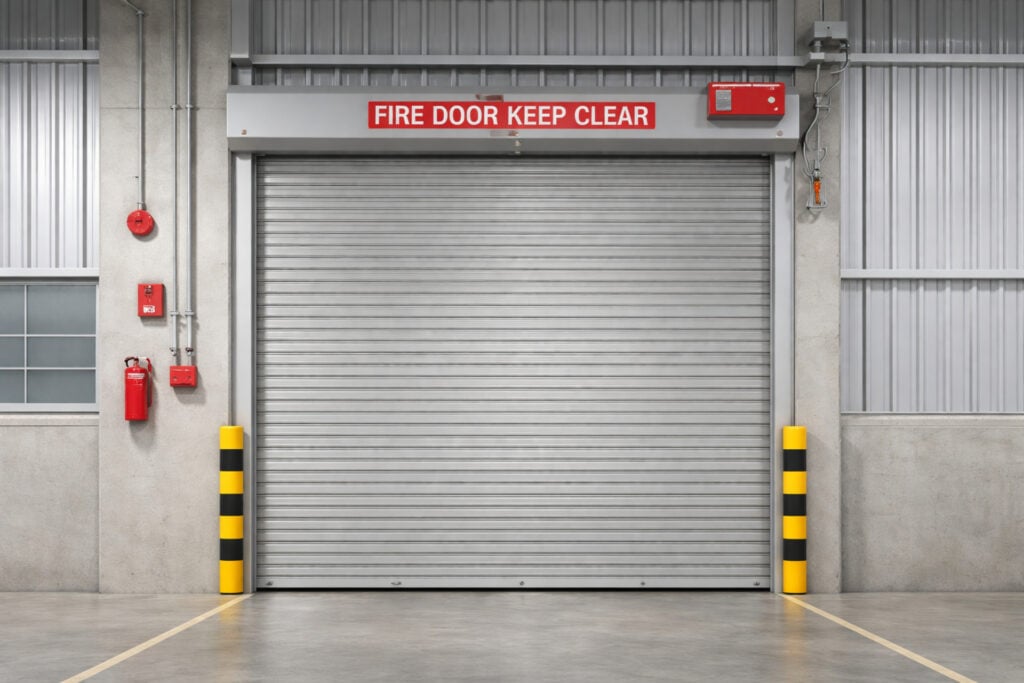
Fire-Rated Rolling Doors

fire rated rolling garage doors

Fire-rated rolling doors are a specialized type of fire door designed to help contain fire and smoke during an emergency. Like other rolling steel doors, they use interlocking steel slats that coil above the opening, but they are built and tested to meet specific fire-resistance ratings. These doors are typically connected to a building’s fire alarm or detection system, so they automatically close when a fire is detected. Businesses install fire-rated rolling doors in openings where building codes require fire separation, such as between storage areas, corridors, mechanical rooms, or different sections of a facility. When activated, the door helps slow the spread of flames and heat, giving occupants more time to evacuate and helping limit damage to other parts of the building.

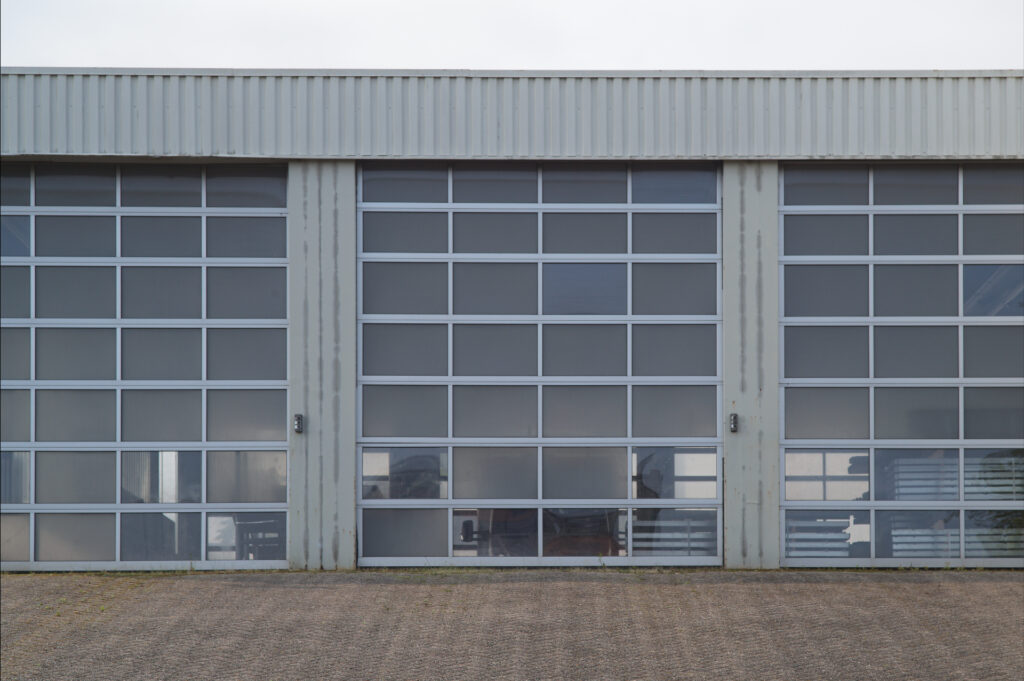
Full-View Aluminum Doors

full view aluminum doors

Full-view aluminum doors, or aluminum glass overhead doors, are designed to provide visibility and natural light while still functioning as a durable commercial overhead door. These doors use aluminum frames with large glass panels, creating a modern appearance that allows people to see through the door when it is closed. Businesses often choose aluminum full-view doors for exterior openings where aesthetic appeal and visual access are as important as functionality, such as entrances that face customers or public spaces. They work well in areas where bringing daylight into a building improves visibility or aesthetics while still allowing the opening to function like a traditional overhead door when vehicles or equipment need to pass through.

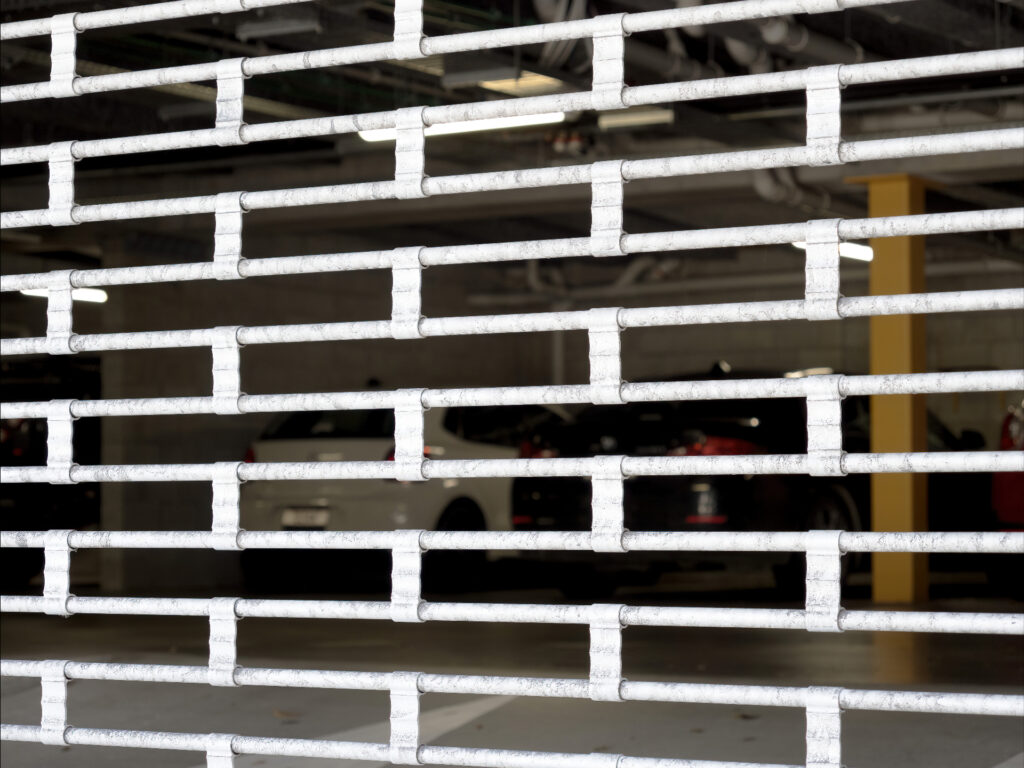
Security Grilles

security grille garage doors

Security grilles are rolling doors made from open metal bars rather than solid panels, allowing visibility and airflow even when the opening is secured. Like other rolling systems, the grille retracts into a coil above the opening when raised, which keeps the overhead area clear. Businesses often install security grilles to protect an entrance or storefront after hours. They work well in openings that face public areas, hallways, or shared commercial spaces where maintaining visibility and ventilation is useful while still providing a physical barrier when the space is closed.

Specialty Commercial Doors

specialty commercial garage doors

Specialty commercial doors are designed for environments that have specific operational or environmental requirements that standard overhead or rolling doors cannot meet. These doors may be engineered for temperature-controlled areas, sanitation-sensitive spaces, corrosion resistance, or unusually large openings, such as airplane hangars. Businesses install specialty high-performance doors in parts of a facility where controlling airflow, maintaining strict cleanliness, protecting equipment, or accommodating oversized vehicles and machinery is essential. Because these doors are built for specialized conditions, their materials, sealing systems, and operating mechanisms are often tailored to the demands of the space they serve.

What Are the Different Types of Commercial Garage Door Materials?

The materials used to construct a commercial garage door play a major role in its durability, appearance, energy efficiency, and long-term performance. Different materials are suited for different environments depending on factors such as exposure to weather, operational demands, and maintenance expectations. Understanding how common commercial door materials compare can help businesses choose a door that performs reliably in the conditions their facility faces.

  • Steel: Steel is the most common material used in commercial garage doors because it offers strong durability and security at a reasonable cost. Most steel doors are constructed from galvanized steel panels or slats, which help resist corrosion, impact, and long-term wear. Many steel commercial garage doors can also be insulated, which improves efficiency, reduces energy costs, and maintains more stable interior temperatures.
  • Aluminum: Aluminum doors are lighter than steel and naturally resistant to corrosion, which makes them useful in environments where moisture or chemicals may be present. They are often used for doors that incorporate glass panels or where a modern architectural appearance is desired.
  • Glass and glazing systems: Glass panels are commonly integrated into commercial garage doors to allow natural light and visibility while the door is closed. These panels are usually mounted within aluminum frames and can be clear, tinted, or insulated depending on the needs of the building.
  • Fiberglass and composite panels: Fiberglass and composite materials are sometimes used in commercial doors where corrosion resistance and reduced weight are priorities. These materials can also allow light to pass through while resisting dents and rust in environments that would otherwise damage traditional steel panels.
  • Specialty materials: Some commercial doors use specialized materials such as stainless steel or high-performance composites when sanitation, corrosion resistance, or extreme durability is required. These materials are typically chosen for environments with strict cleanliness standards or harsh operating conditions.

The Best Types of Commercial Garage Doors by Industry

Different industries place different demands on commercial garage doors depending on how a facility operates. Traffic levels, security needs, environmental control, and the types of vehicles or equipment moving through the opening can all influence which door systems work best. The table below highlights common commercial door types used across a range of industries.

IndustryCommon Commercial Garage Door Types
Airport and freight companiesAirport and freight facilities often use high-speed doors to support constant cargo movement and reduce delays. Heavy-duty sectional overhead doors and rolling steel doors are also commonly installed at large exterior openings where durability and security are important.
Automotive service, repair, and dealershipsAutomotive facilities often rely on sectional overhead doors or aluminum full-view doors in service bays where vehicles move in and out throughout the day. Aluminum full-view doors are also commonly installed in showrooms and customer-facing service areas because they allow natural light and clear visibility while still functioning as commercial overhead doors.
Healthcare facilitiesHealthcare facilities may use high-speed doors in areas where maintaining controlled environments and efficient movement between spaces is important. Insulated sectional doors are also common at service entrances or loading areas that require temperature stability.
Hotels and hospitalityHotels and hospitality properties often use sectional or aluminum full-view doors in maintenance areas, service entrances, or parking structures. These doors help manage vehicle access while maintaining a clean and professional appearance in visible areas of the property.
ManufacturingManufacturing facilities frequently install high-speed doors between production areas to maintain workflow and reduce the movement of dust or contaminants. Rolling steel or sectional overhead doors are commonly used at exterior openings where equipment and materials enter or leave the building.
Office buildingsOffice buildings often use aluminum full-view doors in parking areas or service entrances where visibility and aesthetics are important. Security grilles may also be installed in interior spaces where entrances or storefront-style openings need to be secured after business hours.
Parking garages and parking structuresParking structures often use security grilles or rolling steel doors to control vehicle access and protect entry points when the facility is closed. These open-air designs allow circulation while still providing security when needed.
RestaurantsRestaurants sometimes install aluminum full-view doors in areas that open to patios or outdoor seating spaces to create flexible indoor-outdoor environments. Counter doors are also common at service and drive-thru windows or food pickup counters, where the opening must be secured after operating hours.
Retail storesRetail stores frequently use security grilles to protect storefront openings while still allowing visibility into the store after closing. Counter shutters may also be installed at service counters or kiosks where staff interact with customers through smaller openings.
SchoolsSchools commonly install sectional overhead doors in maintenance areas, storage spaces, or facilities where equipment needs to be moved in and out of the building. Rolling steel doors may also be used in areas that require additional durability and security.
WarehousesWarehouses often use sectional overhead doors or rolling steel doors at loading docks where trucks and shipments move in and out regularly. High-speed doors are also commonly installed inside warehouses where forklifts and workers move frequently between operational zones.
Distribution and logistics centersDistribution and logistics centers typically rely on high-speed metal doors to support continuous traffic and maintain efficient workflow between staging, sorting, and shipping areas. Sectional dock doors and rolling steel doors are also used at exterior loading areas that require security and durability.

Get Expert Help Choosing the Right Commercial Garage Door

Choosing the right commercial garage door involves more than selecting a door that fits the opening. Businesses need to consider how the space is used, how frequently the door will operate, the level of security required, and the environmental conditions the door must handle. By understanding the different types of commercial garage doors, the materials used to construct them, and the factors that affect performance, business owners can make more informed decisions that support reliable operations and long-term durability.

If your business is located in our service area and you need help selecting, installing, repairing, or maintaining commercial garage doors, the team at Commercial Door can help. Our technicians work with a wide range of commercial door systems and can help you identify the best option for your facility. Contact us today to discuss your building’s needs and schedule service for your commercial garage doors.
fire door regulations tulsa

Fire Door Regulations in Tulsa: What Business Owners Need to Know

Commercial buildings in Tulsa, Oklahoma, rely on properly functioning fire doors to contain smoke, limit fire spread, and protect occupants during an emergency. They are part of a larger safety system required by code, and must be installed and maintained correctly to perform as intended.

The City of Tulsa adopts and enforces nationally recognized fire and building codes, including provisions that regulate fire-rated door assemblies. Business owners are responsible for ensuring that required fire doors remain compliant throughout the life of the building. This includes proper installation, annual inspection, and ongoing maintenance.

When fire doors are damaged, altered, or allowed to fall out of adjustment, they may no longer meet code requirements. Violations can lead to correction notices, failed inspections, delays in occupancy approvals, and increased risk exposure. Understanding how fire door regulations in Tulsa apply to your property helps you avoid disruptions and maintain a safer facility.

What Are Commercial Fire Door Requirements in Tulsa?

Fire door regulations in Tulsa are based on the fire and building codes adopted by the City of Tulsa, which reference nationally recognized standards such as the International Fire Code and International Building Code. These codes require fire-resistance-rated door assemblies in specific areas of commercial buildings to compartmentalize fire and smoke and protect exit routes.

A fire door is a complete, tested assembly, not just a heavy door slab. Every component must work together to maintain the rated opening. This includes:

  • The labeled fire-rated door: The door itself must carry a visible and legible fire rating label indicating it has been tested and approved for a specific fire-resistance duration.
  • The labeled frame: The frame must also be fire-rated and properly labeled to match the required rating of the wall and door assembly.
  • Hinges and pivots: Hardware that supports the door must be listed for use on fire-rated assemblies and installed according to manufacturer specifications.
  • Self-closing devices: Fire doors must automatically close and fully latch without manual assistance to prevent the spread of fire and smoke.
  • Positive latching hardware: The door must securely latch when closed to ensure it remains in place during fire conditions.
  • Approved glazing and vision panels: Any glass installed in a fire door must be fire-rated and installed using approved materials and methods.
  • Gasketing and smoke seals where required: Certain assemblies require specific seals to limit the movement of smoke and maintain the integrity of the opening.

In addition to proper installation, annual fire door inspections are required for most commercial buildings in Tulsa. These inspections verify that each assembly closes, latches, and meets clearance and labeling requirements. Inspections must be documented, and records should be maintained for review by the local Authority Having Jurisdiction, typically the fire marshal or building official.

Identified deficiencies must be correctedIf deficiencies are identified, corrective action must be taken, which may includevolve adjustment, hardware replacement, or full door replacement, depending on the severity of the issue. Maintaining accurate records and scheduling annual inspections helps business owners avoid violations and keep their facilities compliant and safe.

Common Fire Door Compliance Issues in Commercial Buildings

common fire door compliance issues tulsa

Many fire door violations in Tulsa are not due to major structural problems. They are often caused by routine wear, improper repairs, or well-intentioned modifications that compromise the fire rating. Because some fire doors are used daily, small issues can develop over time and go unnoticed until an inspection occurs. Some of the most common compliance issues include:

  • Doors propped open: Fire doors must remain closed and latched unless they are connected to an approved automatic hold-open device tied to the fire alarm system. Using wedges, kick-down stops, or other objects to hold a door open defeats its purpose and is a frequent violation.
  • Failed or disconnected closers: If the self-closing device does not fully close and latch,  the door, the assembly does not meet code requirements. Leaking hydraulic fluid, loose mounting screws, or disconnected arms are common problems.
  • Improper hardware replacements: Swapping out fire-rated hardware with non-rated components can void the assembly’s listing, like installing unapproved deadbolts, surface bolts, or additional locking devices can create compliance issues.
  • Unapproved field modifications: Drilling new holes, cutting the door for vision panels, or modifying the frame without proper listing approval can invalidate the fire rating. Even small penetrations from removed hardware can be cited.
  • Excessive clearance gaps: Over time, doors may sag, or frames may shift, creating gaps that exceed allowable limits along the sides, top, or bottom of the door.
  • Missing or painted-over labels: Fire doors and frames must have legible manufacturer labels. If labels are removed, damaged, or covered with paint, inspectors may not be able to verify the rating.
  • Coordinator failures on paired doors: Double fire doors must close in the proper sequence. Missing or malfunctioning coordinators can prevent the doors from latching correctly.
  • Missing or non-compliant astragals: Where required by the listing, astragals must be properly installed on paired doors to maintain the integrity of the opening.
  • Damaged or missing gasketing and smoke seals: Worn, loose, or missing seals can allow smoke to pass through the opening and may result in inspection failures.
  • Improper access control modifications: Electric strikes, magnetic locks, and card reader systems must be listed for use on fire-rated assemblies. Unapproved access control hardware can compromise the rating and create safety concerns.
  • Threshold or floor condition changes: Flooring replacements or added thresholds can alter required clearances and affect door operation.

When Fire Door Repair or Replacement Is Required

When a fire door fails inspection in Tulsa, the next step is determining whether the issue can be corrected through repair or whether full replacement is necessary. The decision depends on whether the fire-rated assembly can still meet its original listing and perform as tested. Some deficiencies are mechanical and can be corrected. Others permanently compromise the rating and require a new assembly.

RepairsReplacement
A failed closer can often be replaced with a properly listed fire-rated closer to restore compliant, self-closing operation.Severely warped, cracked, or delaminated fire doors must be replaced because structural damage can compromise their fire-resistance performance.
Hinges can be adjusted or replaced to correct excessive clearance gaps and restore proper alignment.A frame that is bent, rusted through, or significantly damaged typically requires replacement to maintain the integrity of the rated opening.
Damaged gasketing or smoke seals can be replaced with approved materials to maintain smoke control requirements.A door or frame with missing or illegible fire labels that cannot be verified may need to be replaced to confirm code compliance.
Compliant fire-rated latching hardware can be installed if the existing hardware is non-rated or malfunctioning.Large unapproved field modifications, such as improperly cut vision panels or oversized hardware preparations, often require full door replacement.
Minor surface damage that does not affect the core or structural components of the door may be repaired in accordance with listing requirements.Excessive holes, penetrations, or alterations that cannot be properly repaired under approved methods require replacement of the affected component.

Maintaining label integrity and using listed components is essential in both situations. Whether repairing or replacing a fire door assembly in Tulsa, all corrective work must preserve or restore the door’s tested fire rating. Choosing the correct solution helps prevent repeat violations and supports long-term compliance.

How Fire Door Regulations Affect Different Industries in Tulsa

fire door regulations effects tulsa

Fire door regulations in Tulsa apply across nearly every commercial sector. While the code requirements are based on occupancy classification and building design, different industries tend to encounter specific compliance challenges. Understanding how fire-rated door assemblies function within your type of facility helps reduce violations and operational disruptions.

IndustryThe Effect of Fire Door Regulations
Warehouses and distribution centersLarge facilities often require fire-rated doors to separate warehouse space from office areas, mechanical rooms, and hazardous storage zones. High-cycle use, forklift traffic, and dock operations can damage doors and hardware, making routine inspection critical.
Retail stores and shopping centersRetail properties commonly require fire doors at rear exits, stock rooms, service corridors, and tenant separations. Modifications tied to storefront upgrades or access control systems can create compliance issues if fire ratings are not maintained.
Hospitality and hotelsHotels must maintain fire-rated corridor doors, stairwell doors, and service area doors to protect guest egress paths. Doors that fail to self-close and latch properly are frequently cited during inspections.
Healthcare facilitiesHospitals and clinics often have both fire-rated and smoke-rated door assemblies in patient corridors, treatment areas, and hazardous rooms. Because occupants may have limited mobility, door performance and latching reliability are closely scrutinized.
Office buildingsMulti-tenant office buildings rely on fire-rated stairwell doors, electrical room doors, and occupancy separation doors. Frequent tenant improvements can unintentionally affect fire door compliance if modifications are not reviewed properly.
Manufacturing and industrial plantsFacilities with welding, chemical storage, or high-heat processes often require fire-rated separations between production areas and administrative spaces. Heavy-duty use can accelerate wear on closers, hinges, and latching hardware.
Government and municipal facilitiesPublic buildings must maintain strict compliance standards and documentation. Fire-rated doors are typically required in stairwells, records rooms, detention areas, and utility spaces.
Car dealerships and service centersService bays, paint areas, and parts storage may require fire-rated separations from customer-facing areas. Large openings and specialty hardware must still meet fire door listing requirements where applicable.
Restaurants and food service facilitiesKitchens often require fire-rated doors separating cooking areas from dining spaces, storage, and exits. Grease buildup, impact traffic, and frequent use can affect door operation over time.
Schools, colleges, and universitiesEducational facilities rely on fire-rated corridor doors, stairwell doors, and mechanical room doors to protect students and staff. High daily traffic increases the likelihood of hardware wear and improper door adjustments.
Airports and freight companiesAviation and freight facilities may require rated separations between operational areas, storage zones, and administrative offices. Security integrations and specialized hardware must remain compliant with fire door listing standards.

Protect Your Business With Compliant Fire Doors in Tulsa

Maintaining compliance with fire door regulations in Tulsa requires more than initial installation. Fire-rated assemblies must be inspected annually, properly documented, and serviced using approved components that preserve the door’s tested rating. Even minor hardware changes or building modifications can void a listing and create violations if not handled correctly. Working with experienced commercial door professionals helps ensure repairs, adjustments, and upgrades are completed in accordance with code requirements.

Scheduling regular inspections, correcting deficiencies promptly, and preventing unauthorized modifications reduces the risk of failed inspections, delayed approvals, and increased liability exposure. If you are unsure whether your fire doors meet current requirements, now is the time to act. Contact Commercial Door to schedule a free estimate and fire door evaluation in Tulsa.

fire door regulations oklahoma city

Fire Door Regulations in Oklahoma City: All You Need to Know

Fire door regulations in Oklahoma City exist to protect occupants, slow the spread of fire and smoke, and preserve safe exit routes in commercial buildings. For property owners and facility managers, compliance is required and enforced by the City of Oklahoma City. Businesses that fail to maintain compliant fire door assemblies can face violations, corrective notices, or delays in occupancy approvals.

Understanding how these regulations apply helps prevent disruptions and reduce liability exposure. This guide explains how fire door requirements are enforced in Oklahoma City, what inspectors evaluate, and how business owners can maintain compliance.

Fire Door Requirements in Oklahoma City

Fire doors are classified as fire-resistance-rated opening protectives under the city’s adopted fire code, which is based on the International Fire Code with local amendments. In Oklahoma City, fire doors must function as complete fire-resistance-rated assemblies, meaning the door, frame, hardware, glazing, seals, and closing components must work together to maintain the assembly’s tested fire rating. Fire door assemblies are expected to meet the following requirements:

  • Fire rating and visible labeling: Each fire-rated door and frame must display a legible manufacturer label showing the fire-resistance rating, and that label must remain permanently attached and unobstructed.
  • Proper installation in rated wall assemblies: Fire doors must be installed within required fire-resistance-rated wall systems and assembled according to their tested configuration.
  • Self-closing and positive latching: Doors must close fully and latch securely without manual assistance to ensure the opening remains protected during a fire event.
  • Approved fire-rated hardware: Hinges, closers, panic devices, locks, glazing materials, coordinators, and related components must be listed and compatible with fire-rated assemblies.
  • Acceptable clearance gaps: The space around the perimeter and bottom of the door must not allow smoke and flames to pass through the opening.
  • Intact seals and gasketing: Required intumescent strips and smoke seals must be properly installed and free from damage.
  • Proper coordination of paired doors: Double-door assemblies must close in the correct sequence, and both leaves must latch fully.
  • Code-compliant hold-open devices: Magnetic or automatic hold-open devices, when permitted, must release properly upon fire alarm activation.
  • Automatic operator compatibility: Automatic door operators must not interfere with the door’s ability to close and latch during a fire condition.
  • No unauthorized field modifications: Fire doors may not be drilled, cut, or altered in ways that invalidate their fire rating.
  • Structural integrity of the assembly: The door and frame must remain free of holes, excessive damage, warping, or deterioration that affects performance.
  • Unobstructed operation and required signage: Fire doors must not be wedged, chained, or blocked, and any required signage, such as “Fire Door – Keep Closed,” must be present and visible.

How Fire Door Inspections Work in Oklahoma City

fire door inspections oklahoma city

Fire codes commonly call for annual inspection of fire-resistance-rated door assemblies, and documentation of any deficiencies and repairs should be maintained.

During inspections, personnel from the Oklahoma City Fire Department’s Fire Prevention and Code Compliance division evaluate whether fire door assemblies function properly and maintain their fire-resistance rating.

Rather than reviewing the door in isolation, inspectors perform operational testing to confirm the door closes and latches properly, visually examine labels and hardware for compliance, and assess whether any alterations or damage are present. They may also observe exit pathway conditions and verify that hold-open devices or automatic operators function correctly. In addition to the physical condition of the door, inspectors may request documentation showing that required inspections, maintenance, and prior corrective actions have been completed.

The Most Common Fire Door Violations Found in Oklahoma City Businesses

Even properly installed fire doors can fall out of compliance due to daily use, tenant improvements, or deferred maintenance. In Oklahoma City, many violations stem from routine changes that unintentionally compromise a fire-rated assembly. Common fire door violations include:

  • Propped-open doors: Using wedges, stops, or other devices to hold a fire door open prevents it from closing during an emergency.
  • Unauthorized alterations or non-rated replacements: Installing non-rated hardware, modifying vision panels, drilling new holes, or painting over fire labels can invalidate the door’s rating.
  • Failure to close or latch properly: Misalignment, worn hardware, or improper door coordination can prevent the door from securing the opening as required.
  • Compromised seals or excessive gaps: Damaged gasketing, missing intumescent strips, or clearance gaps beyond allowable limits reduce fire and smoke resistance.
  • Blocked or obstructed egress: Storage items or equipment placed near fire doors can interfere with required exit pathways.
  • Missing inspection documentation: Failure to maintain inspection and maintenance records can delay compliance resolution when deficiencies are identified.

Most of these issues are preventable with routine checks and timely maintenance. Addressing minor deficiencies early reduces the likelihood of corrective notices and reinspection requirements.

What Happens If Your Fire Doors Fail an Oklahoma City Inspection?

failed fire door inspection oklahoma city

If a fire door does not meet code requirements during an inspection, the Oklahoma City Fire Marshal’s Office may issue a notice of deficiency outlining the specific violations that must be corrected.

In most cases, the property owner or responsible party will be given a deadline to correct the identified issues. Once repairs are completed, follow-up verification or reinspection may be required to confirm compliance. Failure to address deficiencies within the required timeframe can lead to additional enforcement actions, including further inspections, citations, or other code-permitted penalties.

Beyond enforcement consequences, unresolved fire door deficiencies can affect occupancy approvals, insurance risk assessments, and overall liability exposure. Addressing violations promptly not only helps avoid delays and added costs but also ensures the building’s fire protection systems function as intended during an emergency.

Rolling Fire Doors and Industrial Facilities in Oklahoma City

In warehouses, distribution centers, manufacturing facilities, and other large commercial buildings in Oklahoma City, rolling fire doors are commonly used to protect wide openings between fire-resistance-rated areas. Unlike swinging fire doors, these assemblies are typically designed to remain open during normal operations and close automatically when activated by heat detection or the building’s fire protection system.

Rolling fire doors have additional compliance considerations due to their mechanical design. Inspectors may evaluate guides, tracks, counterbalance systems, and release mechanisms to confirm the door can deploy properly during a fire. Fusible links or automatic release devices must remain intact and unobstructed, and the door must close fully without interference.

Referenced fire protection standards typically require periodic operational testing, including drop testing, along with documentation of maintenance activities. Industrial and large commercial property owners should ensure these systems are routinely serviced and documented to remain prepared for inspection and capable of performing as intended.

How to Stay Ahead of Fire Door Violations in Oklahoma City

Maintaining compliance with fire door regulations in Oklahoma City requires consistent attention rather than reactive repairs after an inspection. Treating fire doors as part of your routine facility management process helps reduce violations and avoid reinspection delays.

  • Conduct routine operational checks: Perform regular walkthroughs to confirm each fire door closes fully and latches securely without obstruction.
  • Prevent doors from being propped open: Ensure fire doors are never wedged, chained, or held open in ways that interfere with proper operation.
  • Inspect for visible damage or alterations: Look for missing labels, damaged seals, excessive gaps, or hardware changes that could compromise the fire rating.
  • Control hardware modifications during maintenance: Avoid replacing closers, locks, or other components with non-rated hardware during repairs or tenant improvements.
  • Schedule professional fire door inspections: Arrange periodic evaluations by qualified professionals familiar with fire-rated assemblies.
  • Address deficiencies promptly: Correct any identified issues quickly to prevent escalation during future inspections.
  • Maintain organized documentation: Keep inspection reports and repair records accessible in case they are requested during a compliance review.
  • Plan service for rolling fire doors: Ensure industrial and rolling assemblies receive routine maintenance and operational testing.

Fire Door Installation, Inspection, and Repair Services in Oklahoma City

Fire door compliance depends on proper installation, accurate inspection, and code-compliant repairs. Even minor hardware changes, clearance issues, or undocumented modifications can lead to deficiencies during an inspection.

Commercial Door provides fire door installation, inspection, repair, and maintenance services throughout Oklahoma City and the surrounding areas. Our team works with property owners and facility managers to identify deficiencies, replace non-compliant components, and restore fire-rated door assemblies to proper working condition.

If your facility needs professional evaluation or corrective repairs, contact us for a free estimate. We can help ensure your fire doors meet applicable code requirements and are prepared for inspection.

automatic door certification guide

A Business Owner’s Guide to Automatic Door Certifications

Automatic doors are a standard feature in many commercial buildings. They help manage foot traffic, improve accessibility, and create a smoother experience for customers and employees. Because these doors operate automatically in public spaces, they also carry clear safety and performance responsibilities.

Automatic door certification exists to help ensure those responsibilities are met. Certification focuses on the training and qualifications of the professionals who install, inspect, and maintain automatic doors. For business owners, this is not about technical theory. It is about making sure doors function safely, reliably, and predictably in everyday use.

In this guide, we explain what automatic door certification is, the role of AADM certification, how safety standards and inspections apply to automatic doors, and why ongoing maintenance matters for long-term performance and risk management.

Automatic Door Standards vs. Certification

One of the most common points of confusion is the difference between automatic door standards and automatic door certification. These terms are related, but they do not mean the same thing.

Automatic doors themselves are not certified. Instead, they must operate in compliance with established performance and safety standards, which are typically adopted and enforced by local building or safety jurisdictions. These standards define how doors are expected to function, including movement speed, sensing requirements, force limitations, and activation behavior. Compliance means that, at the time of inspection, the door operates within those accepted parameters.

Certification, by contrast, applies to the technicians performing installation, inspection, and maintenance work. It reflects training and demonstrated knowledge of industry standards rather than approval of a specific door.

What Is Automatic Door Certification?

Automatic door certification refers to the credentials held by professionals who install, service, inspect, and maintain automatic pedestrian doors in commercial buildings. These certifications confirm that a technician has completed recognized training and demonstrated knowledge of system operation, evaluation procedures, and applicable standards.

One of the most widely recognized credentials in the industry is certification from the American Association of Automatic Door Manufacturers (AAADM). AAADM certification indicates that a technician has completed approved training through AAADM certification programs and passed formal testing related to automatic door systems. At a practical level, automatic door certification focuses on three core areas:

  • Installation standards: Proper installation of automatic door systems, including mounting, wiring, and setup in accordance with manufacturer and industry requirements.
  • Inspection and testing procedures: Evaluation of door performance to confirm activation zones, safety features, opening and closing speeds, and force settings operate within accepted parameters.
  • Adjustment and ongoing service knowledge: Correct adjustment of controls and components, along with the ability to identify conditions that require service, repair, or further evaluation.

AAADM Certification Explained

Certification from the AAADM is widely recognized across the automatic door industry as a benchmark for technician qualification. AAADM certification indicates that a technician has completed approved training through AAADM certification programs, which may include a factory training course provided by automatic door manufacturers, and passed formal testing related to automatic door systems.

This credential signifies demonstrated knowledge of industry standards, system operation requirements, and proper evaluation procedures for commercial automatic doors. AAADM does not certify individual doors or facilities. Instead, certification applies to the professionals performing installation, inspection, and service work.

Businesses that work with AAADM-certified technicians, including automatic door inspectors, are engaging professionals whose training aligns with nationally recognized guidelines. Many service providers are also AAADM members, reflecting ongoing participation in certification programs and access to current industry training resources.

Why Automatic Door Certification Matters for Businesses

Automatic doors interact with customers, employees, and delivery personnel every day. When they are not installed or maintained correctly, they can create safety risks, disrupt operations, and increase liability for business owners. Automatic door certification helps reduce these risks by ensuring doors are serviced according to recognized safety standards.

Certified door technicians know how to identify issues that may not be obvious, such as improper sensor placement, incorrect closing force, or delayed response times. These issues can lead to doors closing too quickly, failing to detect pedestrians, or stopping unexpectedly, all of which can create hazards in high-traffic areas.

From a business perspective, automatic door certification also supports long-term reliability. Regular inspections and properly trained service help extend the life of automatic doors, reduce emergency repairs, and minimize downtime. For many businesses, certification is less about compliance paperwork and more about keeping entrances safe, functional, and dependable.

Automatic Door Safety Standards and Inspections

automatic door safety standards

Automatic door safety standards define how doors are expected to operate under normal conditions. These standards guide door movement, activation behavior, sensing requirements, and response timing. Inspections use these standards as a reference point to evaluate current door performance.

During an inspection, a technician evaluates how the door functions at that moment in time. This assessment includes checking sensor coverage, activation zones, opening and closing speeds, and the amount of force used during operation. The purpose of the inspection is to determine whether the door is operating within accepted parameters or if corrective action is needed.

Inspections provide a snapshot of door performance and help identify conditions that require adjustment, repair, or follow-up service.

Ongoing Maintenance and Recertification Considerations

Ongoing maintenance focuses on preserving automatic door performance after inspections are completed. As doors are used daily, components experience normal wear and settings can change, making periodic service necessary to keep systems operating as intended.

Maintenance activities may include adjusting controls, servicing mechanical components, updating operators, and addressing conditions identified during prior evaluations. Unlike inspections, which assess performance, maintenance involves taking action to correct or prevent issues.

For business owners, documented maintenance and service records provide continuity over time. This record of care supports consistent door operation, helps avoid unexpected interruptions, and extends the useful life of automatic door systems.

What Business Owners Should Look for in an Automatic Door Service Provider

Choosing the right automatic door service provider affects how well doors are installed, evaluated, and maintained over time. Not all providers offer the same level of qualification or experience, making it important to understand what criteria matter when selecting a contractor.

Certified Technicians and AAADM Inspector Certification

Work with a provider whose technicians hold recognized credentials, including AADM certification, and AAADM-certified inspectors have additional training related to formal evaluation and inspection procedures.

Commercial Automatic Door Experience

Select a provider with experience working on automatic doors in commercial facilities, where usage demands, access requirements, and operating conditions differ from residential applications.

Inspection and Service Documentation

Choose a provider that supplies clear records of inspections, evaluations, and completed service work to support consistency and accountability over time.

Ongoing Maintenance Capabilities

Look for a provider that offers scheduled maintenance and follow-up service rather than relying solely on one-time repairs.

Clear Communication

A reliable provider communicates findings and recommendations clearly, helping business owners understand service needs without unnecessary complexity.
How Commercial Door Supports Safe, Certified Automatic Door Systems

Commercial Door helps business owners manage the safety, performance, and long-term reliability of their automatic doors. Our team consists of certified service technicians who understand automatic door certification requirements, inspections, and ongoing maintenance standards for commercial environments.

We provide professional evaluations, routine service, and corrective repairs to help keep automatic doors operating safely and consistently. Our approach focuses on identifying potential issues early, minimizing downtime, and helping businesses reduce risk through proper care and documentation.

Business owners in Dallas-Fort Worth, Norman, Oklahoma City, Tulsa, Western Arkansas, Little Rock, and Nashville can schedule a free estimate to have their automatic doors evaluated by experienced professionals. Whether you need an inspection, maintenance plan, or service support, Commercial Door is here to help keep your entrances safe and dependable.

nashville fire door regulation

A Business Owner’s Guide to Nashville Fire Door Regulations

Fire doors are a vital part of any commercial building safety system. When installed and maintained correctly, they help contain fire and smoke, giving occupants more time for safe evacuation. For business owners in Nashville, compliance with fire door regulations is not just a safety measure. It’s a legal requirement that directly impacts liability and maintaining building occupancy approval.

Nashville fire door regulations are based on a combination of national standards and local enforcement. Business owners must comply with the National Fire Protection Association (NFPA 80 and NFPA 101), the International Building Code (IBC), and rules enforced by both the Nashville Fire Marshal’s Office and the Metro Codes Department.

This guide explains how to keep your facility compliant from installation to inspection and ongoing maintenance, ensuring your fire doors meet every safety and code requirement in the Nashville area.

Fire Door Codes and Standards in Nashville

Fire door compliance in Nashville is based on a combination of national fire safety standards and local codes. Together, these regulations ensure that every door assembly performs as intended during a fire. Understanding which codes apply to your building is the first step toward meeting safety and legal requirements and helping your business stay compliant with inspection and enforcement processes.

NFPA 80: Standard for Fire Doors and Other Opening Protectives

The NFPA 80 standard outlines how fire doors must be installed, tested, and maintained. It ensures that doors close properly, latch securely, and preserve their fire rating requirements over time. Any installation, repair, or modification must follow these NFPA standards to remain compliant.

NFPA 101: Life Safety Code

NFPA 101 focuses on protecting building occupants by regulating exit routes, fire barriers, and door assemblies. It works in conjunction with NFPA 80 to ensure fire doors provide both structural protection and safe egress during an emergency, meeting the broader goals of national fire safety standards.

NFPA 1: Fire Code

Nashville follows the 2018 NFPA 1 Fire Code, which addresses ongoing fire prevention measures such as inspection, maintenance, and use of fire-rated assemblies. This code gives the Nashville Fire Marshal’s Office authority to review facilities and enforce compliance, ensuring buildings meet consistent fire safety standards across the city.

International Building Code (IBC)

The International Building Code (IBC) governs the construction and design of commercial buildings, including where fire-rated doors are required. Tennessee has adopted the 2021 IBC with state-specific amendments, which Metro Nashville enforces through its local codes and permitting process.

Metro Nashville Fire Prevention Code and Local Amendments

Metro Nashville adapts national standards to meet local needs through Chapter 10.64 of the Metro Code of Ordinances. These amendments guide local permitting, plan review, and enforcement. The Metro Codes Department and Nashville Fire Marshal’s Office oversee these regulations to ensure every commercial property meets the required fire rating requirements for doors and other protective assemblies.

Fire Door Installation, Labeling, and Modifications

Proper installation and labeling are the foundation of fire door compliance and are essential for passing inspection and maintaining life safety standards. Even the most durable door will fail to perform if it’s installed incorrectly or altered in a way that voids its fire rating. Many violations in Nashville begin at this stage, when labels are missing, door hardware is replaced with non-rated parts, or modifications are made without approval. 

Fire Door Labeling Requirements

Every fire-rated door, frame, and piece of hardware must include a visible label showing its fire rating and manufacturer. These are a critical component of compliance, confirming that fire doors perform as tested under real fire conditions and indicate how long the assembly can withstand fire exposure for a specified period, typically between 20 and 180 minutes. If the door includes a vision panel, the glazing material must also be labeled and rated to the same standard. Removing, painting over, or covering a label can void its certification and lead to a failed inspection. Labels must remain legible and match the door’s listed rating in the building’s approved plans.

Approved Installation Methods

Under NFPA 80 and the International Building Code, fire doors must be installed exactly as tested and certified. That includes proper frame anchoring, automatic closing devices, listed door hardware, and code-compliant fire door clearances. Substituting non-rated components or altering how the door operates can compromise its fire resistance. For example, swinging doors in corridors or stairwells must close automatically without obstruction. In new construction or major renovations, the Metro Codes Department may require inspection or approval during installation to verify compliance.

Modifications and Repairs

Once installed, a fire-rated door cannot be cut, drilled, or altered without following strict guidelines. Any modification, such as adding a window, replacing hardware, or changing the door’s swing, must be completed using components that maintain the door’s original fire rating. This applies not only to existing doors, but also to other assemblies like sliding doors and rolling steel doors, which have their own testing and performance standards.

If a door or frame needs to be modified, the work must comply with NFPA 80 and the manufacturer’s specifications. Using listed components and keeping documentation of any changes helps preserve the door’s rating. In some cases, the Metro Codes Department may also require a permit or inspection before or after the modification. Properly executed repairs and documented changes not only protect your investment but also prevent costly compliance issues during the annual inspection process.

Annual Inspections, Documentation, and Common Violations

annual fire door inspection documentation

Fire door inspections are where most compliance issues are identified. In Nashville, these inspections are required under NFPA 80 and enforced by the Nashville Fire Marshal’s Office and Metro Codes Department. Inspectors conduct inspections to verify that doors close properly, latch securely, and retain their fire rating. These regular inspections are essential for keeping your facility compliant and ensuring that doors will perform as intended in an emergency.

Annual Inspection Requirements

Each fire door assembly must be inspected and tested at least once a year by qualified personnel familiar with fire door systems and local code requirements. NFPA 80 requires that all fire doors be inspected to ensure proper operation, adequate seals, and smooth latching. During these inspections, technicians confirm that doors operate correctly, clearances are within code, hardware functions properly, and gaskets are intact. Any deficiencies found during testing must be documented and corrected promptly to restore compliance.

Documentation and Recordkeeping

Inspection results must be recorded and kept on file for review by the Fire Marshal’s Office or Metro Codes Department. Proper record keeping ensures proof of compliance during audits or occupancy renewals. Inspection logs should include the date, inspector’s name, door condition, and any corrective actions taken. Maintaining detailed records of all inspections and repairs, including photos and signed reports, demonstrates due diligence. Each inspection should also include functional testing — verifying that self-closing devices and latches operate as intended to maintain fire protection.

Common Violations Found During Inspections

Nashville inspectors frequently encounter violations ranging from simple maintenance oversights to major safety hazards. Common issues include:

  • Doors that fail to close or latch properly due to misalignment, worn hinges, or damaged closers
  • Propped-open doors using wedges, cords, or magnets without automatic release mechanisms
  • Painted-over or missing fire labels that make ratings unreadable or unverifiable
  • Unauthorized field modifications such as cutouts, drilled holes, or added hardware
  • Unlisted or mismatched hardware, including non-rated hinges, locks, or vision panels
  • Damaged seals, gasketing, or intumescent strips that compromise smoke containment
  • Improper clearance requirements around the frame or meeting edges that exceed NFPA 80 limits
  • Obstructions blocking egress doors or exit routes, such as storage items or furniture
  • Warped, cracked, or deteriorated door cores that prevent full closure
  • Missing self-closing devices or closers that have been removed or disabled
  • Loose, broken, or painted-over hardware that affects operation
  • Missing documentation from prior inspections or repairs

Failing to correct these issues can lead to non-compliance with Nashville fire code and result in serious consequences, such as fines, delayed occupancy approvals, or increased liability during a fire event. Correcting violations promptly ensures every fire door functions as intended to protect lives and property.

Routine Maintenance and Preventive Care for Fire Door Compliance

Regular proactive maintenance keeps fire doors functional and compliant between annual inspections. Nashville building owners and facility managers are responsible for ensuring that doors remain properly maintained, close and latch correctly, and that hardware operates smoothly. The ongoing maintenance of fire doors includes keeping seals intact and ensuring that doors are not blocked open, painted over, or altered without approval. Frequent checks, such as simple visual walkthroughs each month, helps identify problems early, such as damaged gaskets, missing labels, or loose closers, before they lead to violations.

Professional servicing at least once a year helps verify that every fire-rated assembly meets its original rating and operates within NFPA 80 standards. Technicians can replace worn parts with listed components, confirm proper clearances, and provide documentation for inspection records. Consistent maintenance not only ensures compliance with Metro Nashville fire codes but also plays a critical role in preventing fire from spreading, protecting lives and property by keeping fire doors ready to perform when an emergency occurs.

What Should I Do If My Fire Door Fails Inspection?

what if fire door fails inspection

Failing a fire door inspection doesn’t automatically mean your building is unsafe, but it does require prompt action. The issues cited are often small, like worn seals, missing labels, or misaligned latches, but if left unresolved, they can lead to property damage, fines, or delayed occupancy approvals. Taking action quickly is essential for minimizing damage, restoring compliance, and allowing occupants to evacuate safely in the event of a fire. Follow these steps to correct deficiencies and restore compliance:

  1. Read the deficiency report: Identify each failed item by door location and issue code. Note deadlines given by the inspector or Fire Marshal.
  2. Secure life safety immediately: If a door will not close or latch, remove wedges or magnets, clear obstructions, and post temporary monitoring if required by your safety plan.
  3. Tag and take the door out of service if needed: Use a visible tag to mark the door as noncompliant. Keep it closed except for egress until repairs are complete.
  4. Document the condition: Take photos of labels, gaps, and damage. Save the inspection report and list each deficiency in your maintenance log.
  5. Verify the door’s rating and components: Confirm that the door, frame, and hardware match the required fire rating and are approved for use together.
  6. Plan code-compliant repairs: Select listed replacement parts or manufacturer-approved methods. Never drill or cut without verifying that the repair maintains the door’s rating.
  7. Check permit or inspection needs: For certain repairs or modifications, contact the Metro Codes Department to confirm if a permit or reinspection is required.
  8. Complete repairs by a qualified person: Have a technician trained in NFPA 80 make the necessary repairs.
  9. Re-test the door assembly: Test each repaired door to confirm it closes, latches, and seals properly.
  10. Update records: Document the repair date, who performed the work, and what was done. Keep photos and updated inspection reports for your next review.
  11. Request reinspection if required: If the fire marshal requested verification, submit your documentation and schedule a follow-up inspection.
  12. Prevent future failures: Add the repaired door to your maintenance checklist, and train staff to avoid propping open or obstructing fire-rated assemblies.

How Professional Fire Door Assembly Installation Ensures Compliance

Fire door systems are highly regulated, and keeping them compliant requires both technical knowledge and familiarity with local enforcement. Experienced professionals understand how to interpret NFPA 80, apply Metro Nashville Fire Code requirements, and document every detail of an inspection or repair. These experts play a crucial role in maintaining building safety by ensuring that each door operates correctly and meets performance standards. For specialized environments such as healthcare facilities, where patient safety and fire containment are critical, professional fire door management is especially important.

Professional service includes proper installation, certified annual inspections, code-compliant repairs, and thorough recordkeeping. Technicians verify that each assembly meets its original fire rating, uses listed hardware, and delivers reliable fire door performance during real fire conditions. Many providers also coordinate with related life-safety components such as fire dampers, ensuring that doors, walls, and ventilation systems work together to contain smoke and heat effectively.

If you’re a Nashville business owner who needs help with fire door installation, inspection, or repair, contact Commercial Door for a free estimate that meets every NFPA and Metro Nashville requirement. Our technicians specialize in keeping commercial facilities safe, functional, and compliant across Middle Tennessee.

fire door regulations little rock

A Guide to Commercial Fire Door Regulations in Little Rock

Fire doors are more than a building feature. They are life safety systems designed to slow the spread of fire, protect occupants, and safeguard property during an emergency. In Little Rock, Arkansas, businesses must follow both national fire safety standards and local codes enforced by the Little Rock Fire Marshal’s Office.

Building owners are responsible for ensuring fire doors are installed correctly, inspected regularly, and maintained to code. This guide gives a clear overview of the regulations that apply in Little Rock, the most common compliance issues, and how professional services can help your facility remain safe and compliant.

What Are the Current Fire Door Regulations in Little Rock?

In Little Rock, commercial fire doors are regulated under the 2021 International Fire Code (IFC), which the State of Arkansas has adopted with local amendments. These requirements also incorporate standards from the National Fire Protection Association (NFPA) 80, the national guideline for fire doors and other opening protections. Together, they outline how fire doors must be constructed, labeled, installed, and maintained to provide effective protection during a fire.

Local enforcement is handled by the Little Rock Fire Marshal’s Office, which reviews buildings for compliance with fire ratings, labeling, approved hardware, and egress clearance according to local fire prevention codes. Businesses that fail to meet these standards may face violations, fines, or delays in occupancy approval. Key requirements for fire doors in Little Rock include:

  • Fire rating and labeling: Every fire door must display a visible, approved label showing its fire-resistance rating.
  • Proper installation: Frames, hinges, and other components must be installed in accordance with code and manufacturer specifications.
  • Automatic closing and latching: Fire doors must close on their own and latch securely with listed hardware.
  • Unobstructed access: Fire doors must remain free of obstructions and cannot be chained, blocked, or propped open.
  • Compatible hardware: Panic bars, locks, and other parts must be fire-rated and approved for use with the specific fire door.
  • Seals and gaskets: Seals and intumescent strips (materials that expand in high heat to close gaps) must be intact so the door can block the passage of smoke and flames.
  • Clearance gaps: The space between the door and frame must not exceed the limits set by NFPA 80.
  • Glazing and vision panels: Any glass or vision panel in a fire door must be fire-rated and labeled for that application.
  • Field modifications: Drilling holes, cutting vision panels, or altering a fire door without the manufacturer’s approval is prohibited.
  • Annual inspection: Every fire door must be inspected at least once per year, and written records of those inspections must be available for review by the fire marshal.

Fire Door Inspection and Maintenance Responsibilities in Little Rock

fire door inspection maintenance little rock

Building owners and property managers in Little Rock are responsible for keeping fire doors in safe working condition. Under NFPA 80, every fire door assembly must be inspected at least once a year by a qualified professional, and records of these inspections must be kept on file. NFPA 80 defines a “qualified person” as someone with the training, knowledge, or experience to evaluate fire door assemblies. 

Little Rock does not require inspectors to hold a specific certification. Still, many businesses choose inspectors with nationally recognized credentials, such as Intertek’s IQP or the Door and Hardware Institute’s FDAI training, to help ensure inspection reports are accepted without issue. The Little Rock Fire Marshal’s Office may review this documentation during routine compliance checks to confirm that all required testing and maintenance have been completed.

Day-to-day maintenance is just as important as scheduled inspections. Fire doors should be checked regularly to confirm they close and latch properly, that no obstructions block the exit path, and that hardware and frames have not been altered. Seals and gaskets should also be inspected for wear, since gaps can reduce protection against smoke and flames.

Standards for Fire Door Hardware, Exit Signs, and Emergency Lighting in Little Rock

A fire door is only as effective as the components that support it. Inspectors in Little Rock review every part of the system to confirm compliance with NFPA 80 and the IFC. Hardware, exit signs, and emergency lighting must all meet code to keep occupants safe during an emergency.

Fire Door Hardware

Every piece of fire safety hardware attached to a fire-rated door must also be UL-listed and fire-rated, and properly installed. If any non-compliant part is used, the entire assembly may fail inspection. Key types of fire door hardware include:

  • Hinges and pivots
  • Locks and latches
  • Door closers
  • Panic and exit hardware
  • Flush bolts and astragals
  • Glazing and vision panels
  • Electrified hardware
  • Seals and gaskets
  • Kick plates and protective plates

Exit Signs and Emergency Lighting

Exit signs and emergency lighting must be installed in all areas where people need to safely leave a building, including hallways, stairwells, doors, and large open spaces.

  • Exit signs must remain illuminated at all times, even during a power outage, so occupants can quickly locate the nearest exit.
  • Emergency lighting must activate automatically if power fails, using backup batteries or generators to keep exit paths visible.

Common issues include burned-out bulbs, blocked signage, disconnected wiring, or dead batteries, all of which can cause violations during inspections. Regular testing and maintenance are critical to ensure both systems remain reliable, code-compliant, and ready in an emergency.

Rolling Fire Doors Regulations in Little Rock

Some commercial buildings in Little Rock use rolling fire doors, particularly in warehouses, industrial facilities, and areas where a standard swinging fire door is not practical. These doors are designed to stay open during normal operations and automatically drop when a fire is detected, helping isolate fire and smoke and protect adjacent spaces. Rolling fire doors must comply with NFPA 80 just like swinging fire doors, but they have a few additional requirements:

  • Automatic release: Rolling fire doors are equipped with heat-activated devices, such as fusible links or electronic releases, that trigger the door to close during a fire.
  • Annual drop test: NFPA 80 requires rolling fire doors to be tested at least once per year to confirm they close fully and at a safe, controlled speed. This test must be documented and available for review by the Little Rock Fire Marshal’s Office.
  • Reset and inspection: After a drop test or fire activation, the door must be reset and re-inspected to confirm it is operating correctly.
  • Maintenance of guides and tracks: The guides, tracks, and counterbalance systems must remain clean, aligned, and free of damage to ensure the door can drop properly when activated.

Because rolling fire doors use specialized mechanisms to stay open and release in an emergency, businesses often rely on trained technicians to perform testing, resetting, and repairs. Regular maintenance ensures these systems function correctly when needed, keeping the building compliant and protected.

Common Fire Door Compliance Issues in Little Rock Businesses

Even when fire doors are installed correctly, ongoing use and poor maintenance can create serious problems. Fire marshals in Little Rock can cite businesses for non-compliance issues that keep doors from operating as intended. These violations are not only code failures but also reduce the ability of fire doors to contain smoke and flames during an emergency. Common problems include:

  • Propped-open doors: Using wedges, straps, or equipment to hold a door open prevents it from closing in a fire.
  • Blocked egress routes: Storing carts, boxes, or supplies in front of fire doors restricts the clearance needed for safe exit.
  • Missing or damaged labels: Fire doors without clear, legible rating labels are not compliant.
  • Non-compliant hardware: Installing locks, closers, or panic devices that are not fire-rated fails code requirements.
  • Disabled self-closing devices: Disconnecting or removing door closers is a violation that compromises safety.
  • Damaged frames or hinges: Loose, bent, or cracked frames and hinges prevent doors from closing and latching securely.
  • Worn or missing seals and gaskets: Gaps around the door allow smoke or flames to pass through, weakening protection.
  • Improper field modifications: Adding holes, vision panels, or other alterations without manufacturer approval invalidates compliance.
  • Painted-over labels or hardware: Covering rated components or labels with paint makes them unreadable and non-compliant.
  • Combustible storage nearby: Keeping flammable materials too close to a fire-rated door can result in citations.
  • Lack of inspection records: Businesses must maintain written documentation of annual inspections for review by the fire marshal.

Penalties and Consequences for Fire Door Non-Compliance in Little Rock

little rock fire door penalties

Businesses in Little Rock that fail to maintain fire doors and related safety systems face more than citations. Non-compliance can lead to fines, delayed approvals, legal exposure, and increased risk during emergencies. The Little Rock Fire Marshal’s Office enforces these requirements to protect both occupants and property.

Penalty or ConsequenceDescription
Fines for violationsBusinesses may be fined for failing to meet fire door and safety code requirements.
Delayed occupancy permitsNew or renovated buildings can face delays in obtaining occupancy permits until violations are corrected.
Operational shutdownsSerious or repeated violations can result in temporary closures until compliance is achieved.
Reputation damageBusinesses cited for repeated fire safety violations risk losing trust with tenants, customers, or regulators.
Fire marshal re-inspectionsBusinesses may be required to pay for multiple follow-up inspections until issues are resolved.

How Professional Technicians Keep Fire Doors Compliant

Meeting fire door regulations in Little Rock requires more than simply installing a rated door. Every component must be installed correctly, inspected on schedule, and maintained to code. Professional technicians understand the details of NFPA 80, the IFC, and the local amendments enforced by the Little Rock Fire Marshal’s Office. They ensure that doors, frames, and hardware are installed according to both manufacturer specifications and code requirements.

When issues are found, technicians provide detailed reports that can be used as proof of compliance during fire marshal reviews. They also repair or replace damaged or outdated parts with fire-rated components, keeping the entire assembly compliant. 

Commercial Door Can Help You Comply

Commercial Door provides professional fire door installation, inspection, repair, and maintenance throughout Little Rock. Our team handles every step of the process, from correcting hardware issues to preparing inspection records for review by the fire marshal. If your fire doors are due for inspection or repair, schedule a free estimate with Commercial Door today to keep your building safe, compliant, and ready for review.