
Whether you’re running a traditional office building or operating a small airport or manufacturing facility, you want your commercial property to be accessible. You want to welcome customers, clients, employees, and visitors, which means providing entrances and interior doors that people with different mobility needs can use safely and comfortably. The Americans with Disabilities Act (ADA) establishes accessibility standards to help make that possible.
However, understanding ADA entrance requirements involves more than installing a ramp or making sure a doorway is wide enough for a wheelchair. Door hardware, opening force, closing speed, and maneuvering space all play a role in making a commercial entrance accessible.
If you manage a commercial property or own a business, you’ll want to partner with a team that understands the ins and outs of building, maintaining, and repairing ADA-compliant commercial doors. While you’re working with this team, it doesn’t hurt to review this ADA compliance checklist to help identify potential issues with your doors and entrances.
1. Check Doorway Width
One of the most important things to check is whether your commercial door provides enough clearance for someone using a wheelchair or other mobility device.
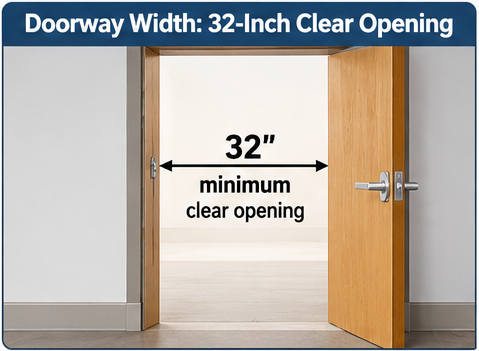
ADA door width requirements stipulate that door openings should provide at least 32 inches of clear width when a swinging door is open 90 degrees. This measurement refers to the usable opening, not just the width of the door itself. Doorways more than 24 inches deep generally require a 36-inch clear opening.
When assessing your doorway width, there are a few steps to take:
- Measure the clear opening with the door open 90 degrees.
- Check double-door configurations to make sure at least one active door leaf provides the required clearance.
- Look for hardware or other projections that reduce the usable opening.
2. Evaluate Maneuvering Clearance
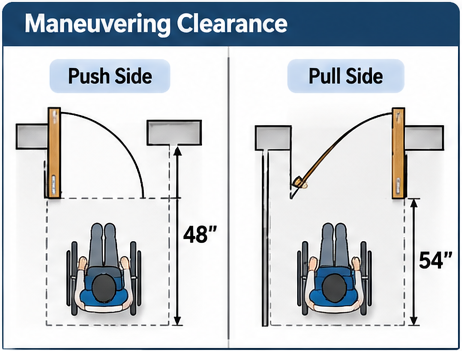
Though you may think accessibility is simply about giving someone with a mobility device enough room to pass through a doorway, it’s more complicated than that. People also need enough space to approach the door, operate its hardware, and move through the opening.
The amount of space someone needs to maneuver through a doorway depends on several factors, including whether they’re pushing or pulling the door and how the door operates. For example, a door with a closer — or a mechanical device that automatically closes a door after someone opens it — may require someone to pull it open against the closer’s resistance. However, a latch determines how the door is released from its closed position.
3. Inspect Door Hardware
People with a wide range of physical abilities need to be able to operate door handles, locks, latches, and other door hardware. That seems like a simple proposition, but if you’re installing or modernizing your commercial door systems, you’ll need to factor in a few considerations.
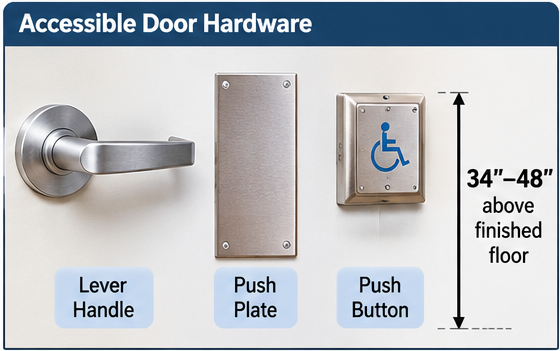
ADA standards generally require operable hardware to be located between 34 and 48 inches above the finished floor. Hardware must also be operable without tight grasping, pinching, or twisting of the wrist.
During your inspection, check for the following features:
- Hardware that can be operated with one hand, such as lever handles or push buttons, without tight grasping, pinching, or twisting.
- Handles that can be operated with a closed fist or loose grip.
- Locks and latches that don’t require complicated hand movements.
- Hardware positioned within the required height range.
Simply put, a door can have adequate clearance, but if someone can’t operate the handle, it still creates an accessibility barrier.
4. Test Door Opening Force
Heavy commercial doors can be difficult to operate for people with mobility issues of limited upper-body strength. That’s why opening force is another important part of ADA accessibility.
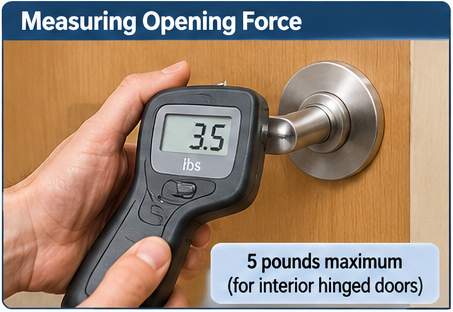
For interior hinged doors and sliding or folding doors, the ADA generally limits the force needed to open the door to five pounds.
When checking your doors, look for signs that they may require more than the permitted opening force. Pay attention to:
- Doors that feel unusually difficult to push or pull open.
- Hinges that are worn, damaged, or improperly adjusted.
- Door closers that create excessive resistance.
- Changes in how easily a door opens over time.
These observations can help you identify doors that may need attention, but they won’t tell you whether a door meets the ADA’s five-pound opening force limit. That requires measuring the force with a door pressure gauge. The measurement accounts for the continuous force needed to open the door after releasing its latch, rather than the initial force needed to get it moving. In simpler terms, it can help you determine whether the door could meet that opening force limit.
5. Check Door Closing Speed
Many commercial doors have door closers, which do exactly what you’d think they do: They’re mechanical devices, typically mounted at the top of the door, that automatically bring the door back to its closed position after someone opens it. These devices help keep doors from remaining open, but they need to be adjusted properly.
If a door closer causes a door to swing shut too quickly, someone using a wheelchair, walker, or other mobility aid may not have enough time to pass through safely. A door that closes too forcefully can also create an obstacle for people with limited mobility or strength.
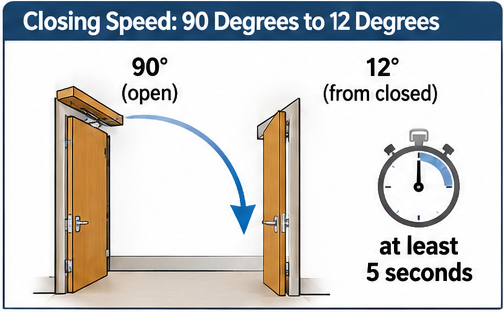
The ADA addresses this issue by setting a minimum closing time for doors equipped with closers. From a 90-degree open position, a door must take at least five seconds to move to a position 12 degrees from the latch.
When inspecting your commercial doors, check for:
- Doors that swing shut too quickly after being opened.
- Doors that slam or close with excessive force.
- Closers that appear damaged, loose, or improperly adjusted.
- Doors that don’t close consistently or latch properly.
In many cases, adjusting or servicing the door closer can improve how it operates. Regular maintenance can also help prevent worn or malfunctioning hardware from creating accessibility problems.
6. Inspect Door Thresholds
Thresholds and changes in floor height can make it difficult for wheelchair users and people with other mobility limitations to pass through a doorway. You’ll want to be aware of anything like abrupt changes or damaged parts like snagged carpet that could catch wheelchair wheels, walkers, or canes.
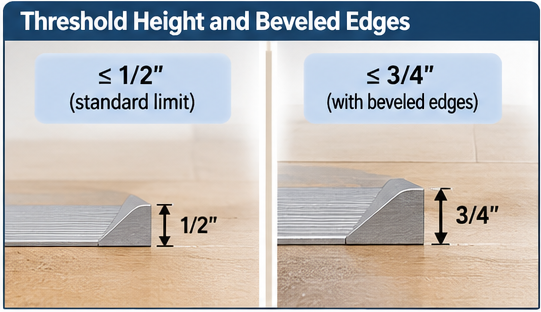
The ADA generally limits doorway thresholds to half an inch in height. However, the standards include an exception for existing or altered thresholds: They may be up to three-fourths of an inch high if they have beveled edges on both sides, with a slope no steeper than 1:2, meaning every half-inch of vertical rise extends at least one inch horizontally.
7. Evaluate Automatic Door Operators
Automatic doors can make commercial entrances easier to access, particularly in buildings that experience frequent customer or employee traffic. They can also help people who have difficulty opening heavy doors manually.
However, installing, maintaining, and repairing an automatic door operator doesn’t automatically make an entrance ADA-compliant. The entire door system still needs to meet applicable accessibility requirements.
Check that:
- Activation buttons and other manually operated controls are within accessible reach.
- Controls have adequate clear floor space for someone using a wheelchair.
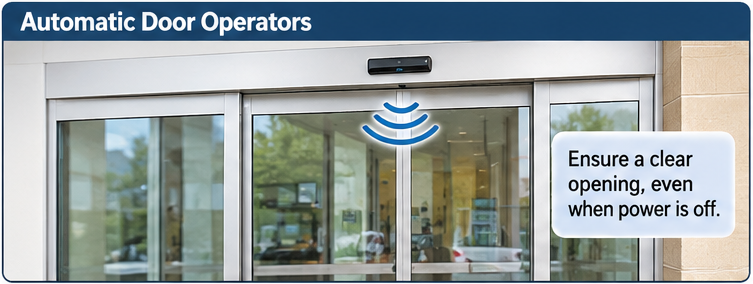
- The door provides the required clear opening, including when the automatic system is powered off.
- The system operates reliably and doesn’t close before someone can safely pass through.
- Doors serving an accessible means of egress have the required provisions for emergency operation.
Automatic door operators should also receive regular inspections and maintenance to keep them functioning properly.
8. Establish a Regular Door Inspection Schedule
ADA compliance isn’t something you should consider only when installing a new commercial door. Hardware wears down, hinges shift, closers lose their adjustments, and automatic operators can develop problems over time.
Regular inspections can help identify issues before they interfere with accessibility.
Make a point of checking:
- Door opening and closing operation
- Handles, locks, hinges, and other hardware
- Automatic operators and activation controls
- Thresholds and surrounding floor surfaces
- Clearances around frequently used entrances
If you notice a door becoming harder to open or a closer is no longer operating smoothly, arrange for repairs or adjustments rather than allowing the problem to persist.
Keep Your Commercial Doors Accessible
Accessible commercial doors help create a safer, more welcoming environment for everyone who enters your building. They also play an important role in meeting applicable ADA requirements.
If your doors are difficult to operate, lack adequate clearance, or have outdated hardware, it may be time to consider repairs, adjustments, or upgrades. A commercial door professional can help evaluate your existing equipment and identify practical improvements.
Commercial Door provides commercial door services to help businesses maintain functional, reliable entrances. Whether you need door repairs, new hardware, or an automatic door operator, contact us today to see how we can make your space more accessible and welcoming to everyone.