
Commercial door problems rarely announce themselves with a clear diagnosis. A door that’s slow to close might have a failing closer, a misaligned frame, or a worn hinge, and the right solution depends as much on what kind of door it is as on what symptoms it’s showing. Different door types are built differently, used differently, and fail differently. This guide breaks down the most common problems by door type, so facility managers and building operators know where to look first.
Common Problems by Commercial Door Type
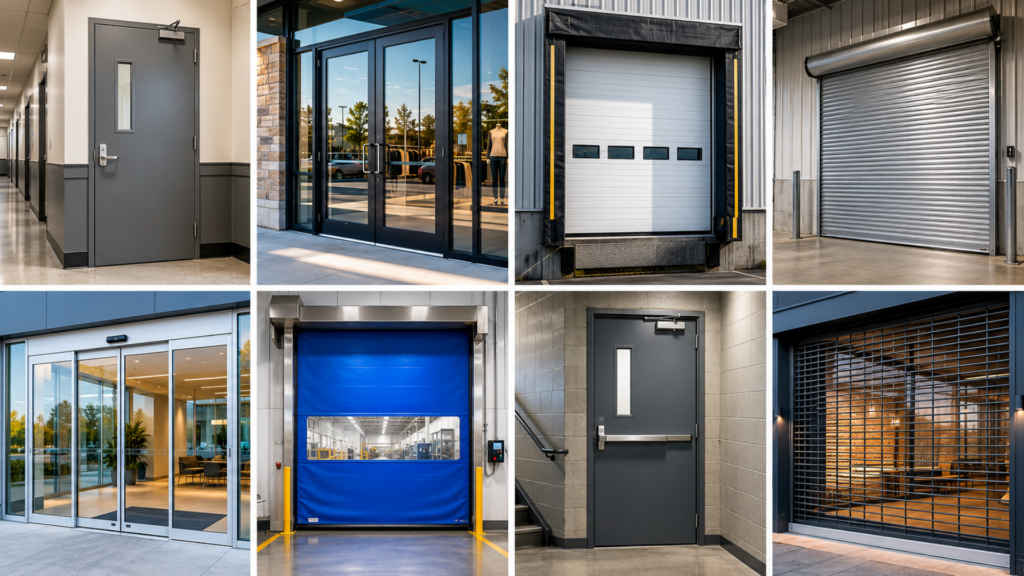
Not every commercial door fails the same way. A hollow metal door in a hospital stairwell accumulates wear in completely different places than a high-speed door in a cold storage facility. A sectional overhead door and a frameless glass door might both be broken, but reached that state through completely different paths, and diagnosing one correctly has nothing to do with the other. The sections below break down where each door type is most vulnerable and what problems facility managers most commonly call us to fix.
1. Hollow Metal Doors
Hollow metal doors are one of the most common commercial doors. Built from steel face sheets around a core with welded or integrated frames. They’re found in offices, hospitals, schools, and government buildings where code-compliant, high-cycle performance is required. The frame and hardware absorb the bulk of the stress on every opening and closing cycle, which is where failure typically begins. The most common problems with hollow metal doors include:
- Frame and hinge wear. Hinge pockets and frame steel fatigue with accumulated cycles, causing the door to drop, drag on the threshold, or bind in the frame.
- Latch and strike misalignment. As the frame shifts or hinges wear, the door pulls out of position and won’t latch cleanly, or requires force to close.
- Closer failure. The door swings too fast, drifts open, or won’t return to the frame, requiring closer body replacement or hydraulic tension adjustment.
2. Steel and Metal Doors
Steel and metal doors are built for heavier-duty applications than standard hollow metal, covering exterior entries with high security requirements, utility and mechanical room doors, and openings that need to resist forced entry or sustained environmental exposure. Because these doors are typically installed at the building perimeter, weather and moisture are the dominant forces driving deterioration. Common steel and metal door problems include:
- Surface corrosion. Moisture and UV exposure break down surface coatings and allow rust to develop, compromising the door’s appearance and structural integrity over time.
- Seal and weatherstripping failure. Perimeter seals degrade under temperature cycling and UV exposure, allowing air and moisture infiltration at the frame.
- Lockset and hardware wear. High-security hardware operates under greater stress than standard commercial locksets and requires periodic service or replacement before it fails.
3. Overhead Doors
Overhead sectional doors operate on a system of hinged horizontal panels that travel along vertical and horizontal tracks, counterbalanced by springs and cables. They’re the standard for warehouses, loading docks, and service bays where large vehicle or equipment openings are required. The counterbalance system does the heavy lifting on every cycle, and that’s where most serious failures originate, including:
- Spring and cable failure. Broken or fatigued springs make the door heavy to operate manually and put added strain on the opener motor, while frayed or snapped cables cause the door to rack or drop unevenly.
- Roller and track wear. Rollers flatten or seize in their stems and tracks, develop wear at bend points, causing binding and uneven panel travel that worsens under load.
- Panel damage. Vehicle or equipment impact dents or cracks individual panels, affecting track alignment and compromising the weather seal along the door’s full width.
4. Rolling Steel Doors
Rolling steel doors operate with a curtain of interlocking steel slats that coil around a barrel and spring assembly housed in a hood above the opening. They’re used in loading dock service openings, interior security partitions, and high-cycle applications where sectional doors aren’t practical. The coiling mechanism bears constant load, and problems there cascade into both the curtain and the operator. Three common rolling steel door issues that frequently occur are:
- Spring and counterbalance failure. Loss of counterbalance tension makes the curtain heavy to operate, places excessive load on the operator motor, and shortens the service life of both.
- Slat damage. Vehicle or equipment impact bends or breaks individual slats, causing the curtain to bind as it coils and creating gaps in the closed position.
- Bottom bar misalignment. The bottom bar shifts out of level or loses contact with the floor seal, allowing air, moisture, and pests to enter under the closed curtain.
5. Storefront Doors
Storefront doors are designed for commercial building entries in retail, office, and medical settings. The aluminum frame is lightweight by design, which keeps the door manageable under high pedestrian traffic but makes the frame and hardware connections the most stress-concentrated parts of the assembly. Weather exposure compounds the wear at every cycle, leading to common problems, such as:
- Closer and pivot wear. Constant pedestrian traffic fatigues closers and pivot hardware, causing the door to drift, slam, or fail to return squarely to the frame.
- Frame and seal deterioration. Weather exposure breaks down perimeter seals and frame corner joints, allowing air and moisture infiltration and reducing thermal performance.
- Glass damage. Impact and thermal stress cause cracking or seal failure at the glass edges, requiring panel replacement and resealing within the aluminum frame.
6. Glass Doors
All-glass and predominantly glass doors use frameless or minimal-frame construction, relying entirely on patch fittings, pivot assemblies, and hinges bolted directly to the glass to carry the door’s weight and absorb the force of every cycle. They’re used in high-end entries, interior partitions, and conference room applications where visibility and aesthetics take priority. The absence of a traditional frame means there’s no structure to distribute stress, so hardware and glass are both vulnerable. Problems include:
- Glass breakage and cracking. Impact, thermal stress, and stress concentration from misaligned hardware can crack or shatter panels, requiring full glass replacement and a hardware inspection to address the underlying cause.
- Patch fitting and pivot wear. Fittings loosen or wear at the glass contact points, shifting the door out of alignment and placing stress on the glass that accelerates cracking if not corrected.
- Closer failure. Frameless glass door closers require more precise adjustment than on framed doors, and improper tension transmits uneven stress directly to the glass panel.
7. Automatic Doors
Automatic doors, including sliding, swinging, and folding configurations, combine mechanical door components with sensors, operators, and control systems to deliver hands-free access. They’re standard at retail entries, healthcare facilities, airports, and any high-traffic entrance where ADA compliance is required. Because failure can originate in any of those layers independently, diagnosing the root cause requires working through the system methodically. Depending on the automatic door type, common issues discovered during diagnoses include:
- Sensor malfunction. Motion and presence sensors lose calibration or fail outright, causing erratic cycling, failure to detect approaching users, or continuous operation when no one is present.
- Operator and motor wear. High cycle counts wear drive motors and operator components, producing slow operation, unusual noise, or complete failure to cycle.
- Track and guide deterioration. On sliding doors, track and guide components accumulate debris and wear at contact points, causing binding and uneven panel travel.
8. High-Speed Doors
High-speed doors use a flexible PVC or fabric curtain driven by a motor and control system to open and close at speeds that minimize thermal loss and maintain workflow between access points. They’re built for manufacturing, cold storage, food processing, and logistics environments where a door may cycle hundreds of times per day. That cycle frequency places them in a different wear category than any other door type, and the flexible curtain adds a second failure mode that rigid doors don’t have. Both lead to failures such as:
- Motor and drive wear. High cycle frequency accelerates wear on drive motors and associated components, producing slow operation, erratic cycling, or complete failure.
- Curtain panel damage. PVC or fabric curtain panels crack, tear, or deform from forklift or equipment impact, creating gaps that compromise thermal separation and security.
- Safety edge and photo eye failure. Safety components lose calibration with use and require regular testing to prevent the curtain from closing on personnel or equipment in the opening.
9. Impact Doors
Impact doors are double-acting swing doors built to be pushed open from either direction, using double-action hinges and a floor guide to control swing and return. They’re standard in commercial kitchens, hospitals, food processing facilities, and industrial environments where carts and equipment move continuously. The design absorbs a high volume of impact, but that stress accumulates steadily in the hardware and panels, leading to the following failures:
- Hinge and pivot wear. Constant bidirectional impact fatigues double-action hinges at the pivot points, causing the door to sag, drag on the floor, or fail to return to the centered closed position.
- Panel damage. PVC, polyethylene, or fiberglass panels crack or deform over time, particularly at the push points and lower sections where equipment contact is most frequent.
- Floor guide wear. The floor guide that keeps the door centered loosens or wears, allowing the door to swing off-axis and placing additional stress on the hinge and frame.
10. Fire Doors
Fire doors are rated assemblies installed in fire-rated walls at stairwells, exit corridors, and mechanical rooms. They’re required to self-close and latch on every cycle to maintain their rating as a passive fire barrier. Unlike other door types, where a functional problem is primarily an operational concern, any failure that prevents a fire door from closing and latching completely is also a code compliance failure.
- Closer failure. A closer that allows the door to rest open, even partially, voids the fire rating and must be repaired or replaced.
- Latch and strike misalignment. Frame shift or worn hardware prevents the door from latching in the closed position, leaving the fire barrier incomplete.
- Seal deterioration. Intumescent strips and smoke seals around the frame perimeter must be intact and properly seated to maintain the assembly’s rated performance under fire conditions.
11. Entry Doors
Commercial entry doors are typically hollow metal or heavy aluminum-framed, equipped with closers, locksets, panic hardware, and weatherstripping to handle the demands of a primary building access point. They carry the highest hardware cycle counts of any door in the facility, and ADA requirements mean that closer force and hardware operability must remain within regulated limits as components wear.
- Closer wear. Entry door closers accumulate more cycles than any other in the building and begin to slam, drift, or fail to return the door fully to the frame as the hydraulic mechanism fatigues.
- Panic hardware failure. Exit devices and push bars develop play in the mechanism or fail to retract the latch cleanly, creating both security and life-safety concerns.
- Weatherstripping and threshold deterioration. Perimeter and threshold seals wear with heavy use, allowing air and moisture infiltration and degrading the door’s energy performance.
12. Hangar and Large-Scale Doors
Hangar and large-scale doors operate in bifold, sliding, or hydraulic configurations to cover openings that standard commercial doors can’t accommodate. They serve aircraft hangars, large vehicle maintenance facilities, and heavy industrial operations where the door itself can weigh several tons and span dozens of feet. At that scale, minor mechanical problems produce significant operational consequences, including:
- Track and roller wear. The weight of a large-scale door accelerates wear at the track and roller contact points, producing progressive binding and misalignment that makes the door increasingly difficult to move.
- Hydraulic system failure. Lift-type hangar doors develop seal leaks and pressure loss over time, resulting in slow or uneven operation and an eventual inability to hold position.
- Drive motor and limit switch failure. Motors wear under sustained load, and limit switches lose calibration, causing inaccurate positioning and doors that overtravel or stop short of fully open or closed.
13. Mantrap Doors
Mantrap doors are interlocking two-door systems where the first door must fully close and lock before the second can open. They are controlled by an interlock controller and access control integration. They’re installed in data centers, financial institutions, pharmaceutical facilities, and any environment where preventing tailgating or unauthorized entry is a security requirement. Because both doors function as one system, immediate security gaps can arise from a failure anywhere in the assembly, such as:
- Interlock controller failure. A malfunctioning controller prevents the system from sequencing correctly, either locking both doors simultaneously or allowing both to open at once.
- Electric strike and magnetic lock failure. These components require regular testing and calibration to confirm they’re releasing and securing on command without delay or inconsistency.
- Sensor and closer misalignment. The interlock depends on sensors confirming each door is fully secured before releasing the next, so closer or sensor problems that prevent a complete close stall the entire system.
14. Security Gates
Security gates, including rolling and sliding steel gate systems, control access at building perimeters, parking facilities, storefronts, and interior security partitions in warehouses and distribution centers. They operate in outdoor or semi-outdoor environments under conditions that accelerate wear on motors, limit switches, tracks, and gate material. Automated gate systems add electrical and control components to the failure profile that manual gates don’t carry. Common issues include:
- Operator and motor failure. Motors that run hot, reverse unexpectedly, or fail to hold position at the open or closed limit indicate drive system wear or loss of limit switch calibration.
- Track and guide wear. Sliding gate tracks accumulate debris and wear at contact points, causing binding and increasing load on the operator motor with each cycle.
- Slat and panel damage. Rolling gate slats and sliding gate panels sustain vehicle impact damage, requiring slat replacement or panel repair to restore curtain integrity and security.
Contact Commercial Door for Expert Repair Across All Door Types
Every commercial door type has a distinct failure profile, and knowing where a door is most likely to fail makes it easier to catch problems early and avoid unplanned downtime. Whatever door type you’re dealing with, the repair approach should match the construction.
Commercial Door services all of the door types covered in this guide across Oklahoma, Texas, Arkansas, and Tennessee, with 24/7 availability and no long-term contracts required. Contact us to request a free estimate or get a technician on-site.


