
Commercial door locks span a wide range of types, grades, and configurations, each designed for a specific set of door functions, traffic volumes, and security requirements. Selecting the wrong type for a door does not just create a security gap; in some cases, it creates a code violation, voids a fire rating, or impedes egress in an emergency.
This article covers the ten lock types found across commercial facilities, what each one is designed to do, and where each one belongs. It also covers the ANSI/BHMA grading system that determines whether a lock is rated for the door it is on, and what distinguishes a genuinely high-security lock from standard Grade 1 hardware.
How Commercial Door Locks Differ from What You’ll Find at a Hardware Store
The distinction between commercial and residential lock hardware is represented by a formal grading system that determines whether a lock is appropriate for the door it is on. The American National Standards Institute (ANSI) and the Builders Hardware Manufacturers Association (BHMA) jointly publish grading standards for door hardware, and those grades carry real consequences for security, longevity, and code compliance:
- Grade 1 is the highest commercial rating. Locks at this level are tested to withstand the highest cycle counts and applied force, making them the required specification for heavy-traffic doors in commercial and institutional settings.
- Grade 2 covers light commercial and high-end residential applications. Hardware at this level meets lower cycle and force thresholds than Grade 1, making it appropriate for interior commercial doors with moderate traffic where the occupancy type does not demand the full commercial specification.
- Grade 3 is the entry-level residential rating, tested to the lowest cycle and force thresholds. This hardware is designed for light residential use and is not rated for the traffic volumes, duty cycles, or security demands of a commercial environment.
10 Commercial Door Lock Types Used in Commercial Facilities
The following ten lock types are the most common in commercial buildings. Each one is designed for a specific range of applications, and selecting the wrong type could create either a security gap or a code violation or both.
1. Mortise Locks
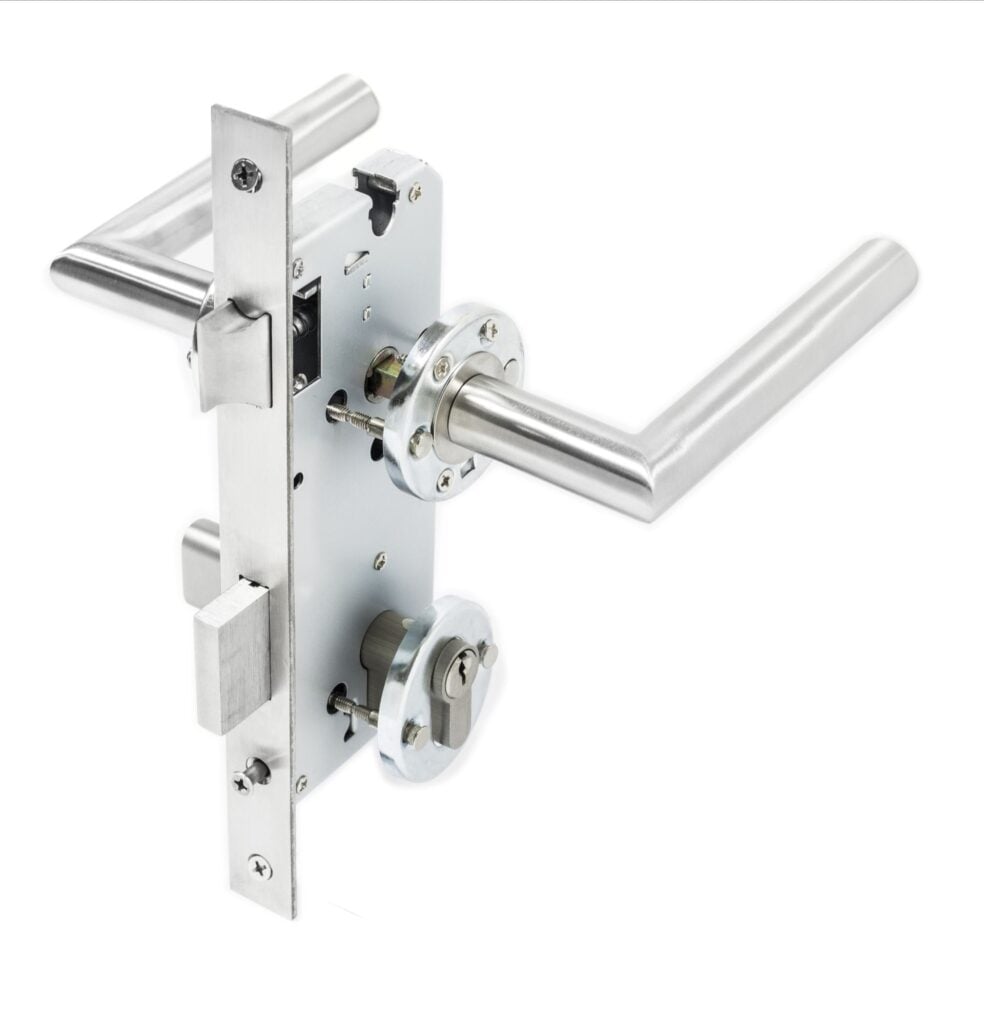
A mortise lock is installed inside a pocket routed into the door body itself, which is what separates it from surface-mounted hardware. Because the lock mechanism is recessed into the door, it distributes force across the door’s thickness rather than relying on screws at the face. Mortise locks are the standard choice for primary entry doors, main corridors, and any exterior door on a hollow metal frame.
They are available for a wide range of functions, including storeroom, office, classroom, and entrance configurations, which determine whether the latch is held by a key, a thumb turn, a lever, or a numerical combination. They are not appropriate for glass storefront doors or aluminum frames that cannot accommodate a mortise pocket. In those applications, rim locks or surface-mounted hardware is the correct alternative.
2. Cylindrical Lever Locks
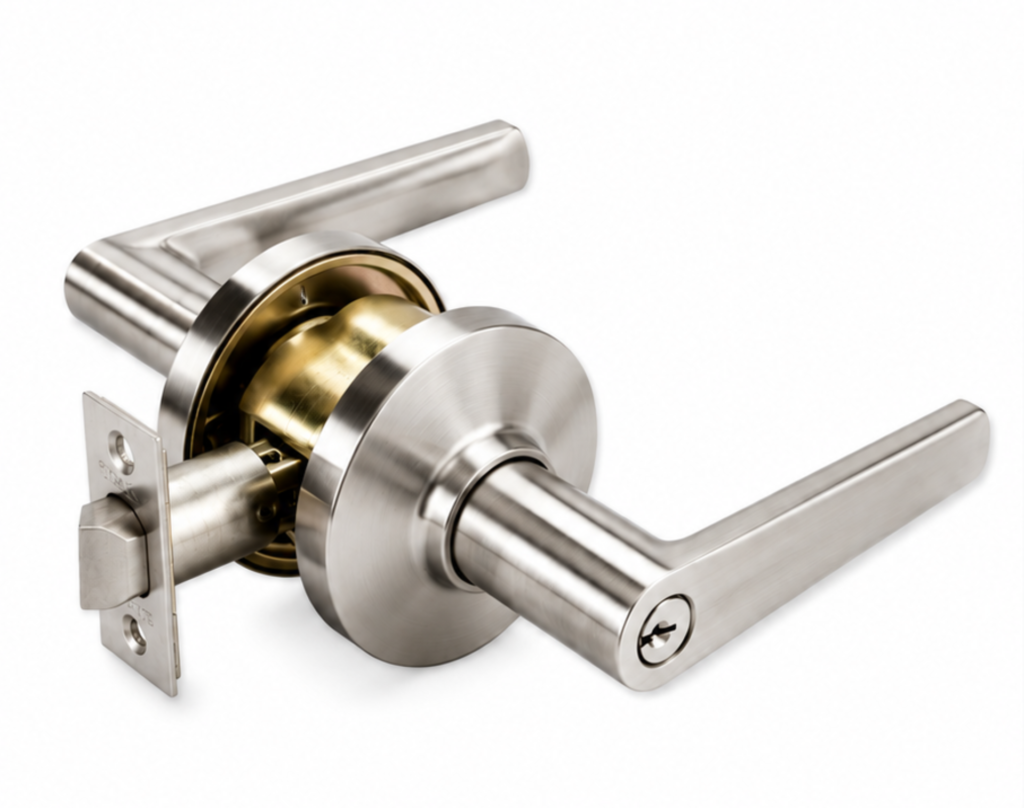
Cylindrical lever locks are the most common lock type in commercial interiors. They are well-suited for office doors, classroom doors, break rooms, and other medium-traffic interior applications. The mechanism is housed in a cylindrical body that fits through a bored hole in the door, making installation straightforward and the hardware relatively easy to replace. Available in Grade 1 and Grade 2, cylindrical locks come in a broad range of applications covering office, classroom, storeroom, and privacy applications.
They are not designed for primary exterior entry doors, where a mortise lock provides better resistance to both forced entry and long-term wear from high cycle volume. Cylindrical locks can also be susceptible to shimming and carding attacks if not installed correctly in the right frame, which is part of why exterior specifications default to mortise construction.
3. Deadbolts
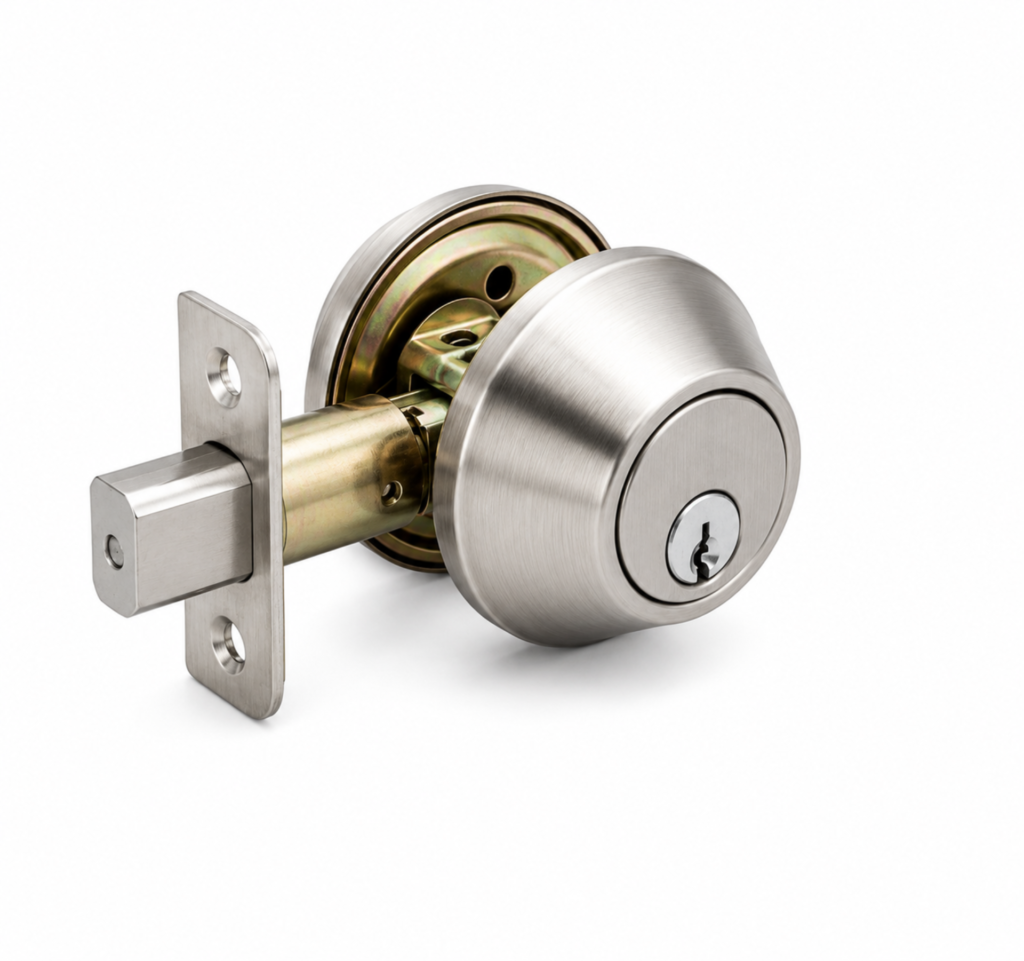
A deadbolt uses a bolt that moves horizontally into the strike plate with no spring action, making it more resistant to shimming than a spring latch. In commercial settings, deadbolts serve a supplemental security role. They are typically paired with a lockset on an exterior door to add a second locking point or installed as standalone hardware on low-traffic access doors. Single-cylinder deadbolts are key-operated from the outside and use a thumb turn on the inside. Double-cylinder deadbolts require a key on both sides.
Double-cylinder configurations are prohibited in many occupancy types because they impede egress under fire conditions, and the occupancy classification and local code requirements for that door should be verified before specifying one.
4. Exit Devices and Panic Hardware
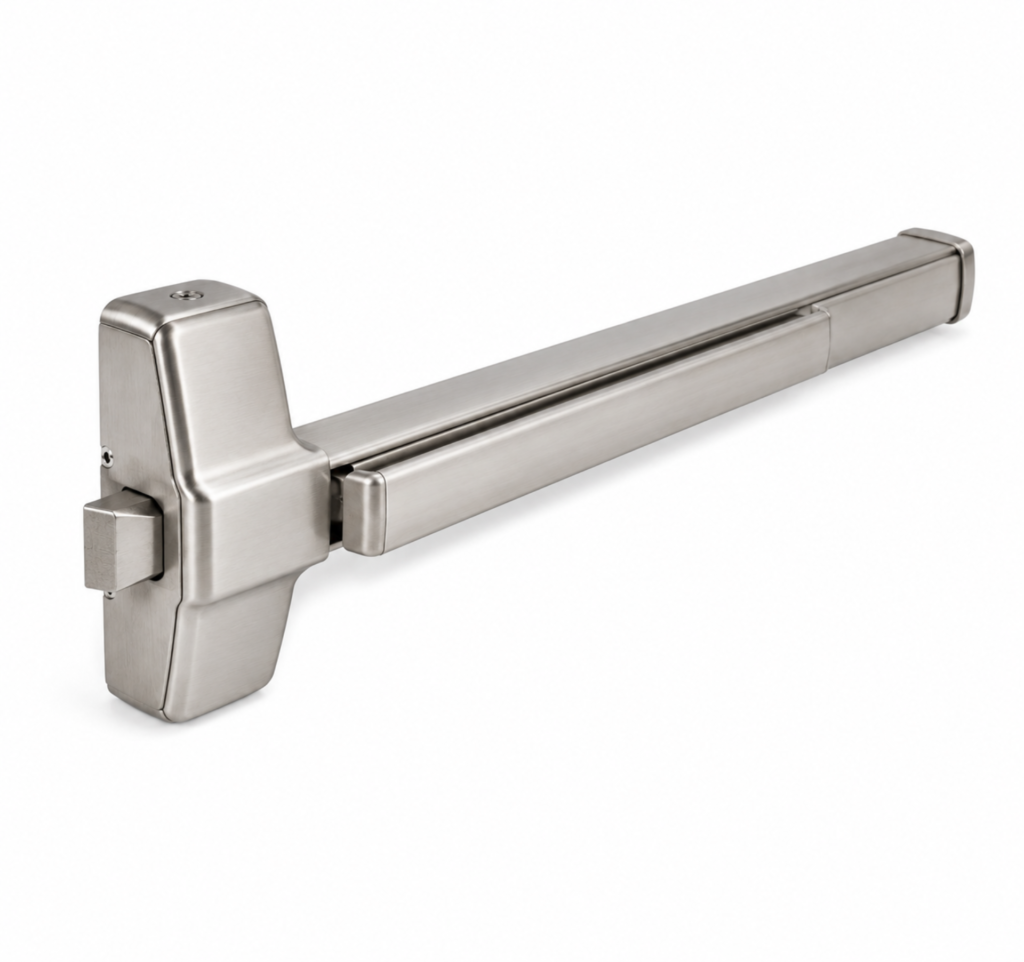
An exit device is simultaneously a locking mechanism and an egress device. The door is secured from the outside by a lock cylinder or electronic credential reader, while the interior push bar allows free egress at all times with a single pushing motion.
Exit devices are the required hardware for high-occupancy exit doors, fire exit corridors, and any door where the building code specifically calls for emergency and panic hardware. The International Building Code and National Fire Protection Association (NFPA) 101 require panic hardware on doors serving assembly occupancies above specific occupant loads, typically 50 or more people. They are not required where the occupancy load and door function do not trigger the code threshold, though many facility managers voluntarily specify panic hardware on secondary exits as a best practice.
5. Electric Strikes
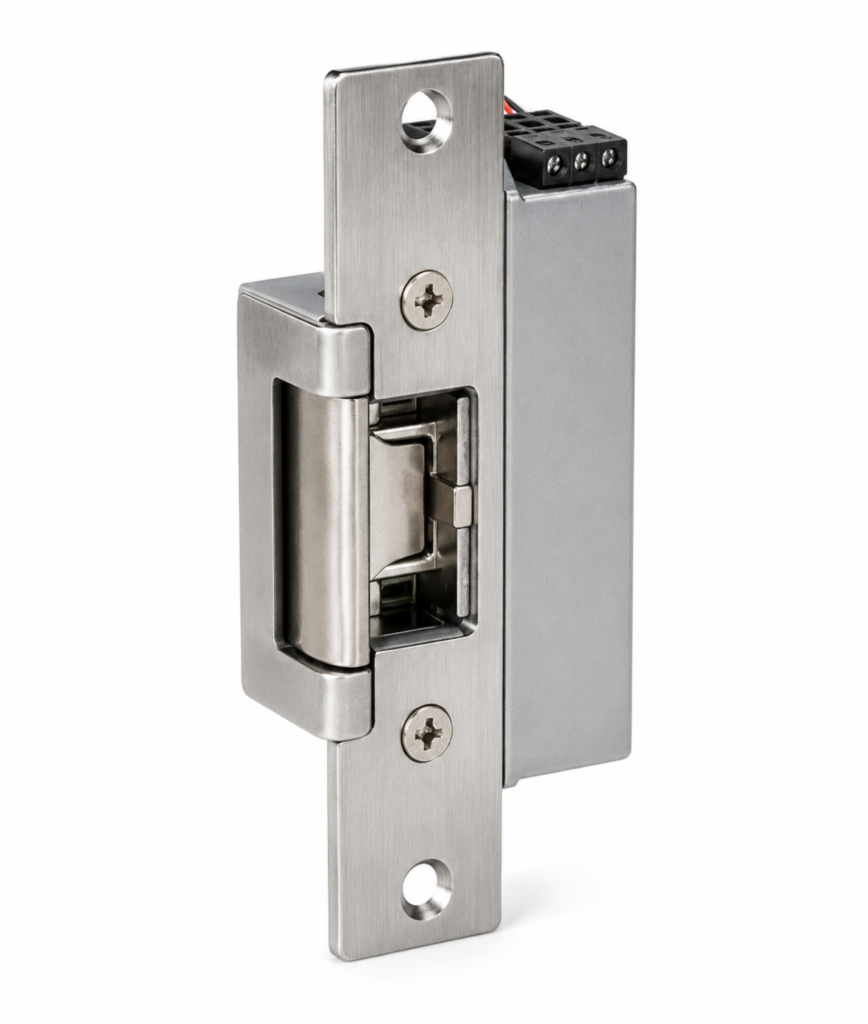
An electric strike is the door-side hardware component of an electronic access control system, appropriate for any controlled access point where a credential system is already in place or planned. It replaces the conventional strike plate in the door frame and holds the door closed when powered. When a credential reader grants access, it sends a signal to the electric strike that releases the latch and allows the door to open.
Electric strikes come in two configurations based on how they behave during a power failure. Fail-safe strikes release when power is cut, leaving the door unsecured, while fail-secure strikes remain locked when power is cut and require a mechanical key override for egress.
The correct configuration depends on whether the door is a primary exit or escape path: a fail-safe is typically required for fire exit doors, while a fail-secure may be appropriate for interior restricted-access doors where security takes priority. Electric strikes are not the right fit where the door requires a standalone mechanical solution with no network or power infrastructure to support it.
6. Electromagnetic Locks
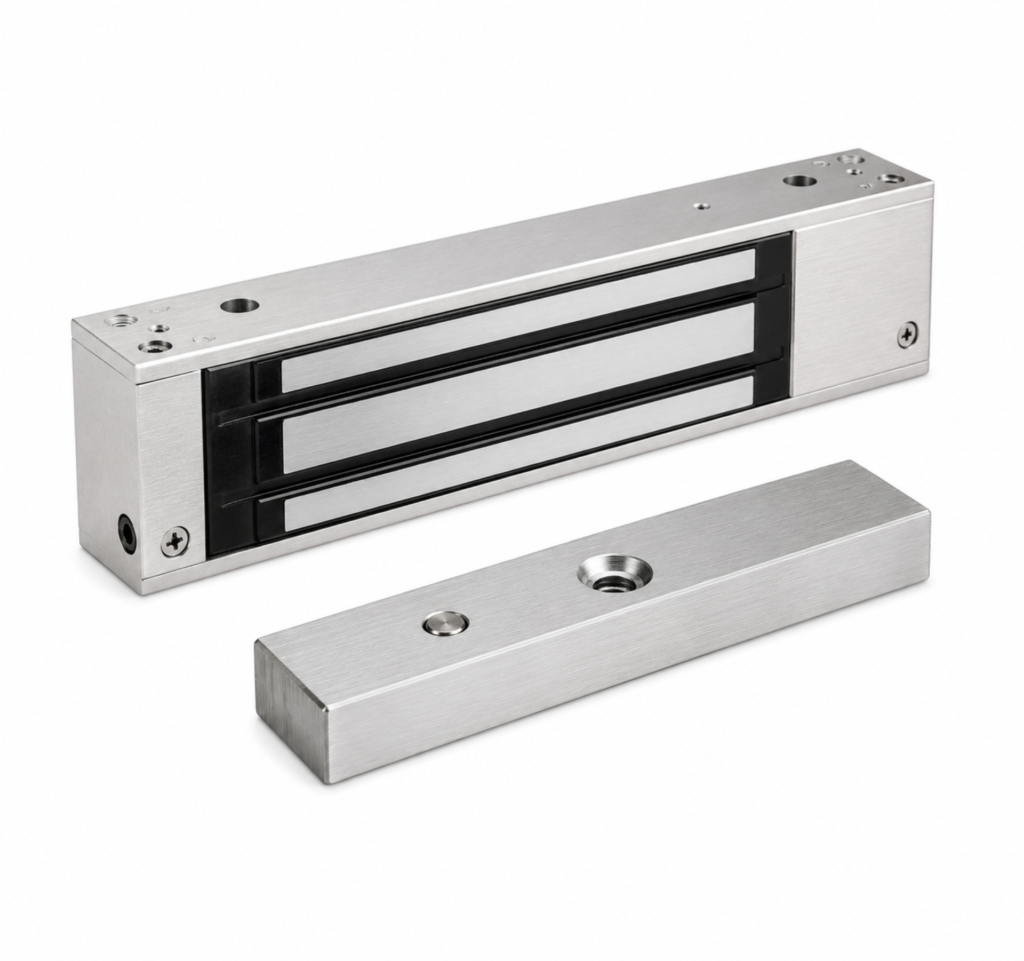
Electromagnetic locks, or maglocks, are suited for high-security access points where holding force and low mechanical maintenance are priorities. A maglock works by mounting the lock body on the door frame and a steel armature plate on the door face; when the door closes, electrical current magnetizes the lock body and pulls the armature plate flush against it, holding the door shut. Because the locking mechanism has no moving parts, maglocks are low-maintenance compared to mechanical lock hardware.
Maglocks require continuous power to remain locked, which classifies them as fail-safe by default: when power fails, the door opens. Because of that power dependency, the International Building Code requires that doors secured by maglocks also have a door position switch, a request-to-exit sensor, and, in many cases a direct connection to the fire alarm system so the door releases automatically during a fire event. A maglock installed without those components is not code-compliant, regardless of how well the lock itself functions. Maglocks are not appropriate for locations where an uncontrolled release during a power failure creates a security problem. In those cases, a fail-secure electric strike or a mechanical lock is more appropriate.
7. Mechanical Keypad Locks
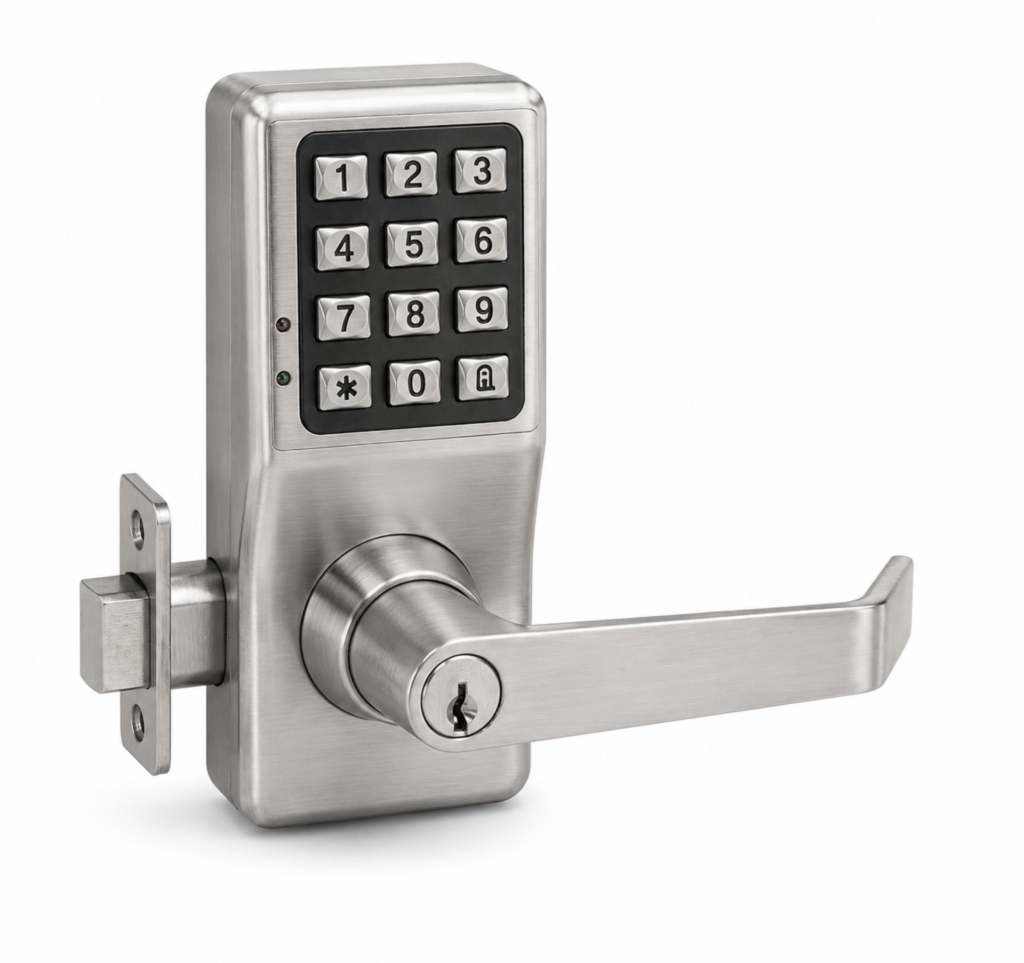
Mechanical keypad locks are well-suited for utility rooms, storage areas, rooftop access points, and any door where multiple staff members need access, but the location cannot support electronic access control infrastructure. They provide keyless entry without any electrical power or network connectivity requirements. Users enter a numeric code to retract the latch, and the lock operates entirely through mechanical action. This makes them reliable in locations without power infrastructure, immune to network-based attacks, and practical for multi-user access scenarios where distributing physical keys is impractical.
They are not appropriate where the facility needs an audit trail of who accessed the door and when, because mechanical keypads cannot log individual users. Keypad codes should be changed regularly and whenever a staff member with code access leaves the organization.
8. Interconnected Locksets
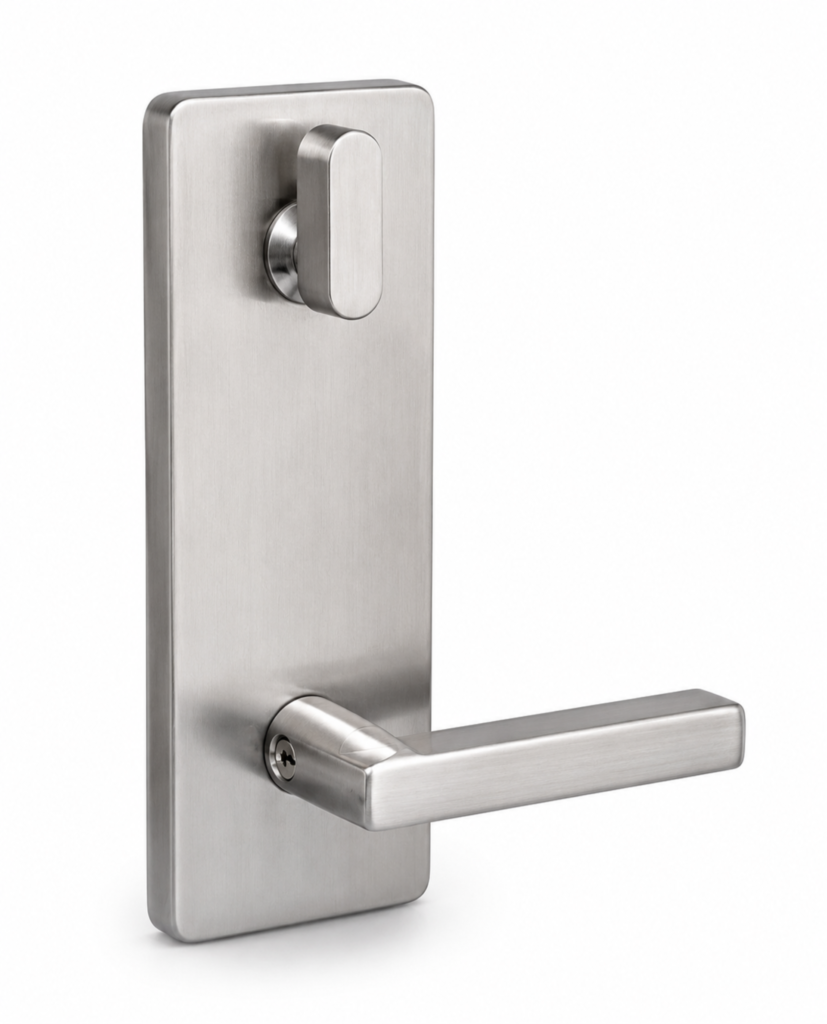
Interconnected locksets are the correct hardware for fire-rated stairwell doors and other egress paths where code requires a single motion to achieve both exit and full door release. The lockset links the deadbolt and the latch so that a single operation, typically depressing the lever or turning the knob, retracts both simultaneously. A person evacuating needs to open the door completely with one motion without fumbling for a separate deadbolt thumb turn, which is what this hardware is designed for.
Interconnected locksets are one of the most overlooked hardware types in facilities that were not originally built with code-compliant egress hardware, and one of the most commonly mis-specified during renovations. Facilities that add a deadbolt to an existing stairwell lockset without understanding the interconnection requirement end up with a code violation on a door that looks properly secured from the outside. On doors that are not in an egress path requiring simultaneous latch and bolt retraction, a separate lockset and deadbolt function correctly, and an interconnected lockset adds cost without a functional benefit.
9. Rim Locks and Surface-Mounted Deadbolts
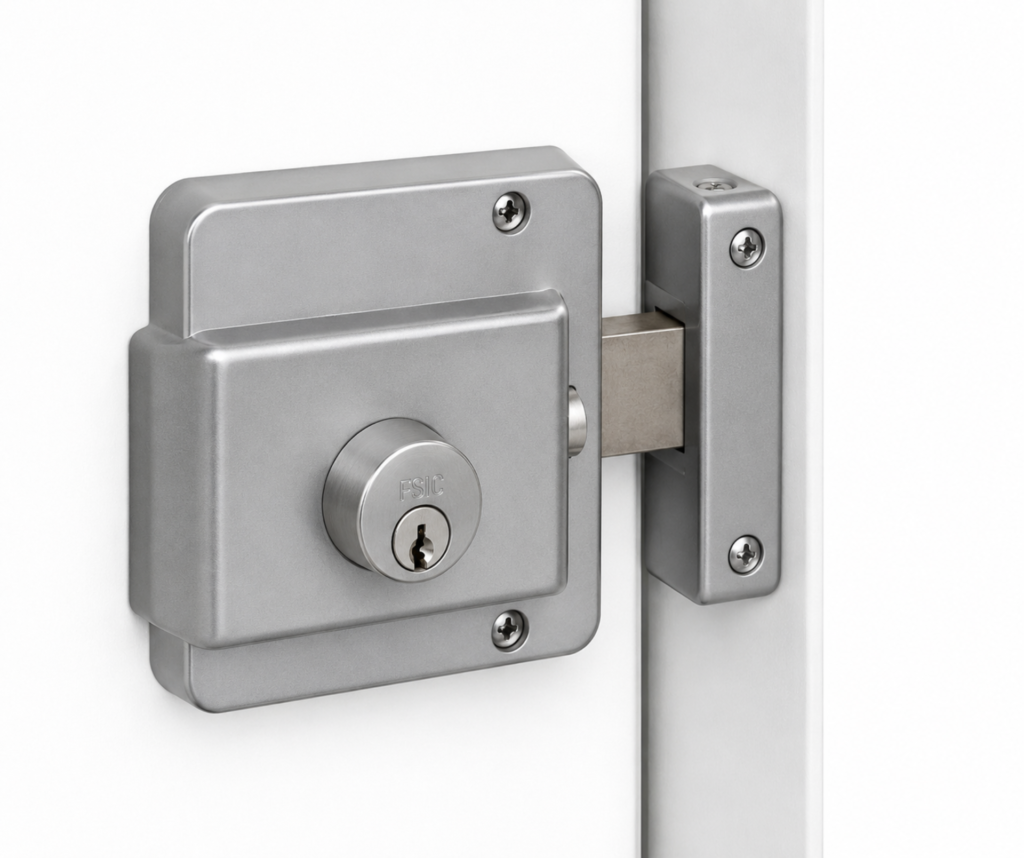
Rim locks and surface-mounted deadbolts are the practical solution for doors where mortise routing is not possible, including glass storefront doors, hollow-core doors with insufficient material depth, aluminum frame doors, and existing doors in older buildings where frame construction cannot accommodate a mortise pocket without a full door replacement. Unlike recessed hardware, rim locks and surface-mounted deadbolts are mounted directly on the door face, making them viable for retrofit and frame-constrained applications.
They are not appropriate as a substitute for mortise hardware on doors where mortise routing is feasible, particularly on exterior or high-traffic applications where forced entry is a realistic concern. The mounting screws bear the load directly in surface-mounted configurations, which makes them more vulnerable under force than a correctly installed mortise lock in the same location.
10. Electronic Access Control Locksets
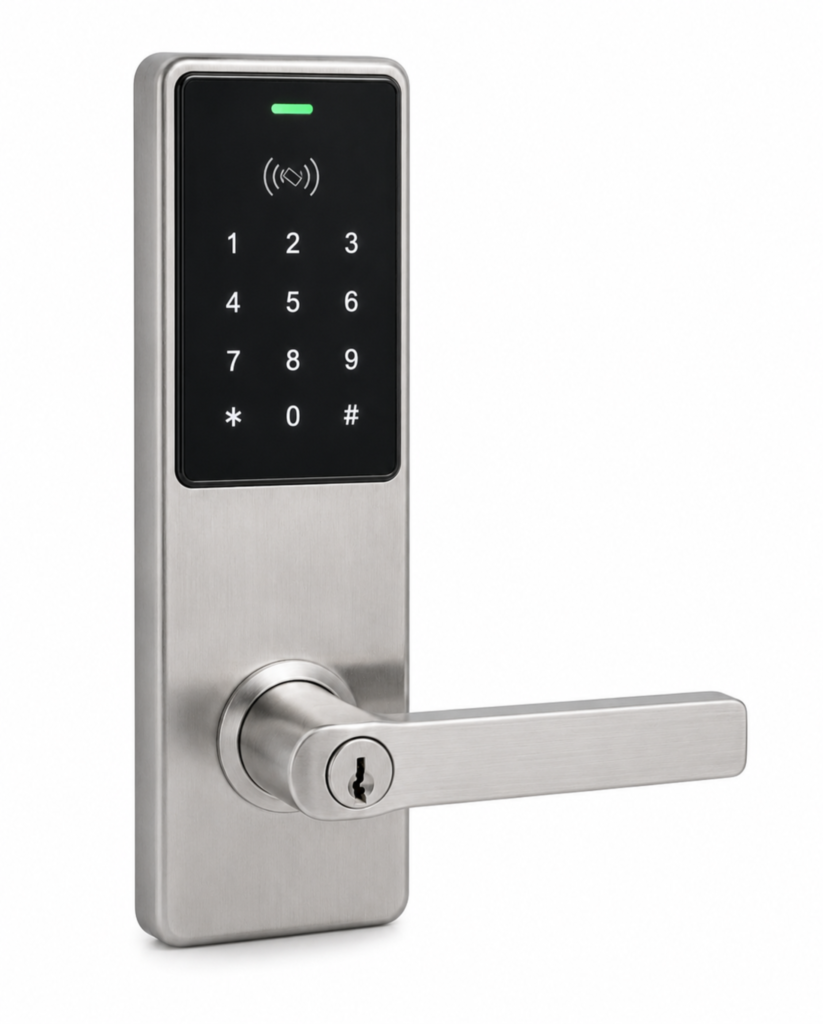
Electronic access control locksets are well-suited for restricted access doors in facilities where security accountability matters, including server rooms, pharmaceutical storage, records rooms, and any environment with compliance requirements around access documentation. They integrate the credential reader and the locking mechanism into a single unit, as opposed to a reader-plus-electric-strike assembly. Common credential types include keycard and key fob readers, PIN keypads, and biometric readers for fingerprint or facial recognition. The defining capability of the category is user-level management: access can be granted and revoked for individual credentials, time-based schedules can restrict when specific users can enter, and the system generates an audit log of every access event.
They are not appropriate where the facility lacks the IT infrastructure or management capacity to maintain the system properly. Unlike mechanical locks, network-connected access hardware can be hacked. Weak credentials, outdated firmware, and misconfigured permissions are all vectors that bad actors exploit to gain unauthorized access without ever touching the physical hardware. The most common failure points are former employee credentials that were never deactivated, shared PIN codes, and audit logs that are generated but never reviewed.
Installation, Compliance, and Maintenance
A correctly specified lock installed incorrectly performs below its grade rating, and a compliant door assembly can fall out of compliance after a renovation, an occupancy change, or a hardware replacement that introduced non-listed components. Maintenance requirements vary by lock type and cycle volume: electronic access control systems require credential audits and firmware updates, while high-cycle mechanical locks benefit from periodic lubrication and inspection to catch wear before it becomes a failure.
If your facility is due for a hardware assessment, request a free estimate. Our technicians serve commercial facilities across Oklahoma, Texas, Arkansas, and Tennessee with 24/7 availability.


