
Getting commercial door dimensions right is an important facility design and renovation decision. The Americans with Disabilities Act (ADA) establishes specific dimensional standards for doors on accessible routes, and those standards are precise enough that small specification errors can render an otherwise well-designed entrance non-compliant.
This guide covers the dimensional requirements the ADA establishes for commercial doors, how those requirements apply across the door types most commonly found in commercial facilities, where facilities most often get the specifications wrong, and what a professional assessment involves.
What the ADA Requires and Who It Applies To
The Americans with Disabilities Act establishes accessibility obligations for two broad categories of facilities.
- Title II applies to state and local government facilities, including public buildings, courthouses, libraries, and municipal offices.
- Title III applies to private businesses open to the public, covering most commercial establishments, including retail stores, restaurants, medical facilities, and hotels.
Both titles impose entrance accessibility requirements, though the enforcement mechanisms and remediation timelines differ.
The 2010 ADA Standards for Accessible Design outline the standards for door compliance. These standards apply in full to facilities built or altered after March 15, 2012. For existing facilities that predate the current standards, the obligation is to remove architectural barriers when doing so is “readily achievable.” This is a case-by-case determination based on the cost and difficulty of the modification relative to the resources of the business. Any planned alteration to a facility triggers compliance requirements for the affected area to the maximum extent technically feasible, provided the cost of path-of-travel improvements does not exceed 20% of the total cost of the alteration.
The Numbers That Define ADA Door Compliance
ADA door compliance is defined by several dimensional requirements, including clear opening width, maneuvering clearance, threshold height, and hardware mounting height, each of which must be met independently. Meeting one does not satisfy the others, and a deficiency in any single measure constitutes a barrier under ADA standards.
Clear Width vs. Door Width
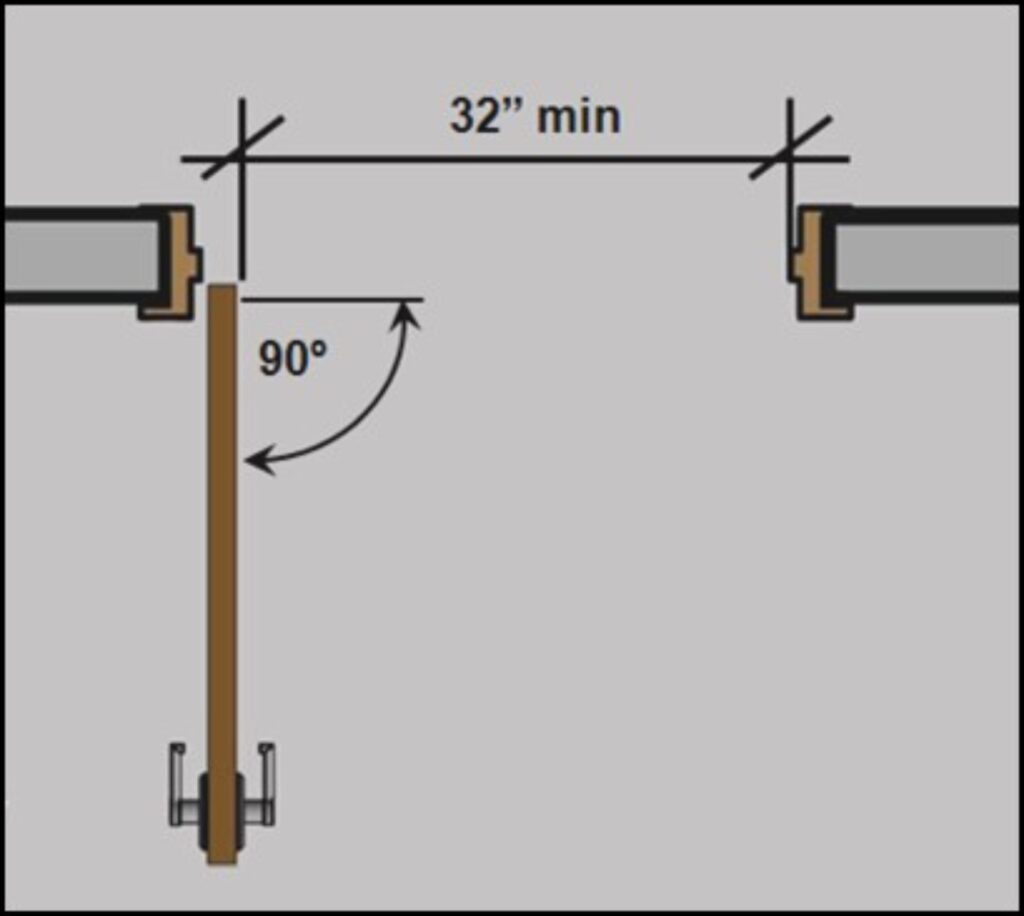
ADA standards require a minimum clear opening width of 32 inches when the door is open 90 degrees. This minimum width represents the actual space for a wheelchair, walker, or mobility device to pass through the door.
Clear width is not the same as the nominal door width printed on a specification sheet or stamped on a door slab. The difference can be the source of many compliance miscalculations. The clear width is measured from the face of the door stop on the latch side to the face of the door at its 90-degree open position, not from frame to frame and not from the rough opening.
When a hinged door opens, the door stop on the latch side and the door slab itself both reduce the available clear opening.
- A 32-inch door slab produces a clear opening of approximately 29.5 inches, which falls short of the requirement.
- A 34-inch slab produces roughly 31.5 inches of clear opening, still non-compliant.
- A 36-inch slab consistently produces the required 32-inch clear opening under standard installation conditions, which is why 36 inches has become the practical specification standard for ADA-compliant hinged doors.
This measurement method must be used consistently when specifying new doors and evaluating existing ones.
Maneuvering Clearance
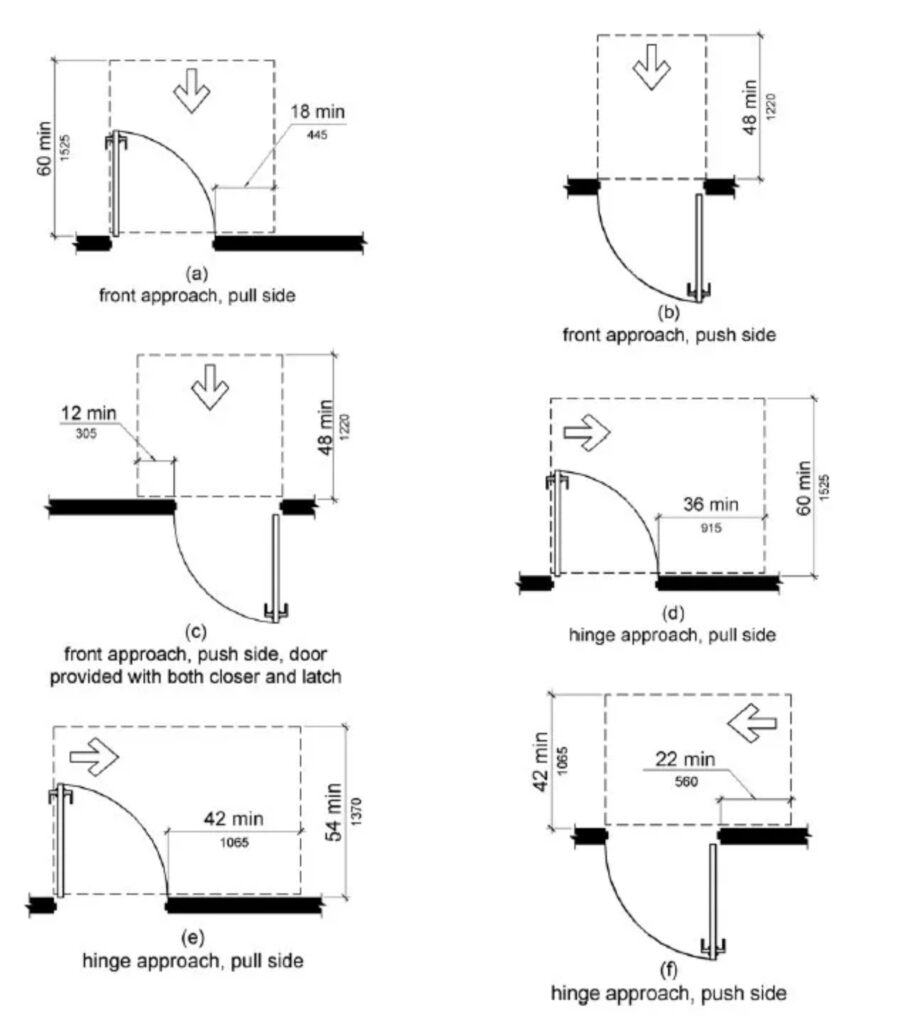
Maneuvering clearance refers to the floor space required on both sides of a door to allow a wheelchair user to approach, operate, and pass through the door independently. It is one of the most frequently deficient requirements in commercial door compliance. A door can meet every dimensional specification and still fail if the surrounding approach space is inadequate. The required clearances have four variables:
- Push or pull: Which side of the door the person is on
- Front, hinge, or latch side: The direction of approach
- Door configuration: Whether the door has a closer, a latch, or both
- Door type: Whether the door is a swinging, sliding, folding, or the opening has no door at all
- Level, unobstructed surface: Maneuvering clearances must be flat, obstacle-free, and no steeper than 1:48.
As an example, a forward approach to the pull side of a swinging door, the Standards require at least 18 inches of clearance on the latch side and 60 inches of depth perpendicular to the doorway, as seen in panel (a) above. On the push side of the same door with both a closer and latch, the perpendicular depth drops to 48 inches, and the latch-side clearance requirement becomes 12 inches, as seen in panel (c) above.
Each combination of approach direction and door configuration produces its own required dimensions. The full clearance requirements for swinging doors, sliding and folding doors, and recessed doors are published by the U.S. Access Board at sections 404.2.4 through 404.2.4.4 of the ADA Standards, which is the authoritative reference for specifying or evaluating any door on an accessible route.
Threshold Height
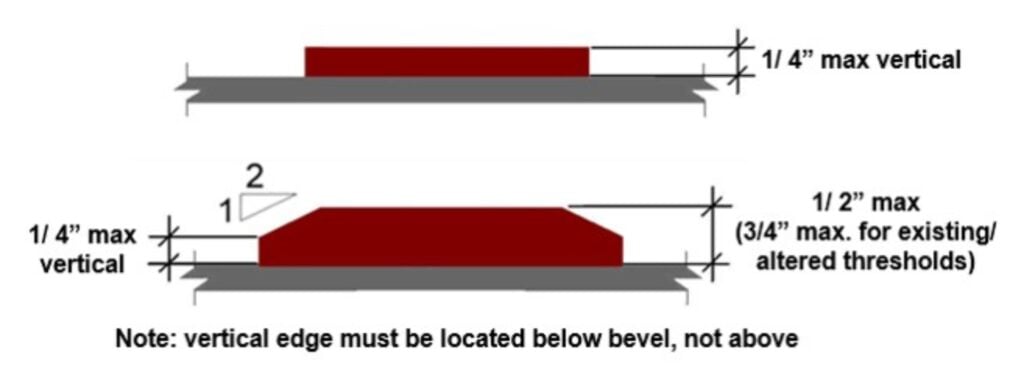
A threshold is the raised strip at the base of a door frame that seals the gap between the door and the floor. Thresholds must not exceed one-half inch in height. Any threshold between one-quarter inch and one-half inch must be beveled with a slope no steeper than 1:2 (as noted in the above diagram), meaning for every half inch of height, the bevel extends at least one inch horizontally (see triangle, upper-left of diagram above).
Thresholds at or below one-quarter inch do not require beveling and may have a vertical edge. New construction and alterations must keep thresholds at or below the one-half inch maximum, and beveling is required for anything over one-quarter inch.
In practice, threshold height is most relevant to exterior door specifications, where weatherproofing often drives threshold design. Flush or near-flush thresholds with appropriate perimeter sealing are the most reliable way to satisfy both weatherproofing needs and ADA requirements simultaneously.
Hardware Mounting Height
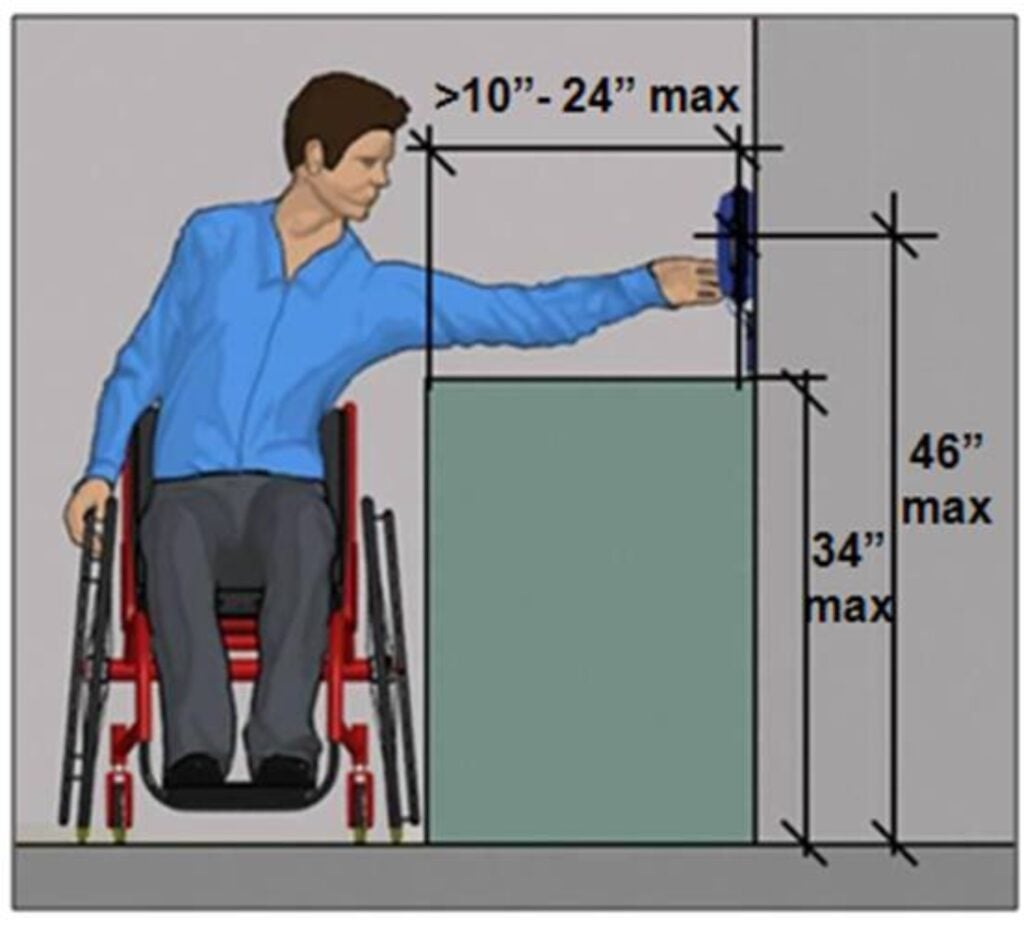
Door hardware must be mounted between 34 and 48 inches above the finished floor. This range ensures hardware is reachable from a seated position and does not require reaching above or below the accessible range. The requirement applies to all ADA-compliant hardware, including handles, pulls, locks, and access control devices.
Doors in Succession
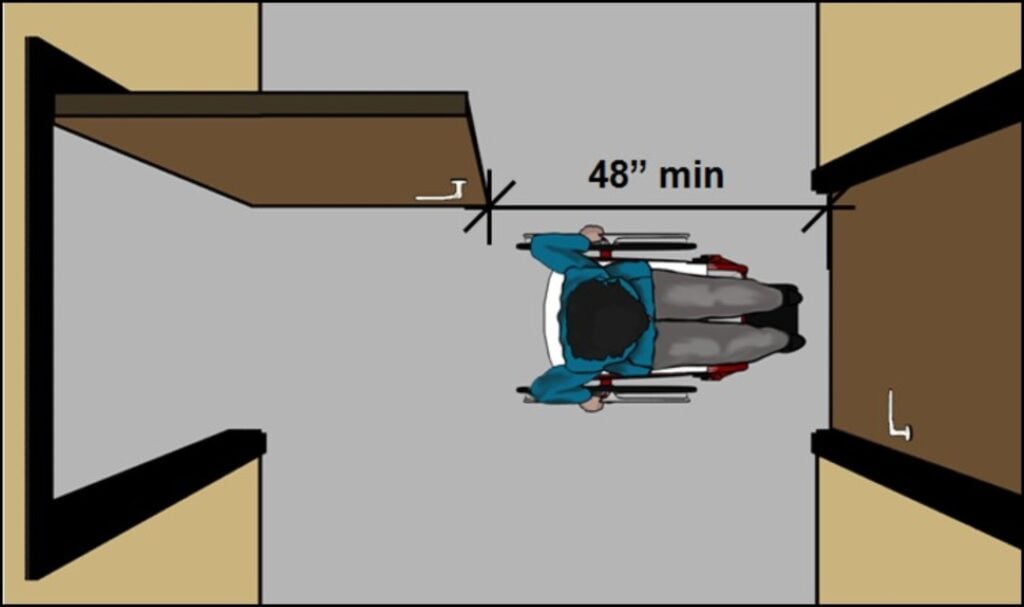
When two hinged or pivoted doors are positioned in series, ADA standards require a minimum of 48 inches between them, measured from the leading edge of the first door in its open position to the face of the second. Both doors must also independently meet all applicable clear width, threshold, hardware, and maneuvering clearance requirements.
The 48-inch minimum ensures a wheelchair user can fully enter the space between the doors, allow the first door to close behind them, and position themselves to open the second without being trapped or forced to hold one door open while operating the other. Where either door swings into the between-door space, the required 48 inches is measured in addition to the door’s swing.
When Full Compliance Isn’t Required
Not every door in a commercial facility is required to meet ADA dimensional standards. For existing facilities, determining what ADA accessibility improvements are required, the obligation is to remove barriers when doing so is readily achievable. What qualifies depends on the cost and difficulty of the modification relative to the resources of the business. Replacing a non-compliant door is generally considered readily achievable for most businesses. Reconfiguring a corridor to achieve maneuvering clearance may or may not be, depending on structural constraints and cost.
The 2010 Standards apply to doors that are part of an accessible route, which is defined as a continuous, unobstructed path connecting accessible elements and spaces within and between facilities. Doors that do not serve an accessible route, including certain service entrances, mechanical room access doors, and doors to spaces that are not required to be accessible, may not be subject to the same requirements.
The Standards also include a dimensional tolerance for existing conditions. In alterations where existing structural or site constraints make it technically infeasible to achieve a 32-inch clear opening, a clear width of no less than 31.75 inches is permitted. This tolerance is narrow and intended for genuine constraint situations, not as a routine alternative to full compliance. Where door replacement alone cannot achieve compliance, alternatives such as ADA lifts may provide an accessible route where one cannot otherwise be achieved within the existing structure.
Which Doors Are Subject to ADA Dimensional Requirements
Whether a door must comply has less to do with its type and more to do with where it sits in a building and who uses it. The following table outlines the most common commercial door locations and whether ADA dimensional requirements apply.
| Doors required to comply | Doors not required to comply |
|---|---|
| Primary public entry doors | Doors to spaces not required to be accessible (e.g., storage closets, private offices not open to the public) |
| Secondary public entrances on an accessible route | Service entrances not used by the public, such as loading docks, provided another compliant entrance exists |
| Interior doors serving public spaces (restrooms, dining areas, meeting rooms) | Doors to mechanical, electrical, and equipment rooms |
| Interior doors serving employee areas that are shared by more than one employee, such as break rooms, shared offices, or internal corridors | Doors to spaces accessed only by ladders, catwalks, or very narrow passageways |
| Doors serving accessible parking areas and loading zones | Doors used exclusively by security personnel to control access |
| Doors on an accessible means of egress, including fire doors | Raised areas exempt from accessible route requirements, such as elevated platforms and certain press boxes |
| Vestibule and mantrap doors when they connect accessible spaces | Employee work areas under 1,000 square feet defined by permanent partitions |
A door that is not required to comply is not necessarily exempt from all ADA requirements. ADA standards address scoping (which doors must be on an accessible route) separately from the technical requirements that apply once a door is on that route. When in doubt about whether a specific door in your facility is subject to ADA dimensional requirements, a professional assessment is the most reliable way to determine compliance obligations accurately.
What Non-Compliance May Cost
ADA Title III complaints can be filed with the U.S. Department of Justice or through private civil action. A successful ADA lawsuit can result in a court order requiring remediation, attorney’s fees, and, in cases involving repeated or widespread violations, civil penalties. The cost of court-ordered remediation is typically higher than proactive correction because it is completed under a compliance deadline rather than as part of planned construction or maintenance work.
Beyond litigation, non-compliant entries affect the actual usability of a facility for customers, employees, and visitors with disabilities. Barriers at entry points have a direct impact on customer access and, in facilities that serve the public regularly, on the facility’s reputation and customer relationships.
The cost of bringing a non-compliant door into compliance varies by situation. A door replacement to achieve clear width compliance is a straightforward project. Reconfiguring an approach to achieve maneuvering clearance may require corridor modifications that are substantially more involved. Identifying and correcting deficiencies during planned renovation or construction is almost always less expensive than addressing them as standalone corrective projects after the fact.
Why a Professional Assessment Is the Right Starting Point
ADA door dimensional compliance involves multiple measurements that interact with each other and with the physical conditions surrounding each door. A deficiency in any one of them constitutes a non-compliant installation regardless of what else is correct. A qualified commercial door contractor can measure clear openings accurately, test closer force on interior doors, evaluate maneuvering clearance dimensions against current approach requirements, review hardware mounting heights, and assess threshold conditions. For facilities planning renovations, a pre-construction assessment identifies which doors in the project scope require correction and allows compliance work to be sequenced alongside planned improvements rather than addressed separately.
Commercial Door provides professional door assessments, installation, and replacement for commercial facilities across Oklahoma, Texas, Arkansas, and Tennessee. Our technicians work with all major commercial door types and are experienced with ADA dimensional requirements across new construction, alteration, and existing facility contexts. Request a free estimate to schedule an assessment or discuss a specific project.


