
Fire doors are more than a building feature. They are life safety systems designed to slow the spread of fire, protect occupants, and safeguard property during an emergency. In Little Rock, Arkansas, businesses must follow both national fire safety standards and local codes enforced by the Little Rock Fire Marshal’s Office.
Building owners are responsible for ensuring fire doors are installed correctly, inspected regularly, and maintained to code. This guide gives a clear overview of the regulations that apply in Little Rock, the most common compliance issues, and how professional services can help your facility remain safe and compliant.
What Are the Current Fire Door Regulations in Little Rock?
In Little Rock, commercial fire doors are regulated under the 2021 International Fire Code (IFC), which the State of Arkansas has adopted with local amendments. These requirements also incorporate standards from the National Fire Protection Association (NFPA) 80, the national guideline for fire doors and other opening protections. Together, they outline how fire doors must be constructed, labeled, installed, and maintained to provide effective protection during a fire.
Local enforcement is handled by the Little Rock Fire Marshal’s Office, which reviews buildings for compliance with fire ratings, labeling, approved hardware, and egress clearance according to local fire prevention codes. Businesses that fail to meet these standards may face violations, fines, or delays in occupancy approval. Key requirements for fire doors in Little Rock include:
- Fire rating and labeling: Every fire door must display a visible, approved label showing its fire-resistance rating.
- Proper installation: Frames, hinges, and other components must be installed in accordance with code and manufacturer specifications.
- Automatic closing and latching: Fire doors must close on their own and latch securely with listed hardware.
- Unobstructed access: Fire doors must remain free of obstructions and cannot be chained, blocked, or propped open.
- Compatible hardware: Panic bars, locks, and other parts must be fire-rated and approved for use with the specific fire door.
- Seals and gaskets: Seals and intumescent strips (materials that expand in high heat to close gaps) must be intact so the door can block the passage of smoke and flames.
- Clearance gaps: The space between the door and frame must not exceed the limits set by NFPA 80.
- Glazing and vision panels: Any glass or vision panel in a fire door must be fire-rated and labeled for that application.
- Field modifications: Drilling holes, cutting vision panels, or altering a fire door without the manufacturer’s approval is prohibited.
- Annual inspection: Every fire door must be inspected at least once per year, and written records of those inspections must be available for review by the fire marshal.
Fire Door Inspection and Maintenance Responsibilities in Little Rock

Building owners and property managers in Little Rock are responsible for keeping fire doors in safe working condition. Under NFPA 80, every fire door assembly must be inspected at least once a year by a qualified professional, and records of these inspections must be kept on file. NFPA 80 defines a “qualified person” as someone with the training, knowledge, or experience to evaluate fire door assemblies.
Little Rock does not require inspectors to hold a specific certification. Still, many businesses choose inspectors with nationally recognized credentials, such as Intertek’s IQP or the Door and Hardware Institute’s FDAI training, to help ensure inspection reports are accepted without issue. The Little Rock Fire Marshal’s Office may review this documentation during routine compliance checks to confirm that all required testing and maintenance have been completed.
Day-to-day maintenance is just as important as scheduled inspections. Fire doors should be checked regularly to confirm they close and latch properly, that no obstructions block the exit path, and that hardware and frames have not been altered. Seals and gaskets should also be inspected for wear, since gaps can reduce protection against smoke and flames.
Standards for Fire Door Hardware, Exit Signs, and Emergency Lighting in Little Rock
A fire door is only as effective as the components that support it. Inspectors in Little Rock review every part of the system to confirm compliance with NFPA 80 and the IFC. Hardware, exit signs, and emergency lighting must all meet code to keep occupants safe during an emergency.
Fire Door Hardware
Every piece of fire safety hardware attached to a fire-rated door must also be UL-listed and fire-rated, and properly installed. If any non-compliant part is used, the entire assembly may fail inspection. Key types of fire door hardware include:
- Hinges and pivots
- Locks and latches
- Door closers
- Panic and exit hardware
- Flush bolts and astragals
- Glazing and vision panels
- Electrified hardware
- Seals and gaskets
- Kick plates and protective plates
Exit Signs and Emergency Lighting
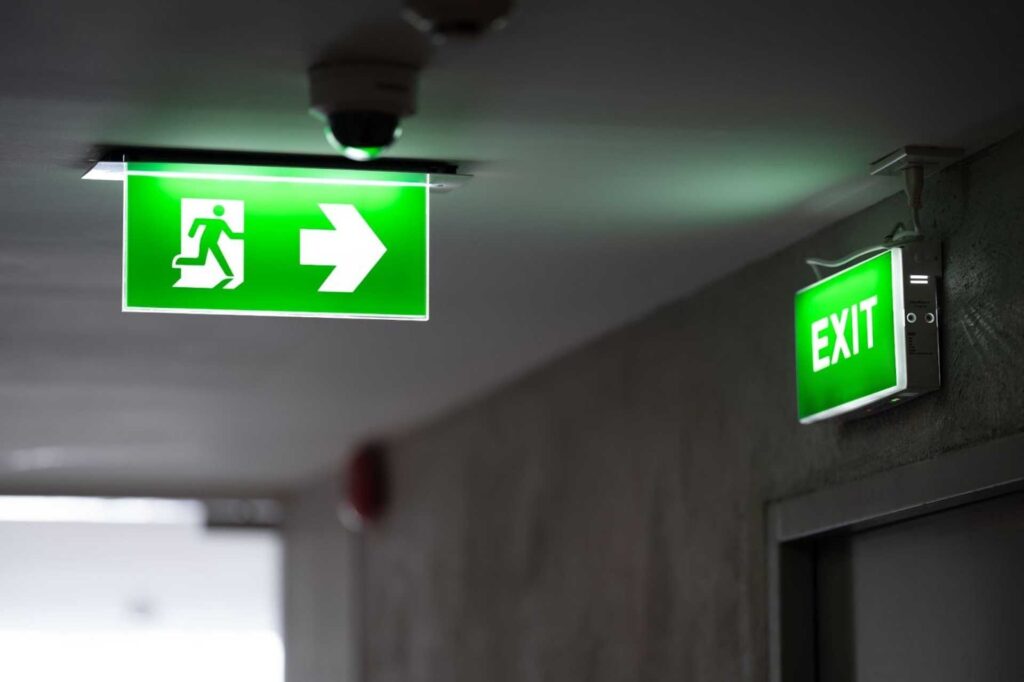
Exit signs and emergency lighting must be installed in all areas where people need to safely leave a building, including hallways, stairwells, doors, and large open spaces.
- Exit signs must remain illuminated at all times, even during a power outage, so occupants can quickly locate the nearest exit.
- Emergency lighting must activate automatically if power fails, using backup batteries or generators to keep exit paths visible.
Common issues include burned-out bulbs, blocked signage, disconnected wiring, or dead batteries, all of which can cause violations during inspections. Regular testing and maintenance are critical to ensure both systems remain reliable, code-compliant, and ready in an emergency.
Rolling Fire Doors Regulations in Little Rock
Some commercial buildings in Little Rock use rolling fire doors, particularly in warehouses, industrial facilities, and areas where a standard swinging fire door is not practical. These doors are designed to stay open during normal operations and automatically drop when a fire is detected, helping isolate fire and smoke and protect adjacent spaces. Rolling fire doors must comply with NFPA 80 just like swinging fire doors, but they have a few additional requirements:
- Automatic release: Rolling fire doors are equipped with heat-activated devices, such as fusible links or electronic releases, that trigger the door to close during a fire.
- Annual drop test: NFPA 80 requires rolling fire doors to be tested at least once per year to confirm they close fully and at a safe, controlled speed. This test must be documented and available for review by the Little Rock Fire Marshal’s Office.
- Reset and inspection: After a drop test or fire activation, the door must be reset and re-inspected to confirm it is operating correctly.
- Maintenance of guides and tracks: The guides, tracks, and counterbalance systems must remain clean, aligned, and free of damage to ensure the door can drop properly when activated.
Because rolling fire doors use specialized mechanisms to stay open and release in an emergency, businesses often rely on trained technicians to perform testing, resetting, and repairs. Regular maintenance ensures these systems function correctly when needed, keeping the building compliant and protected.
Common Fire Door Compliance Issues in Little Rock Businesses
Even when fire doors are installed correctly, ongoing use and poor maintenance can create serious problems. Fire marshals in Little Rock can cite businesses for non-compliance issues that keep doors from operating as intended. These violations are not only code failures but also reduce the ability of fire doors to contain smoke and flames during an emergency. Common problems include:
- Propped-open doors: Using wedges, straps, or equipment to hold a door open prevents it from closing in a fire.
- Blocked egress routes: Storing carts, boxes, or supplies in front of fire doors restricts the clearance needed for safe exit.
- Missing or damaged labels: Fire doors without clear, legible rating labels are not compliant.
- Non-compliant hardware: Installing locks, closers, or panic devices that are not fire-rated fails code requirements.
- Disabled self-closing devices: Disconnecting or removing door closers is a violation that compromises safety.
- Damaged frames or hinges: Loose, bent, or cracked frames and hinges prevent doors from closing and latching securely.
- Worn or missing seals and gaskets: Gaps around the door allow smoke or flames to pass through, weakening protection.
- Improper field modifications: Adding holes, vision panels, or other alterations without manufacturer approval invalidates compliance.
- Painted-over labels or hardware: Covering rated components or labels with paint makes them unreadable and non-compliant.
- Combustible storage nearby: Keeping flammable materials too close to a fire-rated door can result in citations.
- Lack of inspection records: Businesses must maintain written documentation of annual inspections for review by the fire marshal.
Penalties and Consequences for Fire Door Non-Compliance in Little Rock
Businesses in Little Rock that fail to maintain fire doors and related safety systems face more than citations. Non-compliance can lead to fines, delayed approvals, legal exposure, and increased risk during emergencies. The Little Rock Fire Marshal’s Office enforces these requirements to protect both occupants and property.
| Penalty or Consequence | Description |
|---|---|
| Fines for violations | Businesses may be fined for failing to meet fire door and safety code requirements. |
| Delayed occupancy permits | New or renovated buildings can face delays in obtaining occupancy permits until violations are corrected. |
| Operational shutdowns | Serious or repeated violations can result in temporary closures until compliance is achieved. |
| Reputation damage | Businesses cited for repeated fire safety violations risk losing trust with tenants, customers, or regulators. |
| Fire marshal re-inspections | Businesses may be required to pay for multiple follow-up inspections until issues are resolved. |
How Professional Technicians Keep Fire Doors Compliant
Meeting fire door regulations in Little Rock requires more than simply installing a rated door. Every component must be installed correctly, inspected on schedule, and maintained to code. Professional technicians understand the details of NFPA 80, the IFC, and the local amendments enforced by the Little Rock Fire Marshal’s Office. They ensure that doors, frames, and hardware are installed according to both manufacturer specifications and code requirements.
When issues are found, technicians provide detailed reports that can be used as proof of compliance during fire marshal reviews. They also repair or replace damaged or outdated parts with fire-rated components, keeping the entire assembly compliant.
Commercial Door Can Help You Comply
Commercial Door provides professional fire door installation, inspection, repair, and maintenance throughout Little Rock. Our team handles every step of the process, from correcting hardware issues to preparing inspection records for review by the fire marshal. If your fire doors are due for inspection or repair, schedule a free estimate with Commercial Door today to keep your building safe, compliant, and ready for review.


