
In commercial buildings, controlling airflow at entrances plays a direct role in energy efficiency, comfort, and day-to-day operations. Doors that open frequently can allow outside air, heat, cold, dust, and moisture to move freely into the building, placing added strain on HVAC systems and disrupting indoor conditions.
An air curtain is a commercial solution designed to address these challenges without restricting foot traffic or workflow. Commonly used in retail, industrial, food service, and warehouse environments, air curtains create an invisible air barrier at door openings that helps separate indoor and outdoor air.
Understanding what an air curtain is, how it works, and where it is most effective can help businesses determine whether it is the right solution for their facility. In this guide, we explain what an air curtain is, how it works, what it is used for, how effective it is, and the different types of air curtains commonly used in commercial settings.
What Are Air Curtains and How Do They Work?
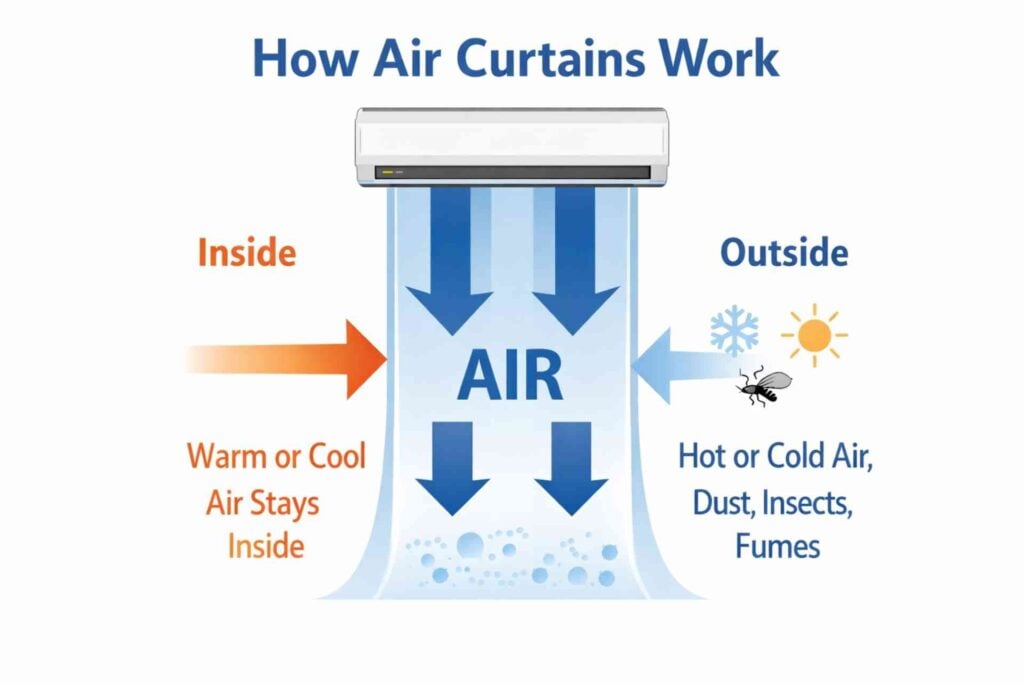
An air curtain, or air door, is a mechanical device installed above or beside a commercial doorway that produces a controlled stream of air across an open entrance. Instead of using a physical barrier, an air curtain relies on airflow to create separation between two spaces while the opening remains unobstructed.
When activated, the air curtain releases a continuous flow of air directed downward or horizontally across the doorway. This airflow is generated by an internal fan and motor assembly that draws in air and discharges it at a specific speed and angle.
The effectiveness of an air curtain depends on the velocity, direction, and consistency of the uniform air stream to counteract pressure differences that naturally occur between indoor and outdoor environments when a door is open. By maintaining a stable air barrier, the air curtain limits air movement across the opening without physically closing it.
What Are Air Curtains Used For?
Air curtains are an ideal solution to manage airflow at open doorways while keeping entrances accessible. They are most effective in environments where doors open frequently or must remain open for operational reasons, and can:
- Reduce indoor and exterior air exchange. Air curtains help limit the amount of outside air that enters a building and conditioned inside air that escapes when doors are open.
- Maintain temperature separation. By creating a stable air barrier, air curtains help support different cold or hot air temperature zones at building entrances or between interior areas without requiring physical separation.
- Manage airflow in high-traffic openings. In facilities with constant foot traffic, deliveries, or equipment movement, air curtains allow doors to remain open for continuous operation without disrupting interior airflow patterns.
- Limit the entry of airborne debris. Air curtains help reduce the intrusion of dust, flying insects, and other airborne particles that can enter through open doors in busy commercial environments.
- Separate interior environments. Within a single facility, air curtains are used to divide sensitive areas with different environmental or operational requirements while maintaining open access between them.
- Reduce HVAC strain caused by door activity. Air curtains help stabilize airflow, reducing the impact of door usage on heating and air conditioning systems.
What Are the Different Types of Air Doors?
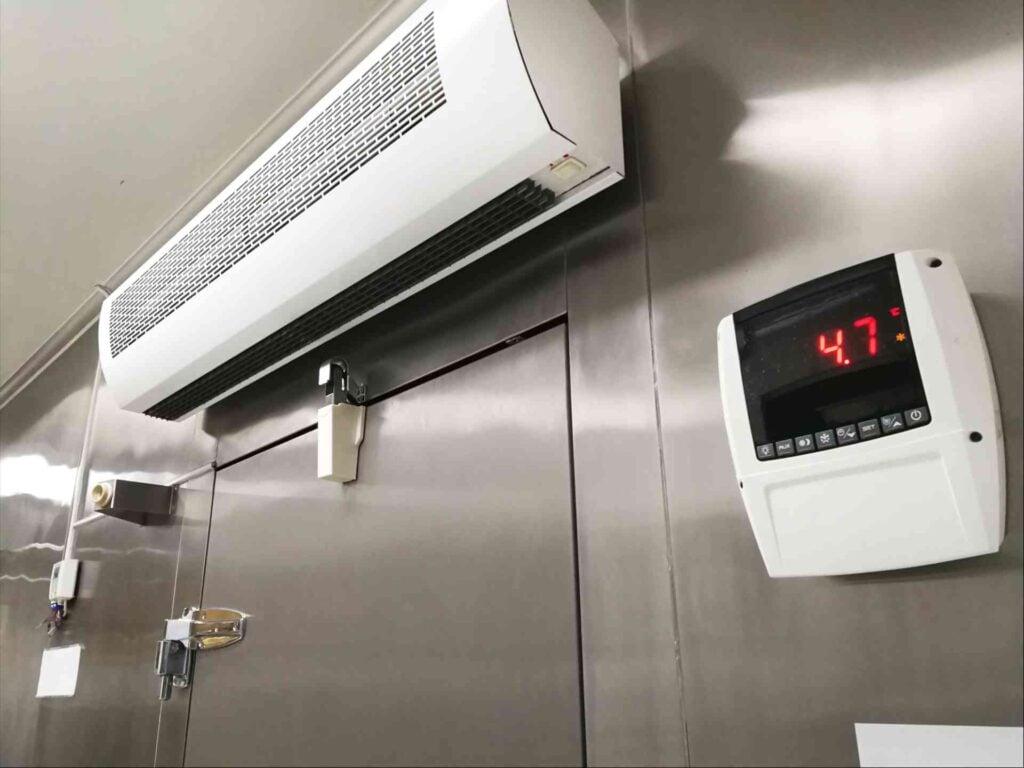
Air curtains are available in a range of configurations to suit different commercial openings, environmental conditions, and operational needs. Understanding the main types helps ensure you select the right air curtain for its application.
| Type of Air Curtain | Description |
|---|---|
| Non-heated air curtains | Non-heated air curtains use ambient air only and do not add heat to the air stream. These units are commonly used in mild climates, interior doorways, or applications where temperature control is secondary to airflow separation. |
| Electric heated air curtains | Electric heated air curtains include internal electric heating elements that warm the air stream. They are often installed at entrances in colder climates where supplemental heat helps reduce cold air infiltration. |
| Gas-heated air curtains | Gas-heated air curtains use natural gas or propane to heat the air stream. These units are typically used in large commercial or industrial openings where higher heating capacity is required. |
| Ambient-duty air curtains | Ambient-duty air curtains are designed for standard commercial entrances with moderate traffic and typical mounting heights. They are commonly used to maintain a comfortable interior in retail stores, offices, and customer-facing spaces. |
| Industrial-duty air curtains | Industrial-duty air curtains are built for demanding environments, including large openings, higher mounting heights, and frequent or continuous use. These units are commonly installed in warehouses, manufacturing facilities, and by loading dock doors. |
| Horizontal air curtains | Horizontal air curtains are mounted above the doorway and direct air flow downward across the opening. This is the most common configuration for commercial entrances. |
| Vertical air curtains | Vertical air curtains are mounted along one or both sides of an opening and direct air horizontally across the doorway. They are used when overhead mounting space is limited or when doorway height exceeds standard limits. |
| Surface-mounted air curtains | Surface-mounted air curtains are installed directly onto the wall or structure above or beside the opening. These air curtains are often visible and common in industrial and commercial environments. |
| Recessed air curtains | Recessed air curtains are installed within ceilings or wall cavities so the unit is hidden from view. This option is often selected for customer-facing spaces where aesthetics are a priority. |
| Automatic air curtains | Automatic air curtains are connected to door switches or sensors and activate when the door opens. This ensures consistent operation without requiring manual input or high operating costs. |
| Manually controlled air curtains | Manually controlled air curtains are operated using wall-mounted switches or control panels. These are often used in industrial settings where airflow control is adjusted based on operational needs. |
What Businesses Commonly Use Air Curtains?
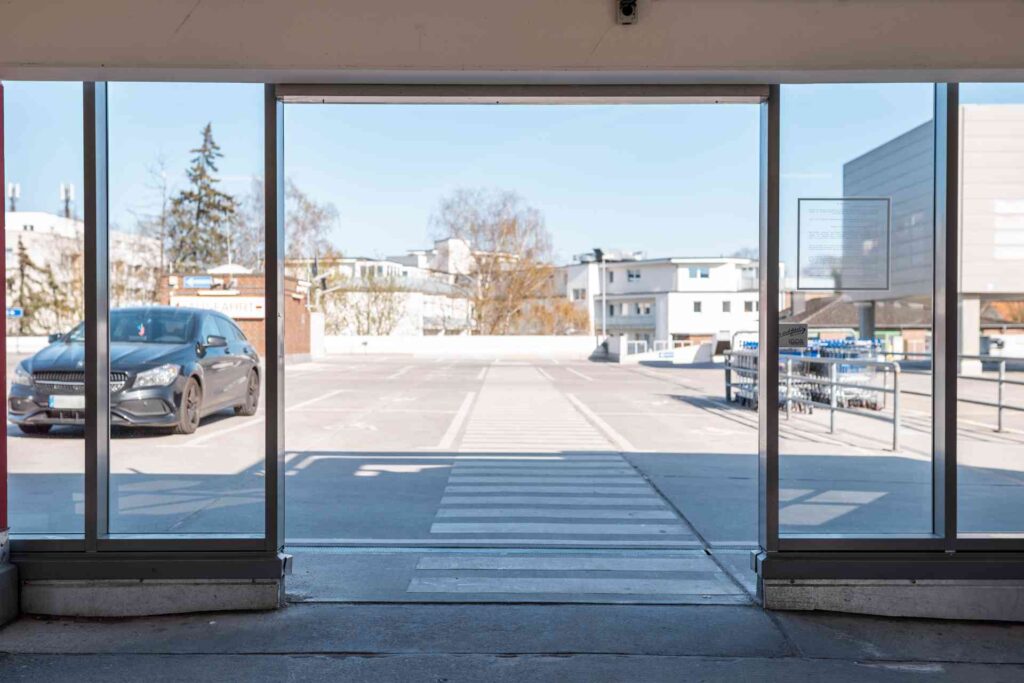
Air curtains are often used across many commercial environments where doorways are frequently used or must remain open for operational reasons. The following business types represent the most common commercial applications for air curtains.
- Retail and commercial storefronts: Air curtains are installed at customer entrances in retail and commercial storefronts to help manage airflow while allowing doors to remain open during business hours.
- Warehouses and distribution centers: Warehouses use air curtains at large openings, receiving doors, and access points where equipment, deliveries, and personnel move continuously throughout the day.
- Restaurants and food service facilities: Restaurants and food service environments use air curtains at kitchen entrances, drive-thru windows, service doors, and receiving areas to help maintain interior conditions while supporting constant staff movement.
- Manufacturing and industrial facilities: Manufacturing facilities install air curtains at production and exterior access points to manage airflow without disrupting operations and reducing energy loss.
- Healthcare and medical buildings: Healthcare facilities use air curtains at entrances and interior openings where maintaining controlled indoor environments is important for patient well-being, protecting against threats like airborne viruses.
- Commercial office buildings: Office buildings install air curtains at main entrances and service areas to help maintain comfortable interior conditions and reduce energy costs during periods of high foot traffic.
- Loading docks and receiving areas: Air curtains are used at dock-adjacent openings to manage airflow when doors open frequently during deliveries and shipping operations.
- Cold storage and temperature-controlled facilities: Cold storage facilities install air curtains at cooler and freezer openings to help manage temperature separation and how much energy escapes during frequent access.
- Transportation and logistics facilities: Transportation and logistics buildings, like airports and freight companies, use air curtains in terminals, freight areas, and service zones with constant door activity.
- Automotive service and vehicle service bays: Automotive service facilities and car dealerships install air curtains at service bay openings where large doors remain open during active repair and maintenance work.
Factors That Can Affect How Your Air Curtain Works
The effectiveness that air curtains offer depends on how well they are matched to the specific doorway and environment. Proper selection, installation, and operating conditions all play a role in how well the air barrier performs.
- Doorway size and mounting height: An air curtain must be sized correctly for the width and height of the opening. Units that are too small or mounted too high may not produce a consistent air stream across the entire doorway.
- Air velocity and coverage: The air stream needs sufficient velocity and uniform coverage to maintain separation between spaces. Inconsistent airflow can reduce the stability of the air barrier.
- Environmental and pressure conditions: Wind exposure, temperature differences, and building pressurization can affect performance. Openings exposed to strong airflow or extreme conditions may require higher-capacity or industrial-duty units.
- Traffic patterns and door usage: Frequent door openings, equipment movement, or long open-door periods make air curtains run continuously and can influence their performance. Units should be selected with real-world usage in mind.
- Role as a supplemental system: Air curtains are designed to support airflow control when doors are open, not replace physical doors or insulation. They are most effective when used as part of a broader approach to environmental management.
Making Informed Decisions About Air Curtains in Commercial Buildings
Air curtains are a practical solution for managing airflow in commercial environments where doors are used frequently or must remain open. Creating a controlled air barrier helps businesses balance access, comfort, and operational efficiency without relying solely on physical doors or structural changes.
For businesses within our service areas, evaluating an air curtain often starts with reviewing doorway usage, environmental conditions, and installation requirements. Commercial Door offers free estimates for air curtain installation, repair, and maintenance, allowing businesses to explore their options and determine the right solution for their facility.


