A commercial door closer is the mechanical device responsible for controlling how a door returns to its closed position after someone opens it. It uses a combination of spring tension and hydraulic regulation to keep that motion smooth and controlled rather than abrupt. They’re common across commercial spaces, where they support security, accessibility, and traffic management, but like any device with moving parts, they’re bound to experience wear and tear over time.
Recognizing the signs that your commercial door closer needs repair helps keep your building’s doors functional, compliant, and secure. In this post, we’ll cover what causes door closers to fail, the signs that indicate your closer needs attention from a commercial door technician, and how routine maintenance can help you avoid repairs altogether.
What Causes Door Closer Problems?
Most commercial door closer issues trace back to one of five underlying causes, and knowing which one is at play helps determine whether a closer needs a simple adjustment or a full repair. Here’s a breakdown of what’s actually going wrong inside a failing closer.
- Hydraulic system failure. Internal valves or seals wear out, allowing fluid to escape or stop regulating properly.
- Mechanical wear. Solid moving parts like springs, gears, and detent mechanisms (the small spring-loaded components that hold the door open at specific positions) wear out from repeated use.
- Mounting and attachment failure. The connection point between the closer and the door or frame comes loose, whether from screws working free of the mounting surface, a mounting plate pulling away, or the wall material behind it deteriorating.
- Geometric misalignment. The arm, pivot points, or the relationship between the door and frame shift out of true over time, even when the closer’s mounting is perfectly solid.
- External interference. Corrosion from environmental exposure or debris and buildup in the arm track acts on the closer from outside its normal operation, rather than from internal wear.
Signs Your Commercial Door Closer Needs Repair

Door closer problems rarely appear all at once. More often, they show up gradually as small changes in how the door feels or sounds during operation, and each one usually traces back to one of the root causes above. Here are the signs to watch for.
1. Difficulty Opening or Closing the Door
One of the most obvious signs that your door closer needs attention is when the door becomes difficult to open or close. Increased resistance usually points to mechanical wear, most often the closer’s internal spring tension dropping below its calibrated range, and on surface-mounted closers, you may notice physical strain on the arm bracket as the door moves.
2. Uncontrolled Closing Speed
Closers are installed to make doors close smoothly, evenly, and at a controlled pace, but when hydraulic valves or seals wear out, that control breaks down in one of two directions:
- Closing too fast. The door snaps shut or slams hard at the latch point, creating injury risk and damaging hardware over repeated cycles.
- Closing too slowly. The door drifts closed at a crawl or stalls before it latches, leaving your building exposed to security and climate control issues.
Either symptom traces back to the same hydraulic failure and is worth having checked out before it gets worse.
3. Hydraulic Fluid Leaks
Any fluid leaking from your door closer is a clear sign of hydraulic system failure, since the closer relies on that fluid to regulate speed and movement. Once gaskets or seals fail, and it starts escaping, the closer gradually loses its ability to do its job. If you see fluid around the closer body or on the door frame beneath it, that closer is on borrowed time, and the sooner it gets looked at, the less likely you are to deal with a full failure at an inconvenient moment.
4. Loud or Unusual Noises
Door closers are usually pretty quiet, so anything that sounds out of the ordinary, such as squeaking, grinding, scraping, or popping during the open or close cycle, is an early warning that something isn’t right. Grinding often points to mechanical wear, while squeaking can indicate dry pivot points from wear or misalignment. These sounds tend to get worse over time rather than better, so catching them early usually means a simpler fix.
5. Door Won’t Hold Open
Many commercial door closers include a hold-open feature, either a built-in arm that locks the door open at a set angle or a separate hold-open device. When this mechanism wears out, doors that should stay open during business hours or high-traffic periods won’t stay in position.
6. Closer Arm Misalignment
If the closer arm catches, sticks, or skips at a specific point in its swing rather than moving continuously, the arm linkage or pivot points have likely shifted out of alignment. This is different from an overall speed problem: the door may open and close at a normal pace but hang up at one specific spot in the arc. That pattern tends to get worse with repeated stress, so catching it early prevents a small misalignment from turning into a bent arm or a cracked mounting point.
7. Obstruction or Debris in the Arm Track
Sometimes a closer binds, sticks, or makes noise not because anything is worn or broken, but because dirt, debris, or paint buildup has accumulated in the arm track or around the pivot points. This is worth ruling out before assuming a closer needs repair, since a thorough cleaning can sometimes resolve symptoms that look identical to mechanical wear. If cleaning doesn’t resolve the issue, the obstruction may have already caused wear to the components underneath it, and a technician can check for both.
8. Loose or Wobbly Closer Body
A door closer that visibly shifts or wobbles when the door operates has a mounting problem. Unlike wear issues that develop gradually, a loose mounting can fail suddenly, since every cycle puts uneven stress on the arm and spindle while the connection point is compromised. If your closer is moving when it shouldn’t be, get it looked at sooner rather than later.
9. Visible Wear and Tear
Rust, corrosion, dents, and cracks are bound to happen over time, especially on exterior doors or in high-humidity environments, and this kind of external interference can shorten the lifespan of the closer by pitting internal components (creating small surface cavities that accelerate wear) and weakening the housing or arm itself.
Regulatory and Compliance Risks
Closer problems on standard doors are an inconvenience, but on doors with a regulatory function, the same symptoms carry higher stakes:
- ADA-designated entrances. Accessible entrances must take at least five seconds to close from a 90-degree open position. Degrading hydraulics often push closing speed past that threshold without the door appearing obviously broken.
- Fire-rated doors. These doors must close and latch completely without assistance every time, since that’s what allows them to perform their fire separation function in an emergency. A closer that’s leaking, slow, or failing to latch is a deficiency that inspectors will flag.
If your building has either type of door, the closer condition on those doors should be checked on a more frequent schedule than the rest of your building.
Routine Maintenance Will Help You Avoid Frequent Repairs
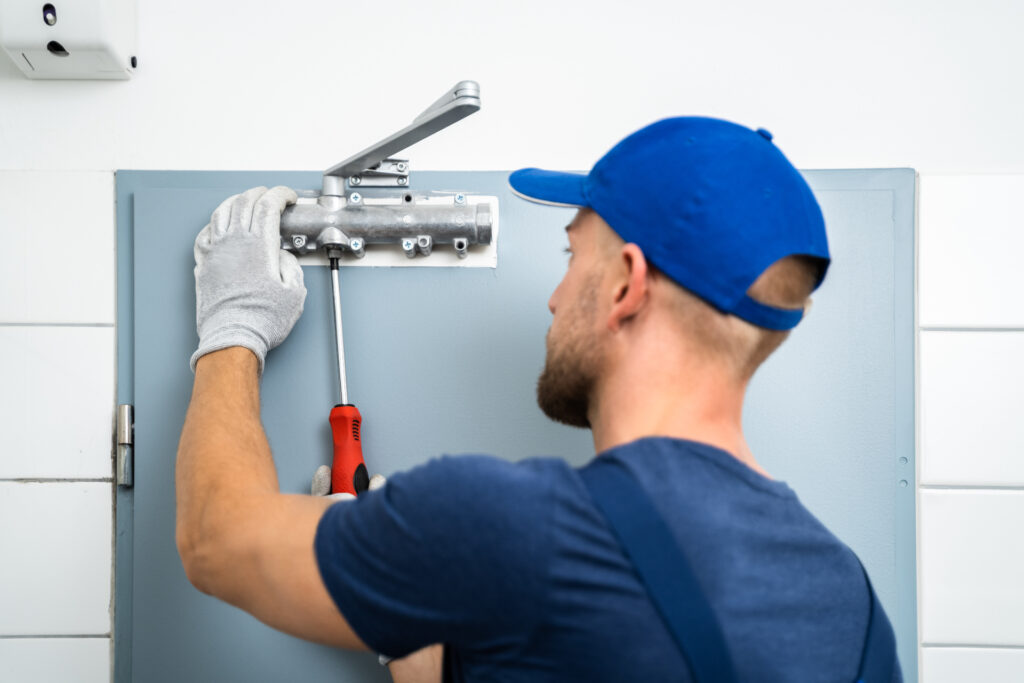
Most door closer problems develop gradually, so a consistent maintenance routine gives you a much better chance of catching issues early. Here are a few things you can do to keep your commercial door closers in good shape.
- Inspect your closer regularly. Check for the signs listed above, including fluid around the body, visible corrosion, unusual resistance, or unusual sounds, and call a technician if anything worsens or affects function.
- Lubricate moving parts. Some closers require lubrication at pivot points to keep everything operating smoothly. Use a manufacturer-recommended lubricant, or ask a technician during a service visit if you’re unsure what your closer needs.
- Make adjustments as needed. Most closers have adjustable valves controlling sweep speed, latch speed, and backcheck resistance, so a door behaving differently is sometimes a simple adjustment rather than a repair.
- Check for loose hardware. Door motion works screws loosen over time, so check and tighten the mounting screws on the closer body and arm bracket during routine inspections.
- Schedule professional inspections. For closers on fire doors, ADA-required entrances, or secured access points, regular professional inspections catch wear that isn’t obvious visually and confirm closing speed and latch function still meet code, which is considerably cheaper than a failed closer or a compliance violation.
Keep Your Closers in Good Shape
A door closer showing any of the signs above won’t get better on its own, and waiting too long can turn a simple adjustment into a full replacement or, on a regulated door, a compliance problem. Whether you’re dealing with an emergency closer failure or just want to get ahead of one with routine maintenance, our technicians have the experience to diagnose the issue correctly and fix it right the first time.
If you’re ready to get your door closers looked at, request a free estimate, and we’ll get a technician out to you. We’re available 24/7, so there’s no need to wait for a convenient time if something needs attention now.