
Automatic doors handle more daily use than almost any other system. They manage the flow of people in and out of a facility from the moment it opens to the moment it closes, and come in a wide range of configurations and applications, from sliding doors at a retail entrance to high-speed roll-ups in a distribution center. Each is built to do the work so people and operations do not have to stop for it.
We put this guide together to share what these systems are, how they work, and what each type of automatic door is suited for. We’ll also cover what separates a well-run system from one that is going to cause problems. If you are evaluating automatic doors for your facility or trying to get a better handle on what you already have, this is a good place to start.
How Do Commercial Automatic Doors Work?
Commercial automatic doors are power-operated door systems used in commercial buildings, designed to open and close without requiring manual operation.
When a person approaches, the door opens automatically in response to either a sensor signal, such as a motion detector picking up movement, or an access control command, such as a key fob, swipe card, or keypad entry. Many facilities use both: sensors on public-facing entrances and access control on restricted areas. The door then closes automatically after each use, without requiring anyone to physically open or close it.
Here is the sequence from the moment a person approaches to the moment the door closes behind them.
1. The Sensor Detects Movement
Above every automatic door we install, there is an activation sensor doing a job most people never think about. It sits above the entrance and continuously scans the approach zone, waiting to trigger the opening sequence the moment someone enters its range.
Most commercial systems use either microwave beam motion detectors or passive infrared sensors for this. Microwave detectors work by emitting pulses and reading the disruption when someone moves through them. Passive infrared sensors detect body heat. Each has a weakness: microwave detectors are vulnerable to electrical interference from nearby equipment, and passive infrared sensors can struggle when ambient temperatures are close to body temperature or when someone is moving slowly.
Choosing between them, or deciding to use both, comes down to the specific conditions of the entry. That is a call we make based on traffic patterns, the environment, and how much tolerance the location has for a false trigger or a missed detection.
2. The Operator Drives the Door Open
When the sensor fires, it signals the electric motor in the door operator to move the door. On sliding systems, the panels run along overhead tracks. On swinging systems, the operator rotates the door through its arc at a controlled speed.
3. A Presence Sensor Holds the Door Open
The activation sensor and the presence sensor are doing two different jobs, and both need to be calibrated correctly. The activation sensor triggers the door to open. The presence sensor covers the opening itself and keeps the door from closing while anyone is still passing through or standing in it. One opens the door, the other keeps it open. When a door closes on someone, one of those two sensors has failed or drifted. That is where we start every time.
4. The Door Closes With Safety Systems Active
Once the presence sensor confirms the opening is clear, the operator closes the door. Safety sensors monitor the door path throughout the closing sequence and reverse the door if something enters it. We set these parameters at installation, and they need to be verified periodically against applicable safety regulations. They drift over time from vibration and wear, and when they do, the door can look completely functional from the outside while its safety margin has quietly eroded.
Why Commercial Facilities Choose Automatic Doors
For facility managers and business owners responsible for operations, compliance, and occupant safety, automatic doors address several ongoing concerns at once. Here are the reasons we see driving the decision most often across commercial properties.
- ADA compliance and accessibility. Automatic doors are one of the most direct ways to create accessible entrances under the Americans with Disabilities Act (ADA). They remove the need to grip door handles or apply manual force to open a door, which is the primary physical barrier for people with mobility limitations. An automatic door system following ADA entrance requirements is often the most straightforward path to a compliant, fully accessible entry point. We have helped many facilities address compliance gaps through automatic door installations, and it tends to be a simpler solution than clients expect.
- Hygiene and contamination control. Because automatic doors require no hand contact to operate, they remove a high-contact touchpoint from your facility entrance. In healthcare environments, food processing facilities, and cleanrooms, that matters considerably. Airtight and hermetically sealed models go further, maintaining pressure differentials and contamination barriers in clinical and controlled areas.
- Energy efficiency. Automatic doors open only when triggered and close promptly after each passage. That consistent behavior directly reduces energy loss at entry points, which translates to real energy savings in facilities where heating and cooling costs are high. For facilities in climates with extended heating or cooling seasons, the difference between a properly functioning automatic door and a manual door that gets propped open adds up fast.
- Security and access control. Our teams integrate automatic doors with access control systems to manage who enters, through which entry points, and at what times. A facility can configure entry via pin codes, card readers, key fobs, video intercom systems, or biometric devices, with the automatic door as the controlled point of passage. Security systems can lock doors remotely, hold them open for emergency exit, or restrict entry to authorized individuals during off-hours.
- Throughput and traffic flow. Entry points create bottlenecks when doors are slow, narrow, or require manual operation. In high traffic areas, that friction compounds fast. Automatic doors sized and configured for actual traffic volume keep people and equipment moving without requiring anyone to stop and manage the door. We see the most immediate operational improvement in facilities upgrading primary public entrances that were undersized or underspecified for the volume they handle every day.
- Improved safety. Properly installed and maintained automatic doors with functioning obstruction detection and compliant force settings reduce the risk that someone is struck by a door. More importantly, they indicate that you are taking reasonable care for everyone entering the building, which matters in both regulatory and legal contexts.
Types of Commercial Automatic Doors
The common types of automatic doors used in commercial settings each have distinct operational uses, and the right choice depends on factors specific to your facility. Here is how we think about each of the types of automatic doors we install and service, including where they perform well and where we would steer a client toward a different option.
Automatic Sliding Doors
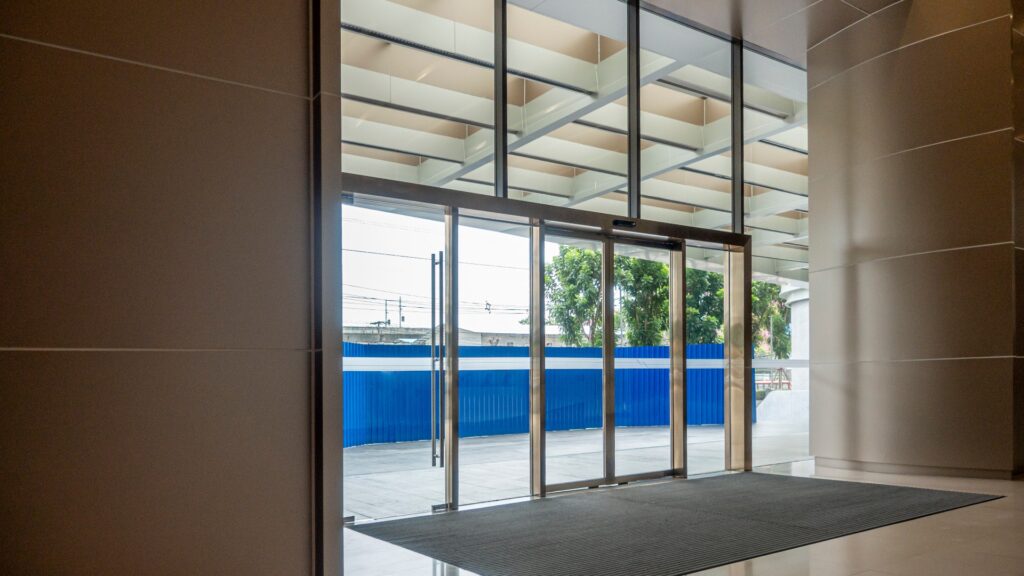
Sliding doors are the most common system we install. A single-panel configuration slides to one side, while a bi-parting configuration separates at the center and opens to both sides, supporting two-way traffic and giving you a wider, clearer opening without increasing the wall space the track requires. Because the panels slide rather than swing, no swing clearance is required, which makes them practical in tight entrance areas where a swinging door would not fit.
Automatic sliding doors run on overhead tracks and work well across a wide range of public entrances: office lobbies, retail storefronts, healthcare facilities, and most high-traffic areas where you need clean, continuous pedestrian flow.
Swinging Automatic Doors
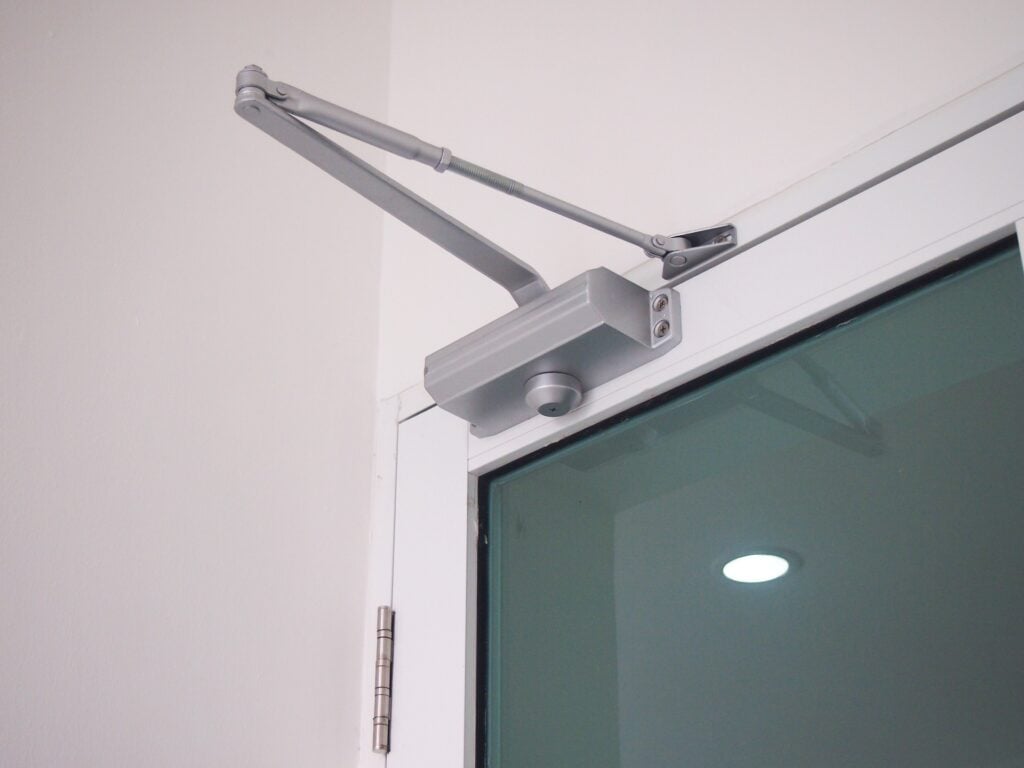
An automatic swinging door uses a low-energy or full-power operator to move a standard hinged door through its arc. Low-energy operators move the door at a controlled, code-compliant speed and are triggered by a push plate or motion sensor. Full-power operators handle heavier doors and higher traffic.
We spec these most often in interior passages, secondary entrances, and situations where a facility already has a swing door and needs to automate it for accessible entrances without replacing the full door assembly.
The installation is typically less involved than a sliding system, and for lower-traffic applications, it is usually the most cost-effective path to hands-free entry without door handles or manual operation.
Automatic Revolving Doors
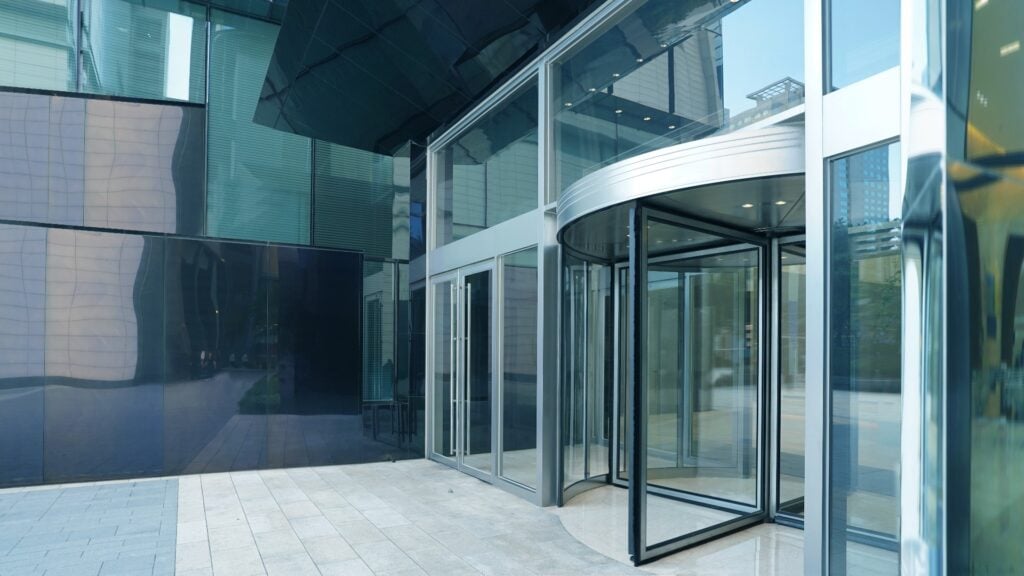
Automatic revolving doors rotate continuously or in response to sensor input, moving multiple users through the entrance simultaneously while keeping interior and exterior environments separated.
Hotels, office towers, airports, and large shopping centers get the most value from revolving doors because they have both the foot traffic volume and the energy costs to make the performance meaningful. They integrate with emergency egress requirements through breakaway panels that collapse flat to create a clear passage during a fire or evacuation event.
Folding and Telescoping Doors
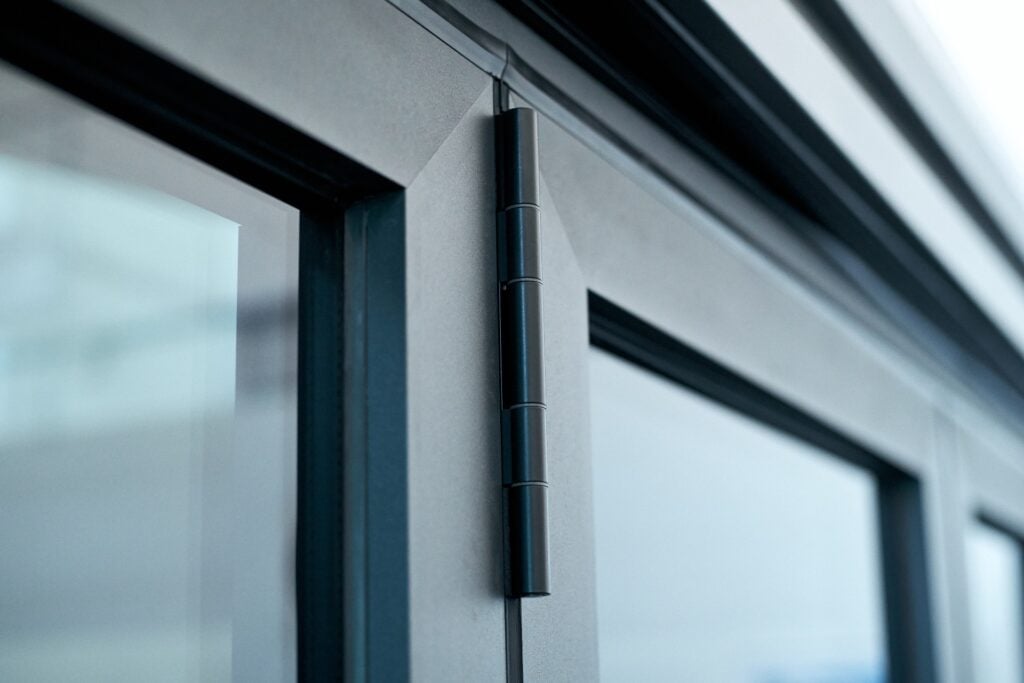
Folding doors use multiple narrow panels that stack accordion-style at the edge of the opening. Telescoping configurations use overlapping panels that slide in sequence, achieving a similar clear opening from a shorter track. Both are typically installed in hospital corridors, loading areas, and facilities that regularly move large equipment through entry points.
If a client comes to us with a wide opening and limited wall clearance on either side, folding or telescoping are the solutions we suggest. For most commercial facilities, it is an excellent solution that tends to get overlooked because it is less familiar than sliding or swinging options.
High-Speed Automatic Doors
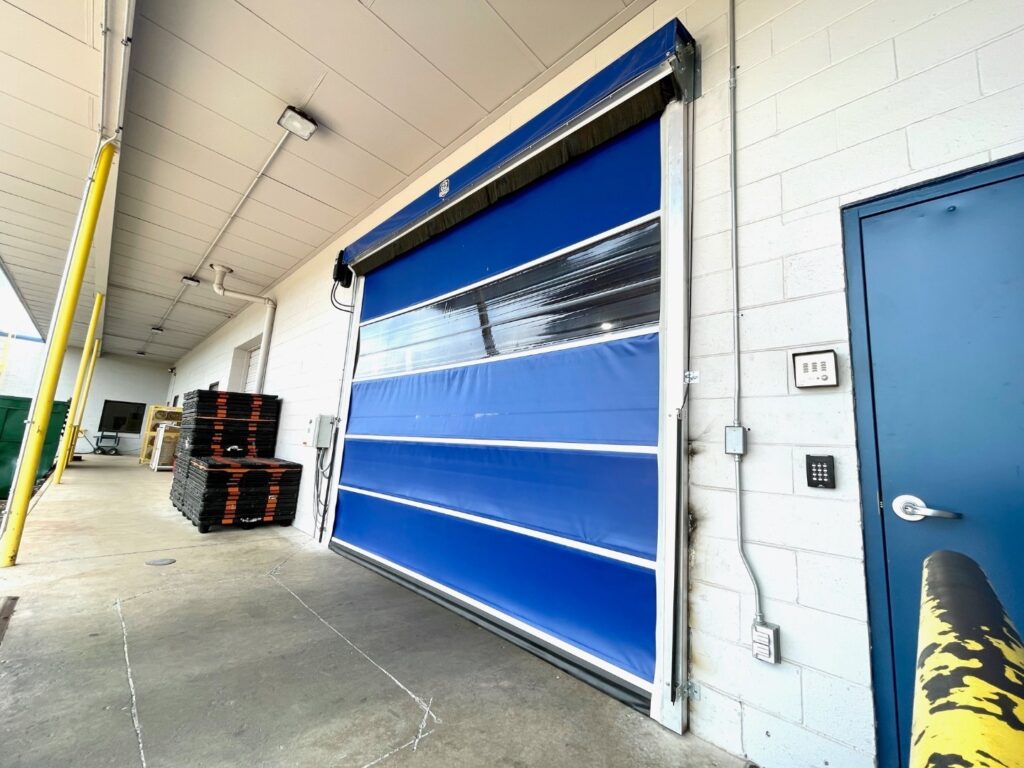
If you are running a distribution center, a manufacturing facility, a cold storage operation, or a food processing plant, and you are not running high-speed doors on your high-cycle entries, you are either overspending on repairs or about to start.
Standard automatic doors are not built for the thousands of daily cycles that industrial and logistics environments demand. They wear ahead of schedule, require constant adjustment, and spend a disproportionate amount of time in a transitional state that defeats the purpose of having a door in the first place.
High-speed automatic doors open and close in seconds, are engineered for the cycle frequency these commercial properties require, and produce measurable energy savings by minimizing transition time at each entry point. For loading dock applications, the right solution is almost always a high-speed system.
What Commercial Automatic Door Installation Involves
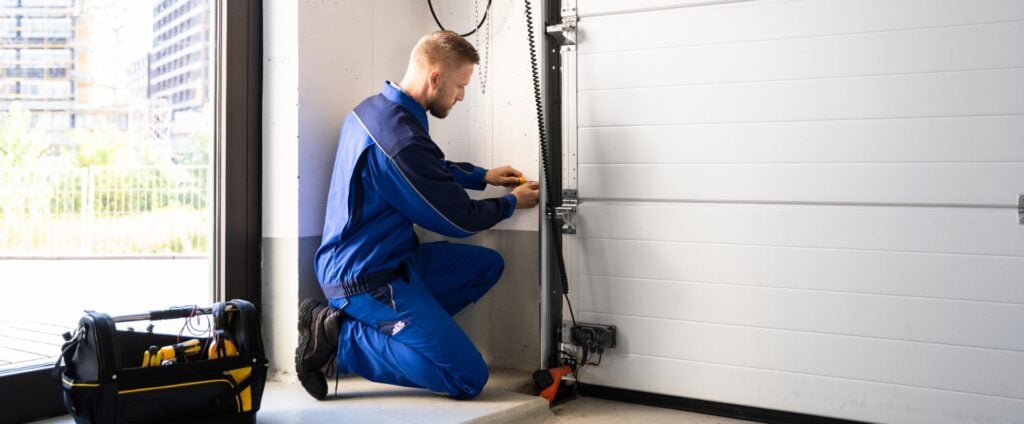
Installation is where the long-term performance of an automatic door system is either established or undermined. More often than we would like, the chronic problems we get called in to fix trace back to the original installation. The door may have worked fine for the first several months. That is not a reliable indicator of whether it was installed correctly. Here is how a proper installation should work.
- Structural mounting comes first. Before anything gets mounted, the wall or frame needs to be verified as capable of supporting the operator and door assembly under sustained load and vibration. Fasteners work loose over time in high-cycle applications, and the structural backing has to hold the load long-term. We have pulled wall mounts anchored into drywall by other contractors. That is not a story that ends well.
- The electrical connection has to be correctly specified. The wiring needs to match the requirements of the operator, the sensors, and any access control system the door communicates with. Sizing it for what the system actually requires, not just what gets it working on day one, is something that gets cut on rushed jobs and shows up as performance problems later.
- The operator gets programmed to the specific door and entry. Every automatic door has a motor that controls how fast the door opens, how much force it applies while closing, and how it responds to the load of the door itself. Those settings are not universal. They are programmed to the actual weight of the door, the expected traffic volume, and the force limits required by the American National Standards Institute and the Builders Hardware Manufacturers Association. Getting them right means the door performs correctly and safely from day one.
- Sensor calibration is specific to the geometry of the entrance. A detection zone that works correctly on a wide retail entry will behave completely differently on a narrow interior passage. Every sensor gets positioned and calibrated to the specific entry it is covering, then tested under real conditions before the job is done.
All of our technicians are AAADM-certified, the industry standard administered by the American Association of Automatic Door Manufacturers. When you are evaluating contractors, it is the clearest signal that the person doing the work knows what the requirements are and has been held accountable to them. For a full walk-through of what to expect from start to finish, our installation guide covers the process in detail.
Why Maintenance Matters
Automatic door systems run quietly in the background, and maintenance tends to get pushed when nothing is visibly wrong. That is completely understandable. The problem is that most of what degrades in these systems is invisible until it is not, and by the time something fails or triggers a safety concern, it has usually been developing for a while. Here is what is happening inside a system that has not been serviced recently.
- Motion sensors and optical sensors lose detection accuracy. Dust and debris accumulate on sensor lenses over time, shortening detection range and narrowing the activation zone without triggering any obvious failure. A sensor that is not reliably detecting someone approaching is not a minor nuisance. It is a safety failure.
- Operator force and speed settings drift out of spec. Vibration and wear shift these settings gradually, often with no visible sign of a problem. We have tested doors applying significantly more closing force than ANSI/BHMA standards allow, with nothing to indicate it from the outside.
- The safety reverse function loses calibration. This is what stops and reverses the door when something enters the door path during closing. When force limits or detection drift, the safety margin shrinks without the door behaving any differently in normal operation. Periodic testing is the only way to know it is still working.
- Track and hardware accumulate friction from inadequate lubrication. Increased drag puts additional load on the electric motor and accelerates wear on the drive components. We see premature operator failures regularly that trace back directly to lubrication being skipped.
- Mounting fasteners work loose over time. Every cycle puts load and vibration through the mounting points. A door that is slightly misaligned because its hardware has shifted looks normal from the outside and shows up as uneven operation and accelerated track wear.
Scheduling regular automatic door maintenance keeps these issues from compounding silently. An annual inspection, or semi-annual for high-traffic applications, covers all of it. Finding a problem during a scheduled visit costs a fraction of what it costs after an incident.
Get Expert Automatic Door Service for Your Commercial Facility
If you manage a commercial facility and you are evaluating a new automatic door installation, assessing a system that has not been serviced recently, or dealing with a door that is not performing correctly, those are exactly the situations we handle every day. Our AAADM-certified technicians work exclusively on commercial automatic door systems and are available 24/7 for both scheduled service and emergency repair across Oklahoma, Texas, Arkansas, and Tennessee.
Business owners and facility managers in Norman, Oklahoma City, Tulsa, Dallas-Fort Worth, Western Arkansas, Little Rock, and Nashville can request a free estimate today—no long-term contract required. Tell us what you have or what you are trying to accomplish, and we will give you a straight answer on the right solution for your facility.